


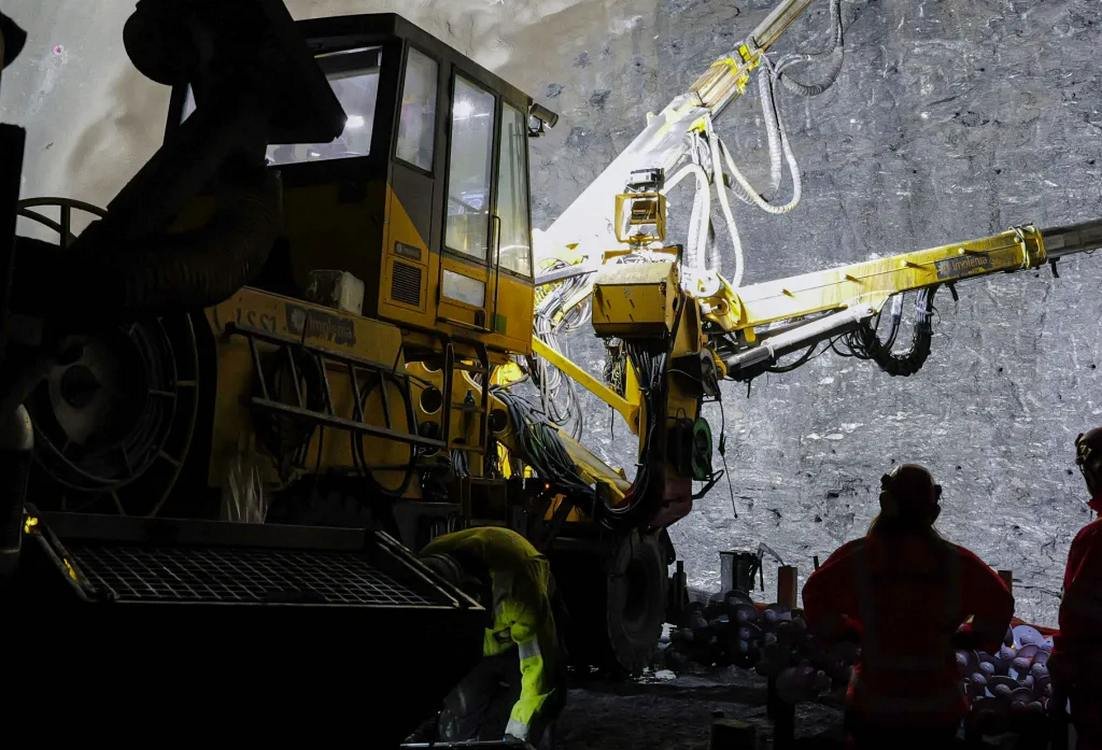
– credit, Norwegian Public Roads Administration
1,000 feet below the North Sea, blast after blast brings Norwegian engineers closer and closer to completion of the longest undersea road tunnel on Earth.
No one better to do it than Norway either, given that their citizens already built the world’s longest undersea road tunnel: the 9-mile-long Ryfylke.
The Rogfast—short for Rogaland Fixed Link—will be 7.6 miles longer than that. It should have a transformative effect on Norway’s west-coast transit map. One of the longest coastlines of any country in the world gives Norway a unique beauty, but what is a 40-minute flight flight for the crow between Stavanger and Bergen turns into a 5-hour journey in a car, requiring two ferry rides.
Funneling 4 lanes of traffic 300 meters below the sea will dodge all the fjord roads, and let motorists make the trip in substantially under an hour.
Norwegian construction firm Skanska is currently tunneling north from the island of Vestre Bokn, while the Swiss engineering firm Implenia is tunneling from Randaberg in the south, with the two ends scheduled to meet in 2029.
The cost of the project is currently estimated to come in at just short of 1 billion euros.
Niall Firth, writing at MIT Technology Review, brought to light (literally) some of the details of what it’s like blasting out the world’s longest undersea tunnel by physically descending into the bowels of the incredible engineering project.
Therebelow, contractors work 12-hour shifts for 12 days straight before receiving a 16-day break to reacquaint themselves with the surface, fresh air, and sunlight. Compared with most other nations engaged in these projects, Norwegians opt for explosive blasting and drilling methods compared to tunnel boring machines.
The approach apparently offers more flexibility, and gives ample opportunities to plug leaks from the sea above by injecting “grout,” a concrete-like sludge that seals the rock in advance of further blasting. Each blast adds about 5-6 yards of tunnel.
The biggest challenges according to Firth are the inevitability of the water trying to worm its way into the tunnel and the variation in the hardness of the rock to be blasted. It can unexpectedly change from being as hard as gneiss to loose as soil, and engineers have to continuously test the next 15-20 yards for hardness and water presence. Resisting tens of thousands of pounds of pressure, gneiss or granite may need only steel beams for support after a blast, while the looser stuff may need an entire reinforced concrete ceiling.
Nevertheless, the contractors are building the tunnel with the expectation it will be in top condition for the next century.
It’s not all danger and leaks and terrors down in the tunnel, though. Being set in one of the most advanced economies in the world, the project included some truly incredible features. One of these is a 4-lane underground roundabout.
Another is an exceptionally large hall that countryman Edvard Grieg could be proud of. The hall is lit in fantastically vibrant colors which cause the veining in the rocks to shimmer, and in the future it’s planned that artists will bring installations into the hall.
UNDERSEA TUNNELS: This Undersea Tunnel Marvel is Set to Break 5 Records and Shave Hours Off Travel Times in Europe
Much like the dry humor of the Norwegians that Firth encounters repeatedly on his trip, the great hall of lights has a drier purpose: to stop people from falling asleep in the dark monotony. Anyone who’s driven through the Saint Goddard tunnel in Switzerland, for example, will know how boring it can be, no pun intended.
Additional challenges, such as boring down two massive, 27-feet-wide ventilation shafts, and constantly removing the masses of blasted rock, needed to be budgeted for in the project. This rock will offer Norway and the local community an interesting rebate of sorts for the taxpayer cost of the tunnel—a brand new artificial island.
With 85 million cubic meters of stone and debris, it’s about the only use suitable for such a large quantity of waste rock without trucking it all across Norway for gravel and mine backfill.
ABOVE GROUND TUNNELS: Austria and Italy Finish Digging World’s Longest Rail Tunnel–Ready to Reshape Travel Maps
The Rogfast tunnel, with its record-breaking length, incredible engineering, and great hall of lights, seems liable to become a tourist attraction. It doesn’t hurt that either side of its nearly 17 mile length is some of the most beautiful fjords and landscapes anywhere in Europe.
The opening of the tunnel is slated for 2033.
SHARE This Incredible Feat Of Engineering Under The Cold North Sea…
