


Coconut fungi experiment by Vera Wang wins awards at 2026 Hawaii State Science and Engineering Fair – Released by SOEST
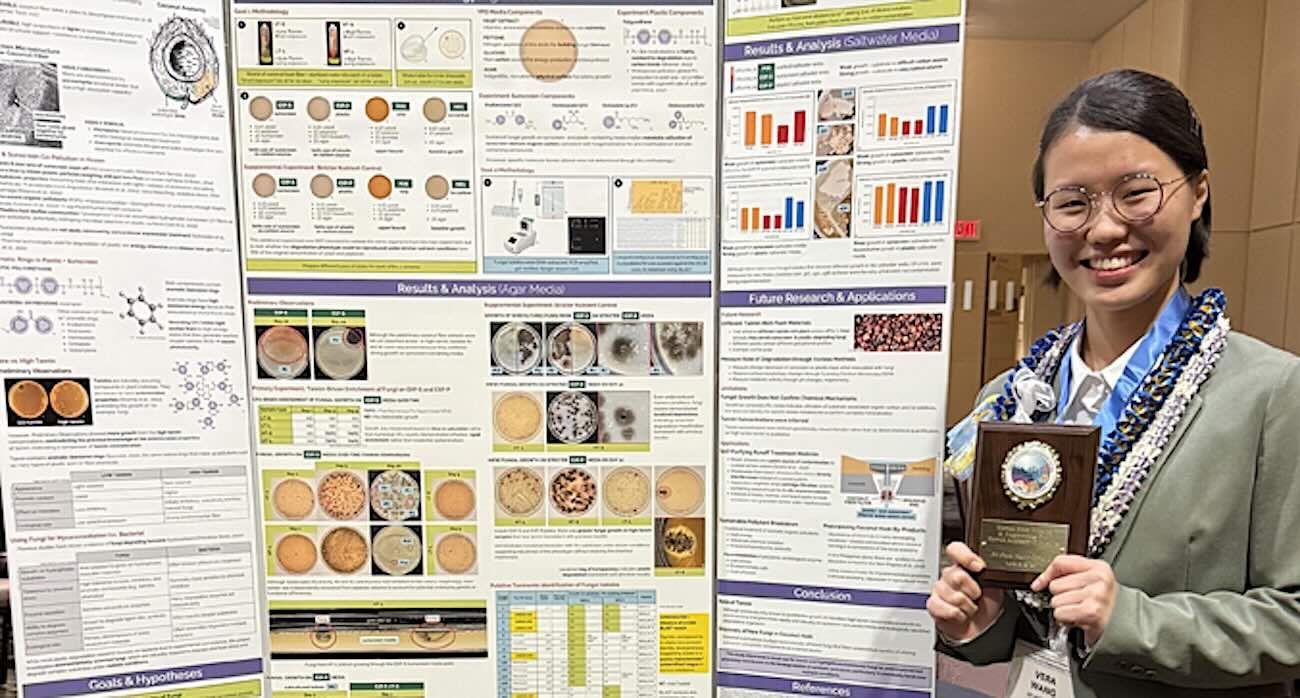
An East Honolulu high school student discovered a fungi in coconut husks that could clean up plastics and sunscreen from the ocean—and her won multiple awards at the Hawaiʻi State Science & Engineering Fair.
Vera Wang, a senior at Kaiser High School, won in multiple categories after conducting experiments in Anthony Amend’s lab at the University of Hawaiʻi at Mānoa. And she qualified for the International Science & Engineering Fair taking place next May in Arizona.
Her science fair success, including the discovery that the fungi may be a previously-uncharacterized species, all began during her sophomore year.
Ms. Wang designed and built an ocean filter that removed sunscreen and microplastics from the surface water which was inspired by traditional Polynesian weaving while incorporating modern environmental science.
It was not only scientifically effective, but was sustainably made entirely from coconut byproduct waste. Soon, Wang realized that removing the pollutants from water is only part of the problem. The next challenge she considered was how to dispose of them responsibly—and again found success.
“I learned that the pore structure of coconut fiber supports the movement of air and water, which can create a favorable environment for microbes,” Wang said. “That led me to wonder whether coconut husk could do more than physically capture pollutants. So this year, my research at the Amend Lab began exploring the fungal communities living in coconut husks and studying their growth and degradation abilities on sunscreen and plastic media.”
They discovered that fungi found naturally on coconut husks can biodegrade (decompose) sunscreen and plastic, and that a tannin compound can be used to identify sunscreen- and plastic-degrading fungi. The tannins present in the fibers might be encouraging growth of these complex degraders.
Additionally, their genetic testing showed that some of the fungal species did not have a match to anything in the world’s largest reference database of known genes and genomes, indicating that these may be previously uncharacterized species.
MORE SCIENCE FAIR WINS: Youth is Fighting Microplastic Pollution with Magnetic Liquid After Winning Google Science Fair
Kauai in Hawaii by Karsten Winegear
Among her awards, Wang’s project earned 1st place in the Microbiology category and a scholarship award from the McInerny Foundation.
“I am so grateful to have been given the opportunity to pursue my project in the Amend Lab,” said Wang, who worked closely with Kaylee Christensen, a graduate student in the Marine Biology Graduate Program.
“My research would have never, ever, been possible without Anthony and Kaylee. This project has been part of a much longer journey, so having it recognized feels both surreal and deeply rewarding.”
“This work was made possible because of Vera’s vision, and it gives me such optimism about the future of science in Hawaiʻi,” said Amend, who is based in the Pacific Biosciences Research Center at School of Ocean and Earth Science and Technology (SOEST).
CHECK OUT: New Mexico Girl Wins $250,000 Top Prize in Teen Science Fair For Inventing Tool That Could Prevent Starvation in Africa
“Her success is a testament to our public school system which is doing a wonderful job supporting and training our next generation of students. I can’t wait to see what discoveries she makes in college.”
SHARE THE TEEN-GENUITY With Science Students on Social Media…
