


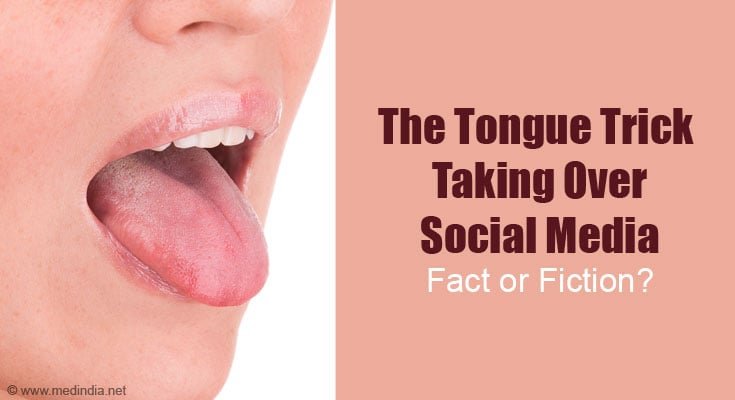
The tongue-sticking stress relief trend has gained millions of views online, but researchers say its purported benefits are not backed by scientific evidence.
Highlights:
- Experts say the viral tongue-sticking stress hack is not supported by scientific evidence
- No studies show that tongue protrusion alone activates the vagus nerve or calms the nervous system
- Evidence-based techniques such as breathing exercises remain far more effective for stress relief
A growing social media trend claims that simply sticking out your tongue for a few seconds can calm the nervous system, activate the vagus nerve, and melt away stress. Videos promoting the technique suggest it works almost like a reset button for the brain and body.
However, despite the popularity of the trend, there is currently no scientific evidence showing that sticking out the tongue alone reduces stress, lowers anxiety, or directly regulates the nervous system.
Experts say the claim appears to be based on real scientific concepts involving the tongue, facial muscles, breathing, and the vagus nerve. But the leap from those concepts to the idea that tongue protrusion itself is a proven stress-relief technique is not supported by research.
According to neurologists, movements involving the tongue, jaw, and facial muscles are connected to important nerve pathways. Yet the notion that a single facial movement can switch off stress or directly activate the body’s relaxation system remains highly debated.
The bigger picture, experts say, is that stress regulation involves multiple systems working together, including breathing patterns, hormones, the autonomic nervous system, and several regions of the brain.
There is no evidence that sticking out the tongue alone can produce the kind of physiological changes often claimed in viral videos.
Advertisement
Does the Tongue Have Special Connections to the Brain?
The tongue is far more than a muscle used for speaking and eating. It is connected to several cranial nerves that help control speech, swallowing, breathing, and sensation.
Research published in Scientific Reports examined how the tongue,/medlink> helps maintain posture and movement during speech.
The study found evidence that reflex mechanisms in the tongue help stabilize its position when speaking, highlighting the tongue’s complex communication with the nervous system (1✔ ✔Trusted Source
Tongue reflex for speech posture control
Go to source).
However, the study did not investigate stress, anxiety, emotional regulation, or mental health outcomes.
This distinction is important because many social media claims are built around genuine scientific findings that are then stretched far beyond what researchers actually studied. The existence of tongue reflexes does not mean that sticking out the tongue can calm the nervous system or reduce stress levels.
Advertisement
Is the Vagus Nerve Really Being Stimulated?
One of the most common claims surrounding the trend is that tongue protrusion activates the vagus nerve.
The vagus nerve, also known as the tenth cranial nerve, plays a major role in regulating heart rate, digestion, breathing, inflammation, and emotional responses. It is one of the body’s most important communication pathways between the brain and internal organs.
Because the vagus nerve helps regulate the parasympathetic nervous system—the body’s “rest-and-digest” response—it has become a popular target for wellness trends.
However, researchers studying vagus nerve stimulation use very different methods from those promoted online.
A review published in Clinical Autonomic Research notes that medically studied vagus nerve stimulation typically involves implanted devices or specialized non-invasive electrical stimulation systems applied to the ear or neck (2✔ ✔Trusted Source
Vagus nerve stimulation (VNS): recent advances and future directions
Go to source).
Similarly, a randomized clinical trial published in Biological Psychology found that transcutaneous vagus nerve stimulation reduced anxiety symptoms and perceived stress after two weeks of treatment (3✔ ✔Trusted Source
Effects of transcutaneous vagus nerve stimulation on subthreshold affective symptoms and perceived stress: Findings from a single-blinded randomized trial in community-dwelling adults
Go to source).
But participants received carefully controlled electrical stimulation through the ear for several hours each day—not tongue exercises.
Experts say there is currently no evidence showing that sticking out the tongue produces the same biological effects as clinically tested vagus nerve stimulation techniques.
Advertisement
Why Do Some People Feel Calmer After Doing It?
The fact that some people report feeling calmer does not necessarily mean the tongue movement itself is responsible.
According to neurologists, many people perform the exercise while slowing their breathing, relaxing facial muscles, stretching the jaw, or focusing their attention on their body. Any of these actions may contribute to a temporary feeling of relaxation.
Researchers increasingly recognize that stress can be influenced by breathing patterns, muscle tension, posture, and attention. When people deliberately pause, breathe more slowly, and focus on bodily sensations, they may naturally feel calmer regardless of whether the tongue is involved.
This makes it difficult to determine whether the reported benefits come from the tongue movement itself or from other changes happening at the same time.
What Does Research Say About Facial Exercises and Mental Health?
The idea that facial movements can influence emotions is not entirely new.
A systematic review published in the International Journal of Environmental Research and Public Health examined studies investigating facial muscle exercises and mental health (4✔ ✔Trusted Source
Effects of Facial Muscles Exercise on Mental Health: A Systematic Review
Go to source).
Researchers found some evidence suggesting that facial exercises may improve mood and certain psychological outcomes. However, the overall quality of evidence was low, and findings were inconsistent across studies.
The authors concluded that more research is needed before facial exercises can be recommended as an evidence-based mental health intervention. Importantly, none of the studies reviewed specifically examined sticking out the tongue as a stress-reduction technique.
The review also noted that facial expressions may interact with emotional processing through complex brain pathways, but these relationships are far more sophisticated than a simple cause-and-effect relationship between one movement and one emotion.
What Methods Are Actually Proven to Reduce Stress?
While evidence for tongue protrusion remains absent, several other techniques have been studied extensively.
A systematic review published in the Journal of Holistic Nursing analyzed breathing-based interventions and found that controlled breathing exercises consistently improved anxiety and stress outcomes across multiple studies (5✔ ✔Trusted Source
A Systematic Review of Breathing Exercise Interventions: An Integrative Complementary Approach for Anxiety and Stress in Adult Populations
Go to source).
Researchers reported that breathing exercises can influence physiological stress responses and improve emotional regulation. Unlike the tongue-sticking trend, these techniques have been examined in numerous clinical studies and systematic reviews.
Neurologists and mental health professionals commonly recommend approaches such as:
- Controlled breathing exercises
- Progressive muscle relaxation
- Mindfulness and meditation
- Physical activity
- Grounding techniques
- Adequate sleep and stress-management strategies
These interventions have a much stronger evidence base than any claim involving tongue protrusion.
Why Are Experts Urging Caution?
Scientists say the problem is not that the exercise is necessarily harmful. Rather, the concern is that social media often presents preliminary biological concepts as proven health interventions.
The tongue is connected to important nerve pathways. Facial expressions may influence emotional experiences. The vagus nerve plays a role in stress regulation. All of these statements are supported by science.
What is not supported by science is the claim that simply sticking out the tongue directly reduces stress, activates the vagus nerve in a clinically meaningful way, or calms the nervous system on its own.
Current evidence does not demonstrate that tongue protrusion is an effective stress-management technique. Any calming effect people experience is more likely related to accompanying behaviors such as slower breathing, facial relaxation, increased body awareness, or taking a brief break from stressful thoughts.
For now, the viral trend remains exactly that—a viral trend. While the science behind the tongue, facial muscles, and the nervous system is fascinating, researchers have yet to find evidence that sticking out your tongue is a proven shortcut to stress relief.
Frequently Asked Questions
Q: Does sticking out the tongue reduce stress?
A: There is currently no scientific evidence showing that tongue protrusion alone reduces stress or anxiety.
Q: Can the tongue activate the vagus nerve?
A: No research has demonstrated that sticking out the tongue activates the vagus nerve in a clinically meaningful way.
Q: Why do some people feel calmer after doing it?
A: The effect may be related to slower breathing, muscle relaxation, mindfulness, or taking a brief pause rather than the tongue movement itself.
Q: Is the exercise harmful?
A: Experts do not consider it harmful, but they caution against viewing it as a proven stress-relief technique.
Q: What stress-management methods are supported by research?
A: Controlled breathing, mindfulness, meditation, physical activity, and progressive muscle relaxation have stronger scientific support.
Q: Why has the trend become popular?
A: The trend combines scientific terms such as the vagus nerve and nervous system regulation, making the claims sound convincing despite limited evidence.
References:
- Tongue reflex for speech posture control – (https://pmc.ncbi.nlm.nih.gov/articles/PMC10944480/)
- Vagus nerve stimulation (VNS): recent advances and future directions – (https://pmc.ncbi.nlm.nih.gov/articles/PMC11543756/)
- Effects of transcutaneous vagus nerve stimulation on subthreshold affective symptoms and perceived stress: Findings from a single-blinded randomized trial in community-dwelling adults – (https://www.sciencedirect.com/science/article/pii/S0301051125001875?via%3Dihub)
- Effects of Facial Muscles Exercise on Mental Health: A Systematic Review – (https://pmc.ncbi.nlm.nih.gov/articles/PMC8623932/)
- A Systematic Review of Breathing Exercise Interventions: An Integrative Complementary Approach for Anxiety and Stress in Adult Populations – (https://journals.sagepub.com/doi/10.1177/08980101241273860)
Source-Medindia
