


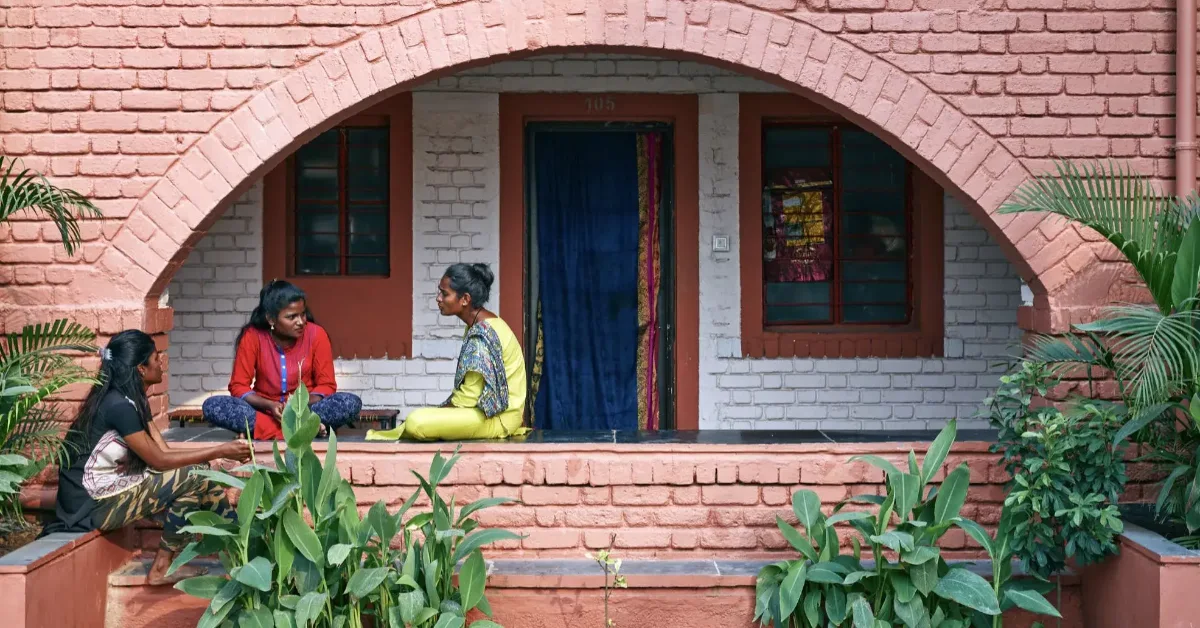
For families living in the slum of Sanjaynagar in Maharashtra, India, “home” hasn’t exactly invoked feelings of comfort or safety.
People live in one-room homes alongside a handful of other family members, experiencing little to no amenities like indoor plumbing or leak-free roofs.
Since the first dwellers arrived in Sanjaynagar in the 1980s, more than 900 people from about 22 different communities have squeezed into 206 metal shacks.
But in 2018, the non-governmental organization Snehalaya began working with the Community Design Agency to turn the informal settlement into safe housing for as many people as possible.
In alignment with the Indian government’s Housing For All program, and a number of other housing organizations, CDA embarked on a creative and collaborative redevelopment project, involving 937 Sanjaynagar residents in designing a new apartment complex, and even welcoming them to help make financial and management systems.
Now, at least 33 families — 100 people — live in the first completed building of the redevelopment project, which they call “Swapnapurti,” a word that translates to “a dream fulfilled.”
Courtesy of Community Design Agency
Each unit includes a living room, single bedroom, kitchen, bathroom, and a balcony. There is running water. Green plants, bamboo screens, and bricks made of crushed sand and ash have made the homes 8-10 degrees cooler. There are more than 25 community spaces, like roof gardens, courtyards, and a health center.
The amenities are abundant, but what most community members appreciate most is that they have their own space.
“I relish the privacy I have now,” resident Pooja Gawali told NPR. Prior to moving into the new apartments, she shared a one-room shack with six other adults.
“It’s a joy to be able to live freely. We’re still a tight-knit family, but life is so much easier when everyone has their own space.”
Courtesy of Community Design Agency
CDA reported that 50% of the current apartment homes are owned by women, who also experience enhanced dignity and safety with private toilets and running water.
Residents are also able to keep vital connections to their existing communities, livelihoods, land, and cultures, as they build new avenues of wellbeing, education, and employment.
But how can slum-dwelling families suddenly have the means to move into what would be considered a luxury apartment?
The Sanjaynagar Redevelopment Project works with the local government and its charitable donors to front much of the costs, but then each participating family pays 10% of the costs of construction — about $1,000 for a 300-square-foot apartment, NPR reported.
Community members assist in the planning of the Sanjaynagar Redevelopment Project. Courtesy of Community Design Agency
The families pay this by taking out low-interest housing loans provided by Rang De, a social lending platform that specializes in peer-to-peer lending. This connects borrowers directly with individual lenders and bypasses traditional banks, making interest rates lower and approval easier.
“The question we are trying to solve is ‘how do we enhance social cohesion, how do we use design and building to make sure that social capital flourishes, so that the communities can strengthen even more?’” Sandhya Naidu, managing director at CDA, the agency that helped develop the apartments, said in a statement.
“It is now more critical than ever to collectivize and innovate if we are to increase access to affordable housing in India. At every step, our work is based around one key question: What does it take to build thousands of communities and not millions of homes?”
A resident sits outside of a shack in Sanjaynagar. Courtesy of Community Design Agency
While only one apartment building has been actualized so far, a second is under construction now, and the results of the pilot show promise. The redevelopment project was just awarded a Silver prize at this year’s World Habitat Awards.
“This project highlights why in-situ upgrading should be a tenet of housing policy,” David Ireland, CEO of World Habitat, said in a press release.
“Involving residents throughout the regeneration process delivers so much more than just improved living conditions. It strengthens and empowers communities.”
As the next stage of construction gets underway, Sanjaynagar families now living in Swapnapurti see the potential for everyone in their village. And for the project organizers who are making it happen, this trust is instrumental.
A resident enjoys a full kitchen in her new apartment. Courtesy of Community Design Agency
“We often forget that slums possess high levels of social capital. These are networks built over the years on trust and solidarity,” Janardhan, of CDA, told NPR.
“Most low-income re-housing programs [in India] displace residents completely from where they’ve lived, moving them to an entirely new location, and they stand to lose all of that. We didn’t want that to happen.”
So far, the project has been a success. And it’s only getting started.
“The pilot provides an alternative redevelopment model that is scalable, low-carbon, and a community-led blueprint for inclusive housing across India,” World Habitat remarked on the project.
“It now has plans to complete a total of 10 buildings in Sanjaynagar and to share the successful model with other city governments in India.”
You may also like: This building used to be a Japanese rice cracker factory. Now, it’s home to 200 people
Featured Image: Courtesy of Community Design Agency
