


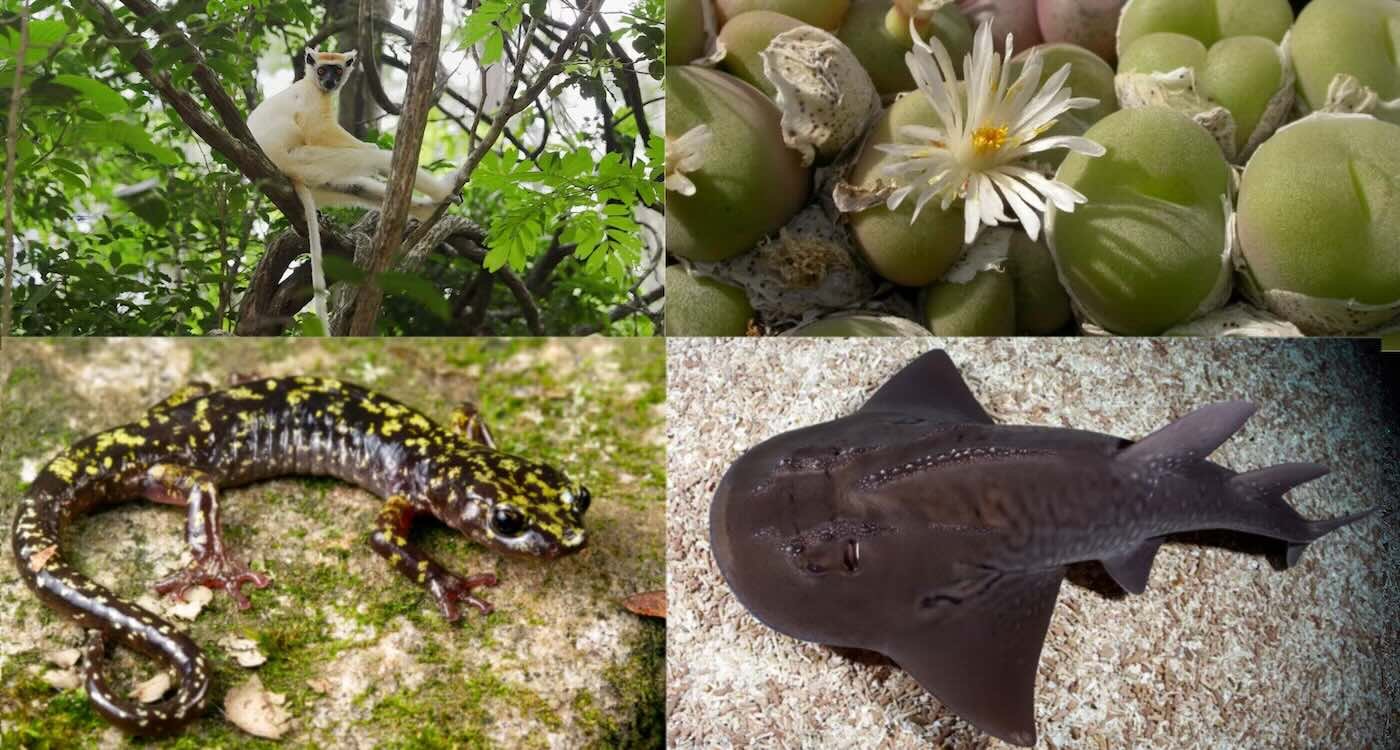
Photos (top left, clockwise): Golden-crowned sifaka (by Fanamby), fuzzy belly button in bloom (by Chris Rogerson), bowmouth guitarfish (by Mark Erdmann), and Hickory Nut Gorge green salamander (by Todd W. Pierson) – Phoenix Species Project
In 2021, Leonardo DiCaprio, the Bezos Earth Fund, and nine other conservation philanthropies launched the Protecting Our Planet Challenge, focused on protecting at least 30% of the most important land, freshwater, and marine area on the planet.
In the years since, the Hollywood actor/director continued discussions about an even more ambitious challenge to protect the most at-risk species—and he and his conservation group, Re:wild (which helps protect hundreds of threatened species in 360 locations worldwide), unveiled that big idea this week.
The Phoenix Species Project.
From rhinos and tigers, to a golden-crowned lemur, nature is full of comeback stories. Species numbered by just a handful of individuals have rebounded, when given the proper resources—and, in the process entire ecosystems have recovered.
The Phoenix Species Project builds on those good news stories.
The effort begins with a $200 million commitment to provide unprecedented support to the recovery of 100 species facing imminent extinction—including mammals, amphibians, reptiles, birds, fish, plants, and invertebrates from 30 countries.
Leonardo DiCaprio at 2019 Cannes film festival by Georges Biard (CC BY-SA 3.0 / Wikipedia)
The commitment of new money beyond small, short-term grants—$100M from the Bezos Earth Fund and $100M from Re:wild—will offer the sustained investment endangered species need to rebound.
“When we protect species, we also protect the forests, wetlands, grasslands, and oceans they depend on,” said Leonardo DiCaprio, founder of Re:wild.
“The Phoenix Species Project has the potential to make a lasting impact where it’s needed most.”
The full Phoenix 100 list can be found on the project’s new website, but in addition to the golden-crowned sifaka lemur, a few highlights include these species:
- Ancient shark-like bowmouth guitarfish, a ray found in shallow ocean waters from South Africa to Japan and Australia, whose fins are among the most prized in the fin trade. [Implementing partner: ReShark]
- Honey-scented, daisy-like fuzzy belly button, a tiny desert succulent that is illegally harvested for the ornamental plant trade in western South Africa. [Implementing partner: South African National Biodiversity Institute]
- Tree-dwelling Hickory Nut Gorge green salamander, lives only in a small canyon in North Carolina in the United States, and is within the world’s most diverse salamander hotspot, the Appalachian Mountains. [Implementing partner: Amphibian & Reptile Conservancy]
- Small, extinct-in-the-wild freshwater Charco Azul pupfish, whose common appearance belies its dramatic history when the freshwater spring it lived in dried up in Mexico after a drought, and years of water extraction for agriculture. [Implementing partner: Universidad Autónoma del Estado de Morelos]
- Lost-and-found night parrot from Australia’s remote deserts and dry grasslands, which remains elusive because of its nocturnal, ground-dwelling habits. [Implementing partner: Bush Heritage Australia]
A 2021 peer-reviewed essay in Conservation Biology argued that even species reduced to tiny populations can recover with sufficient conservation funding, and committed local partners.
“This fund is focused squarely on species recovery—not merely stopping decline,” explained Barney Long, a senior director at Re:wild.
“Recovering species takes time, so the fund is designed to provide sustained, five-years of support for each species, freeing conservationists from disruptive short-term funding cycles and equipping them to do what’s actually required to bring species (fully) back.”
“We have the tools we need to prevent these species from going extinct,” says the Phoenix Species Project senior manager in a media release. “We just need to mobilize the resources.”
SEND THIS TITANIC NEWS To Nature-Loving Friends on Social Media…
