


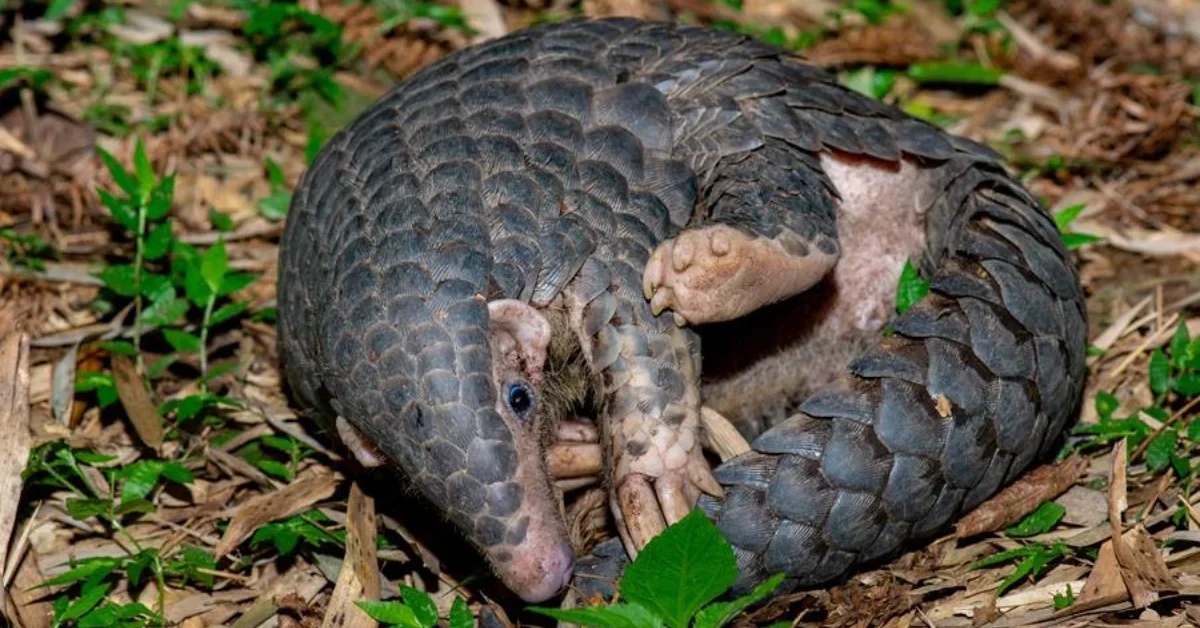
In a conservation video for the nonprofit Flora & Fauna, Sir Stephen Fry refers to the pangolin by many names.
“Scaly quadruped, dedicated parent, toothless wonder, armored anteater,” he lists off. “Night-time wanderer, real-life Pokémon, walking pinecone.”
But Fry ends with a few monikers that underscore how endangered the mammal is.
“Most-trafficked mammal … disappearing … close to extinction.”
There are eight species of pangolin in the world, and all of them are imperiled. Two are vulnerable, three are endangered, and four are critically endangered.
Native to parts of Africa and Asia, pangolins have long been targeted by poachers for their meat and scales, the latter of which are believed to have medicinal value, despite a lack of scientific evidence.
Researchers have taken a vested interest in pangolins in the last several decades as their population plummets due to wildlife trafficking.
Temminck’s pangolin. David Brossard (CC BY 2.0)
“We can’t protect what we do not know, and now that we have confirmed that this other species of pangolin exists, we can use that information to help protect these endangered animals,” Anderson Feijó said in a press statement.
Feijó is the Negaunee assistant curator of mammals at the Field Museum and co-corresponding author of a new study in Communications Biology, which was published on July 1.
In the study, Feijó and his peers announced a new species of pangolin that had been hidden in plain sight among the trees of Nepal and Northern India for almost 200 years.
In their research, they found evidence of the Manis aurita, a pangolin that had first been described in 1836, and had been downgraded to a subspecies of Chinese pangolin. Using integrative genomic and morphological evidence, they were able to confirm that it was in fact a distinct species in and of itself: the Himalayan pangolin.
According to Feijó and his peers, the differences between the Himalayan pangolin and the Chinese pangolin are slight but distinctive. Compared to its Chinese relative, the Himalayan pangolin has a longer tail, a bigger body, and much smaller ears.
The Himalayan pangolin. Tulshi Laxmi Suwal
“The newly resurrected species name, aurita, even refers to its distinct ears,” said Feijó.
“Aurita” is derived from the Latin word auris, which means ear. It is commonly used for scientific names throughout the animal kingdom, like the Plecotus aurita, or Brown long-eared bat, and the Aurelia aurita, a moon jellyfish with ear-like gonads.
The discovery came on the heels of half a decade devoted to analyzing the pangolin family tree.
Himalayan pangolin. Flora & Fauna International
“This finding marks the culmination of more than five years of research that began in Nepal, where we first documented evidence suggesting that Himalayan pangolins represented a distinct evolutionary lineage,” said Narayan Koju, a researcher at the Nepal Engineering College at Pokhara University and the study’s lead author.
“The confirmation of Manis aurita as a valid species demonstrates the importance of long-term research, international collaboration, and museum collections. Most importantly, it provides a strong scientific basis for conservation planning, wildlife forensics, and efforts to protect one of the world’s most-trafficked mammals from extinction.”
You may also like: Global mammal count is on the rise with 1300 new species
Featured Image: Flora & Fauna International
