


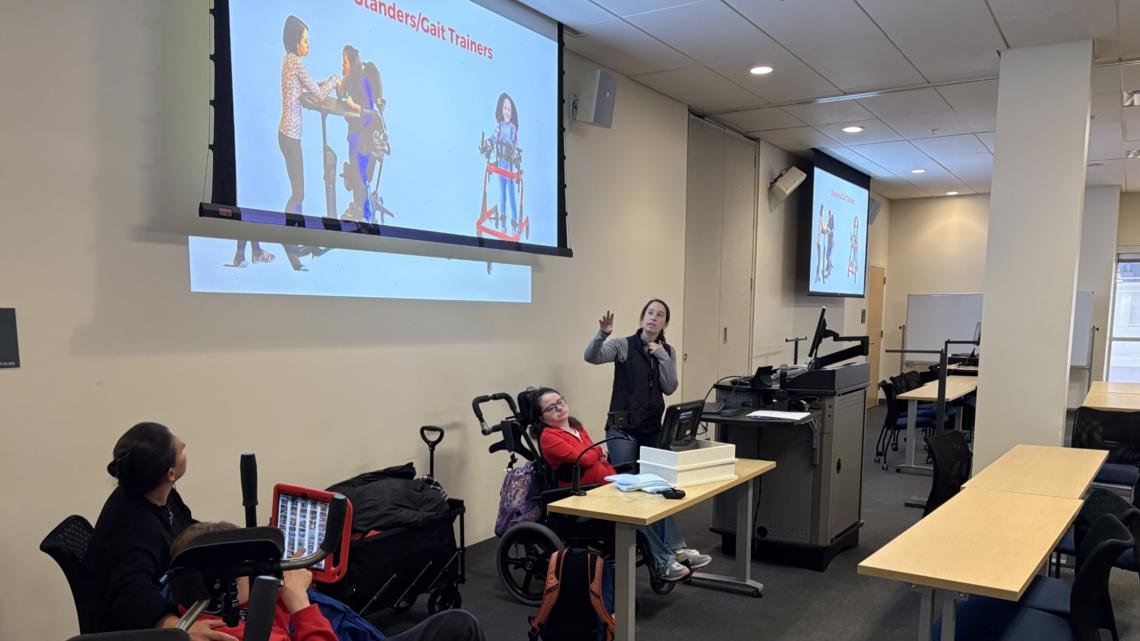
University of New England Occupational Studies students are learning how assistive technology helps overcome barriers, with help from Special Olympics Maine.
BIDDEFORD, Maine — Innovation can change lives by making it safer and easier for people with disabilities to take part in everyday activities.
With support from Special Olympics Maine, future Occupational Therapists are seeing for themselves how assistive technology helps Mainers of all abilities live more independently.
Students in the Occupational Studies program at the University of New England are learning how assistive technology helps people with disabilities overcome challenges.
“Do you want to say hi? Hi, my name is Scotty Wentzell, and it is so nice to meet all of you,” Scotty said.
Scotty uses the GoTalk app on his iPad to introduce himself by playing a recorded message.
Scotty, who’s already had a lifetime of heart surgeries, has Dubowitz Syndrome. The extremely rare chromosomal disorder causes physical and developmental delays.
Annie Nee has Rett Syndrome, a rare genetic disorder that slowly affects her motor skills and ability to speak.
“I use a wheelchair to move, and I even sit in it when I am in the car,” Annie said.
Annie uses a Windows-based device called a Tobii Dynavox, which she controls with her eyes. The device costs around $20,000 and is not always covered by insurance. It helps her communicate, manage daily tasks, and live more independently.
Grace Stults is Annie’s caregiver. “Annie can now control the lights in her room, TV, and the music she listens to, and anything else we can hook up to a smart outlet, which is really cool,” Grace explained.
Grace is also the Health & Wellness Director for Special Olympics Maine. She and Scotty’s mom, Lisa Wentzell, are showing the UNE students how adaptive equipment helps both Annie and Scotty live active, meaningful lives. With this equipment, Scotty, a Special Olympian, can participate in sports such as downhill skiing. He uses a slider while his dad guides him.
RELATED: Special Olympians urge better health care for people of all abilities in Maine
“Scotty stands here, he is on skis, the slider has skis, he holds on, and then dad’s behind him,” Lisa explained.
Scotty’s mom wrote a book about celebrating inclusion. ‘A Dog and His Boy: The Adventures of Spillway & Scotty’ has reached thousands of students across Maine and New England.
Students had the chance to use Annie’s device and adaptive appliances that require only one button to operate. They say first-hand accounts of how innovation and adaptive equipment break down barriers will help their patients in the future.
“I have never seen someone use a Tobii device, and they had a good experience, so when I get into my field, I can have a little background knowledge,” exclaimed Charlotte Hosterman, a UNE junior.
Assistant Clinical Professor Christopher Delenick, an occupational therapist, says the presentation goes beyond what students read in textbooks and class articles.
“When they are working with people as a professional, they can say, I remember that classroom experience when Scotty and Annie talked about X” as a frame of reference,” Delenick said.
All to help people of all abilities live more independent, empowered lives.
