


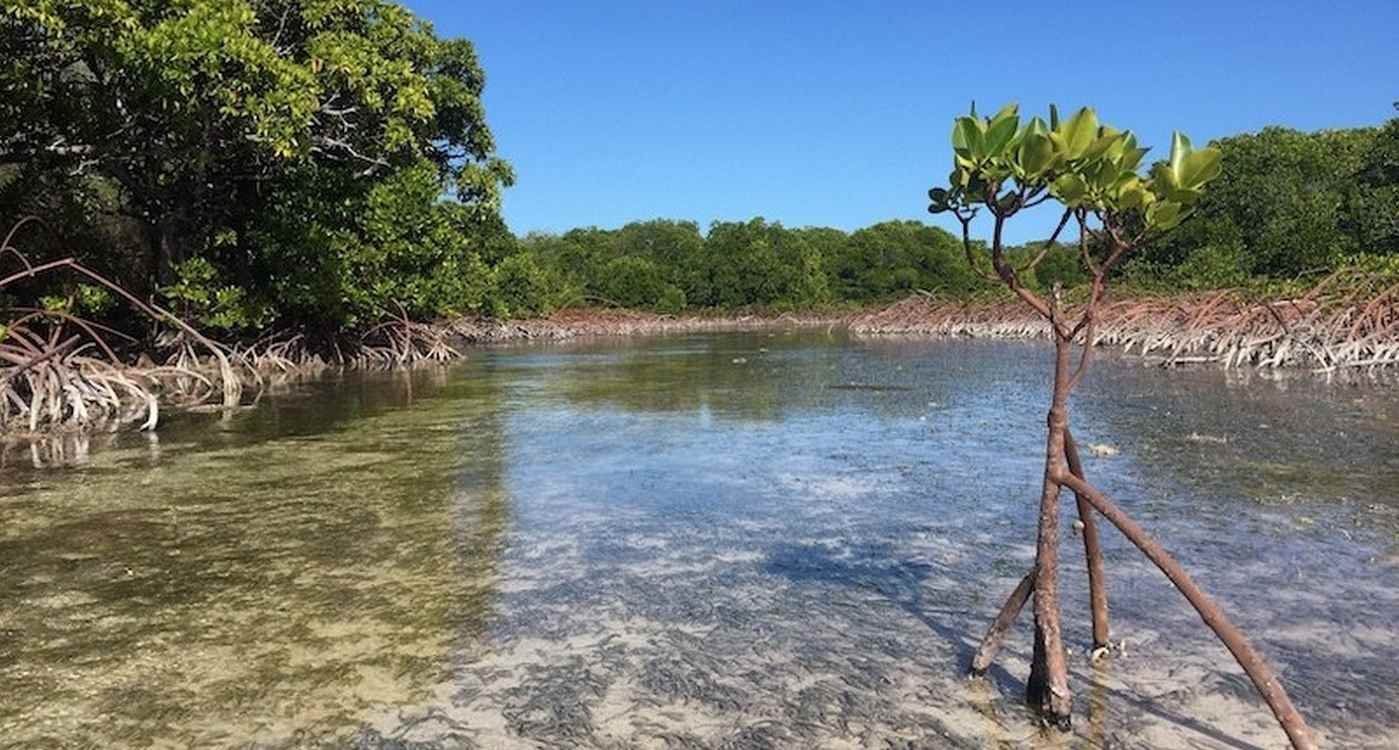
Mangrove forest on Ouvéa Atoll, in New Caledonia – credit, Daniel Friess via Tulane University
In what is both literally and figuratively a “landmark” study, research has shown that mangrove forest destruction has not only stopped in the last 20 years, but reversed—the world has more than it did at the turn of the century.
Additionally, the degree of age and robustness among intact mangrove forest, known as “closed canopy” forest, has increased far more.
Mangrove forests are among our planet’s best environmental stewards. They absorb up to 5-times more carbon than terrestrial trees, provide exceptional filtering services of pollutants and excess nutrients, and a nursery sanctuary for fish, invertebrates, and crustaceans to grow and feed beyond the reach of predators.
They also provide unrivaled defense against storm surges and tsunamis, as humanity came to understand following the great and tragic Indian Ocean tsunami of 2004.
The countries of South and Southeast Asia were subjected to a sort of A/B test—how much damage was inflicted on nations that had clear-cut their mangroves forests versus those who still had them.
In Indonesia, where this test played out island by island, the result was clear to see, and a clear piece of evidence presented in the new study published in Science by a team from Tulane University.
“Some islands were covered by mangroves and after the tsunami those islands were [still] protected very well, so that increased public awareness about the importance of protecting mangroves,” lead author Dr. Zhen Zhang told the BBC.
Mangrove forests declined through much of the late 20th century, with the world losing nearly 1,120 square miles between the 1980s and 2010. During the past 16 years, gains have outpaced losses. By 2023, mangrove areas had rebounded, resulting in only about a 1% net decline over the entire 4-decade period—a much smaller loss than previously estimated.
“What we’re seeing now is a real shift. Mangroves are now showing a net increase globally, and the rate of degradation is slowing,” said Daniel Friess, Cochran Family Professor of Earth and Environmental Sciences at Tulane and director of The Mangrove Lab. “While some mangroves are still being lost, this could make them a rare conservation success story and an important source of optimism for climate action.”
SWAMPY SUCCESS: Everglades Restoration Project Ongoing for 20-Plus Years Sees Huge Rewilding Success
If Professor Friess read GNN more, he’d know that conservation success stories are not rare at all, but regardless, mangrove restoration could be considered as a greater success than most.
Mangroves and seedlings are thriving in the Zhangjiang River Estuary in Fujian Province, China – credit, Zhen Zhang via Tulane University
With their location along coastlines and their habit of attracting diverse marine and freshwater wildlife, they are tempting targets for development, either into aquaculture operations or coastal housing.
Additionally, very few people take time off for a hike in a mangrove forest; it takes a real nature lover to endure the mud, bugs, and humidity in and around them. Their recreational value is therefore much less than a terrestrial forest.
MORE MANGROVE MEDIA: The Largest Landfill in Latin America has Been Turned into a Mangrove Forest
Beyond increases in area, the Tulane research highlights another encouraging trend: many existing mangrove forests are becoming denser and healthier. Closed-canopy mangrove forests, which store more carbon and provide stronger coastal protection, have expanded globally over the past 4 decades.
Rates of degradation have dropped significantly since the 1980s, reflecting the growing impact of conservation policies and restoration programs worldwide. That growth suggests that mangroves may be capturing more carbon than previously recognized.
SHARE This Encouraging Sign The Natural World Is Recovering…
