


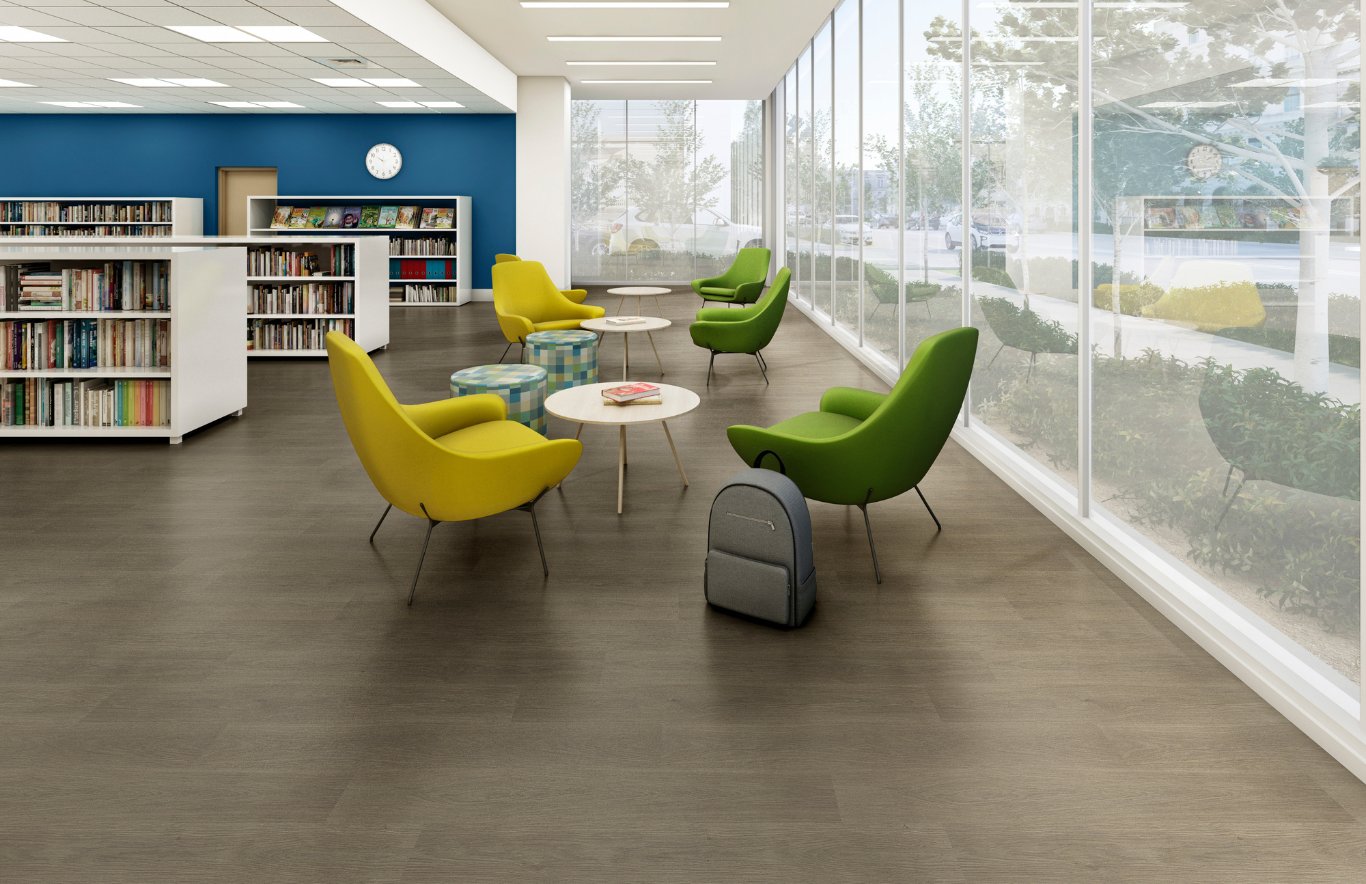
Interface’s noravant timber rubber. | Photo Credit (all): Interface
By Ryan Akers
Learning spaces are evolving across every level of education. From elementary schools to university campuses, today’s classrooms must support varied teaching styles, inclusive experiences, student health and well-being, long-term operational resilience, and sustainability.
In K–12 settings, learning has become more active and movement-based. Students regularly transition between floor activities, small-group collaboration, and individual study, making it more common for teachers to reconfigure classrooms throughout the day. While flexibility looks different in higher education, it is no less essential. Lecture halls, labs, studios, and shared campus spaces often serve multiple departments and functions over time.
Across schools and universities, flooring plays a critical role in how spaces function, feel, and perform. Resilient flooring is frequently specified to help create adaptable learning environments that support students and are built to last.
Designing for Health and Well-Being at Every Age
Interface’s norament satura rubber.
Student health and well-being remain central drivers of education design, from early childhood through adulthood. While K–12 and higher education have distinct needs, the built environment plays an important role in supporting both emotional and physical well-being.
Emotional Well-Being
Welcoming school environments can help students feel safe, engaged, and ready to learn—particularly in early grades, where sensory experiences strongly influence behavior and focus.
Emotional well-being is also a growing concern in higher education. Inside Higher Ed’s 2025 Student Voice survey found that 29% of respondents rated their mental health as below average or poor, indicating that nearly one-third of college students may be struggling.
Material choices can contribute to calmer, more comfortable learning environments that support well-being. Today’s resilient flooring options, including LVT and rubber, are available in a wide range of styles that support biophilic and human-centered design strategies.
Research suggests these approaches can positively affect occupants by:
- Reducing visual stress through natural color palettes and organic patterns
- Adding warmth and comfort with tactile surfaces underfoot
- Supporting calmness and sustained focus through subtle references to nature
Recent advancements in LVT and rubber flooring have expanded aesthetic options, allowing designers to specify materials that feel refined and welcoming without sacrificing performance.
Interface’s Lasting Impressions LVT.
Physical Health
Indoor air quality, cleanability, and material emissions also affect students of all ages.
In K–12 environments, reducing exposure to harmful substances is especially important as children continue to develop physically. In higher education, where students spend long hours in classrooms, labs, and libraries, healthy indoor environments support comfort, concentration, and overall learning outcomes. Research published in Cureus shows that improving ventilation and indoor air quality in schools can support cognitive performance and help reduce asthma-related symptoms. Resilient flooring can contribute to healthier indoor environments in several ways:
- Low-VOC materials help minimize indoor air contaminants
- Non-porous surfaces resist moisture and dirt, making spaces easier to clean
- Many LVT and rubber floors can be maintained without harsh chemicals that negatively affect air quality
By supporting healthier indoor environments, resilient flooring helps create spaces where students and educators can thrive—from elementary classrooms to college campuses.
Supporting Focused Learning in a Noisy World
Noise is one of the most significant barriers to learning, particularly in flexible and open classrooms. Higher noise levels are linked to reduced attention, impaired working memory, and decreased comprehension. A 2025 meta-analysis of classroom noise spanning 21 international studies found a moderate negative impact on student cognitive and academic performance, with younger students especially affected. These findings underscore the importance of acoustics in learning environments.
Many resilient flooring solutions offer noise-dampening properties that help reduce impact sound from footsteps, rolling furniture, and daily movement. This contributes to quieter, more focused classrooms, corridors, and shared campus spaces.
Withstanding High-Traffic Learning Environments
Few building types experience the daily wear that schools and universities do. Floors must withstand constant foot traffic, frequent furniture movement, and regular cleaning.
In K–12 schools, durability and ease of maintenance help minimize disruptions to learning and reduce strain on facilities teams. In higher education, long service life and life-cycle value are equally critical for large campuses managing multiple buildings and budgets.
Resilient flooring supports these demands by offering:
- Non-coated options that eliminate the need for waxing, stripping, and chemical-intensive maintenance
- Modular formats that allow individual tiles to be replaced rather than entire floors
- Long service life that helps reduce downtime and total cost of ownership
These characteristics support both school districts and higher-education institutions planning for long-term use and evolving space needs.
Lowering Environmental Impact Over Time
Sustainability expectations continue to rise across the education sector. Schools and universities are increasingly evaluating materials based on environmental impact, transparency, and longevity. According to Metropolis Magazine’s 2026 Sustainable Design Report, 75% of surveyed U.S. architects and design professionals want to incorporate more sustainability into their projects. The good news? Tools such as Environmental Product Declarations (EPDs) and Health Product Declarations (HPDs) allow institutions to evaluate materials based on carbon impact and material health across the full life cycle.
Resilient flooring options that combine long service life with responsible material choices support these goals. Durable, high-performance surfaces like rubber flooring help reduce replacement frequency, lower maintenance demands, and minimize environmental impact over time.
Supporting the Next Generation of Learning
Flooring choices play a meaningful role in how education spaces adapt to changing needs, support learning outcomes, and endure over time. As schools and campuses continue to evolve, materials must meet shared demands for flexibility, health, performance, and sustainability.
Resilient flooring, including rubber and LVT, helps K–12 schools and higher-education institutions meet these challenges by delivering reliable performance in high-use environments. When foundational materials work harder and last longer, learning environments are better positioned to do the same.
Ryan Akers is Vice President of Segment Sales at Interface.
