


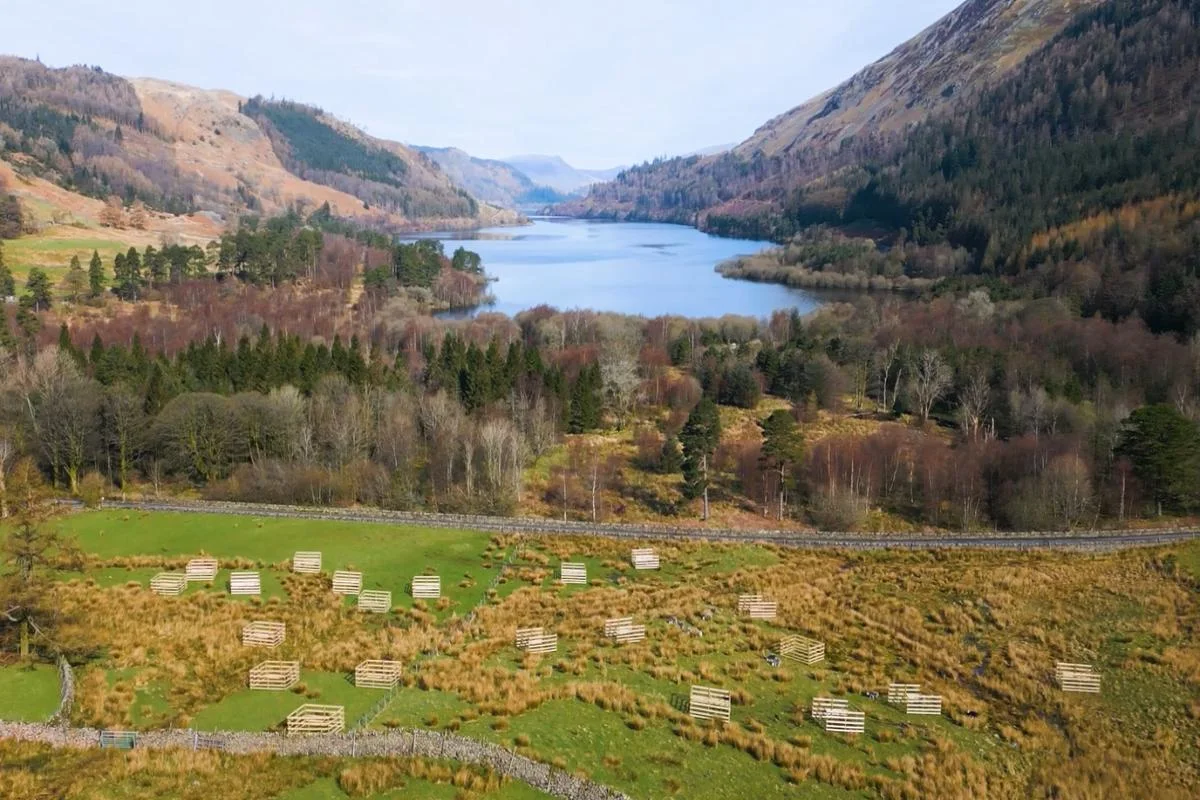
Creating a resilient water supply, while providing a home for native biodiversity has been the aim of a huge collaborative effort at Thirlmere Reservoir. Used to provide a quarter of a million people with high quality drinking water, this body of water is surrounded by beautiful acres of nature but was impacted by the devasting effects of Storm Desmond back in 2015.
As a result of the storm, huge volumes of sediment entered the reservoir, putting the water supply at risk. This prompted United Utilities to manage the land, with an aim of introducing practices to help maintain a sustainable, clean supply of water in an ever-changing climate.
Turning that plan into action meant working collaboratively with experts. United Utilities formed the Thirlmere Resilience Partnership with Natural England, Cumbria Wildlife Trust and the John Muir Trust, pooling knowledge and unlocking extra funding and identifying solutions and opportunities over short, medium and longer timeframes.
Matt Powell (Image: United Utilities)
It uses an innovative whole-catchment, map-based risk assessment approach that looks at Thirlmere not as a single body of water, but as one interconnected system. Techniques such as peatland restoration, river restoration, vegetation recovery and native woodland expansion all enhance raw water quality from the fells, reducing the need for treatment downstream.
The full benefits of the Thirlmere resilience will take decades, but the impacts of the partnership can already be seen. A river has been re-meandered using minimal intervention and materials found on site. Lighter grazing has allowed vegetation to regenerate naturally and 500 hectares of peatland have been restored.
Benefits of woodlands
The partnership is using new approaches to woodland management. 63 hectares of coniferous plantation have been converted to native broadleaf woodland, with 35,000 trees planted in 2025 and 2026 alone. This includes in areas on slopes once considered inaccessible. Some of the saplings have been grown in United Utilities’ own onsite tree nursery and adapted to the altitude and climate of the fells. It’s thanks to volunteers who’ve supported with tree planting, speeding up the natural recovery of the catchment.
And the benefits? All of this work increases water retention, stabilises soils, reduces sediment loss, improves water quality, carbon sequestration and resilience to high flows and drought, as well as creating niches for biodiversity. The catchment’s wildlife is responding too: four pine martens have now made Thirlmere their home.
(Image: United Utilities)
River restoration
More than 1,165 metres of river have been restored, with spawning gravels increasing by 150m² — a perfect home for fish with salmon redds being established. Slower-flowing water now reconnects more readily with the floodplain, allowing sediment to settle before it ever reaches the reservoir.
Monitoring
Independent monitoring, carried out with the Centre for Ecology and Hydrology, is tracking the impact of these changes on the upland ecosystem, while regular reassessment confirms the interventions are bedding in and reducing risk as intended.
Matt Powell, catchment partnership officer at United Utilities, said: “Storm Desmond showed us that protecting drinking water can’t just be about pipes and treatment works — it has to start out on the fell. This award-winning partnership lets us see the whole catchment as one system, so every tree we plant, every metre of river we restore, is targeted at reducing risk for the long term. What’s really pleasing is that as the landscape recovers, wildlife is coming back with it — the return of pine martens and salmon spawning in the river are signs the whole ecosystem is responding, not just the water quality.”
United Utilities says the lessons from Thirlmere are already spreading further afield. This programme is now being used across other North West catchments and has been shared with fellow water company Hafren Dyfrdwy to help assess resilience in its Vyrnwy catchment following major storms. The whole-catchment thinking behind the project is also feeding into Landscape Recovery Schemes — government-backed programmes designed to deliver large-scale ecological improvement over 20 years.
United Utilities (Image: United Utilities)
Outside of the catchment, the North West’s water company, which recently secured 59th place globally in TIME magazine’s ranking of the world’s 750 most sustainable companies, has made significant progress on ambitious environmental pledges, including:
Planting one million trees
Enhancing 1,800km of rivers
Restoring 7,000 hectares of peatland
These initiatives, all to be delivered by 2030, are designed to protect and enhance the region’s natural environment, improve biodiversity, and build resilience to climate change and reflects United Utilities’ long-term commitment to creating a stronger, greener, healthier future for the North West.
Over the next five years, United Utilities will also be investing more than £900 million in Cumbria as part of its Big North West Upgrade, enhancing over 200km of rivers, lakes and bathing waters and safeguarding drinking water supplies.
Find out more at unitedutilities.com
