


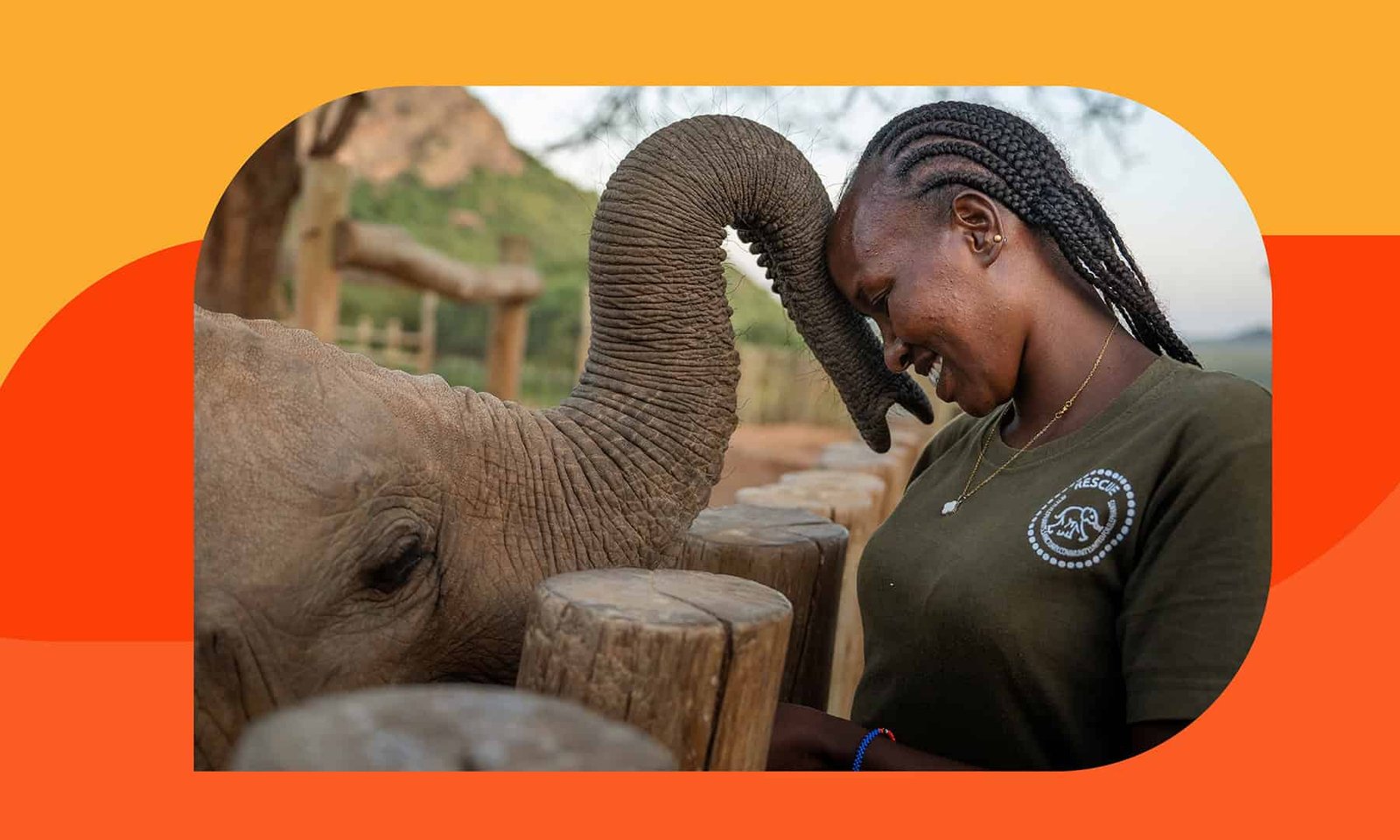
When Dorothy Lowakutuk became one of Africa’s first female elephant keepers, she joined a movement challenging old assumptions about who conservation is for – and who gets to lead it
Nemparwai was barely a week old when she arrived at north Kenya’s Reteti elephant sanctuary. Her eyes were swollen shut, her body bruised after falling into a well, and her ears still bore the pink flush of a newborn calf. Keeper Dorothy Lowakutuk had driven through the night to reach her, crossing rain-soaked plains as storm clouds gathered over the forested peaks of the Lenkiyo Hills, known internationally as the Matthews Range. Now came the harder part: earning the young elephant’s trust.
Lowakutuk spent that night – and the next – by Nemparwai’s side, talking to her, singing, shedding tears. On the second day came a breakthrough, as Nemparwai warily scooped milk from Lowakutuk’s cupped hands and finally began to feed.
“She became my baby,” says Lowakutuk, recalling the rescue. “When I sat next to her, she would lie across my legs to sleep. She wouldn’t take her milk unless I was near. She gave me kisses and made me feel so happy that I had saved her.”
Solutions every Saturday
Uplift your inbox with our weekly newsletter. Positive News editors select the week’s top stories of progress, bringing you the essential briefing about what’s going right
Sign up
Kisses from a baby elephant would be reward enough for most people, but Reteti’s significance reaches far beyond the bond between keeper and calf. As Africa’s first Indigenous-owned elephant sanctuary, it is part of a growing grassroots movement putting local communities at the heart of conservation, recognising that the future of wildlife is inseparable from the livelihoods of the people who share its landscapes.
In the region around Reteti, those people are the Samburu. For centuries they have moved with the seasons across their communal rangelands, herding cattle, goats and camels. In the dry months – when rivers disappear into dusty luggas – families dig deep wells, passing buckets of water hand to hand, singing as they work.
It’s a culture rooted in patriarchal tradition. Elders hold authority, while arranged marriages, polygamy and female circumcision persist in some communities. For generations, women’s voices and influence over community life have been stifled.
Although Lowakutuk is proud of her Samburu identity, she knew from an early age that she wanted a different future. She was six when her father died. His first wife and her sons claimed the family’s livestock, leaving her mother, Lipiyian, with little to support five children. Somehow Lipiyian earned enough to keep the family afloat and her daughter in school.
Lowakutuk once feared being trapped in an arranged marriage. Today, she helps other Samburu women gain independence, income and a voice. Image: Simon Pocock
“I knew I didn’t want to get married, because I had seen other women suffering in [arranged] marriages,” Lowakutuk says. “I wanted my own job, and I really wanted to rescue my mum.”
Rather than seek a city job in Nairobi, an eight-hour drive south, she looked closer to home, studying for a diploma in community development and social work. “I wanted to return my knowledge back to my community, to help it develop so it will always come through crisis,” she says.
Lowakutuk was interning at a local hospital when, in 2016, she got wind of a job as a keeper at Reteti – a new wildlife sanctuary, run and owned by locals. After cruising her interview, she became one of Africa’s first female elephant keepers.
Reteti was founded the same year by Samburu elders working alongside Sri Lankan-born conservationist, Katie Rowe. Of its board members, 90% are drawn from local communities. They’re joined by the Sarara Foundation – also co-founded by Rowe – which acts as Reteti’s operating and funding partner, plus stakeholders including the Kenyan Wildlife Service and Save the Elephants. The board decides how the sanctuary is staffed, managed and run, and how tourism revenue is spent: 40% covers operating costs, 60% funds community projects.
Elephants made me understand how I should lead: not by intimidating, and not by fighting. Leadership has to grow from inside you
Lowakutuk’s first job at Reteti was in the kitchens, helping prepare the 700 litres (154 gallons) of milk the sanctuary’s baby elephants guzzle daily. She gathered forage, acacia pods and even fresh elephant dung from the bush, to help orphaned calves settle in. Today she works as a visitor guide and an elephant keeper, meaning long nights sleeping beside sick elephants, and exhausting days leading them on bush walks, preparing them for life back in the wild. When the elephants reach seven to nine years old, those journeys end with tearful goodbyes.
“It’s like letting go of your own child: it’s never easy,” says Lowakutuk, who has a five-year-old daughter, Marjorie. “For us, it is success – but it’s never easy. The elephants feel the same, they cry when we cry.”
Those farewells leave a lasting mark on their keepers. Elephants, Lowakutuk says, have taught her everything she knows about leadership. “They made me understand how I should lead: not by intimidating, and not by fighting. Leadership has to grow from inside you, and then you’re chosen by your good deeds, not your bad ones.”
Last year, Reteti returned 13 young elephants to the rangelands. Since opening, its rescuers have reunited 60 stranded calves with their mothers, drawing on Samburu tracking knowledge. Across the region, a blend of modern conservation, sustainable land management and ancient Samburu bush knowledge has helped elephant numbers recover from a few hundred 30 years ago to more than 6,000 today. Leopards, lions, rare Grévy’s zebras and gerenuk – also known as the giraffe-necked gazelle – roam its savannahs.
But elephants are only part of Reteti’s success. Its impact on local livelihoods has been just as profound. Its 110 staff are recruited from Samburu communities while 1,250 local ‘milk mamas’ supply more than 20,000 litres (4,400 gallons) of goat milk each month to feed the hungry elephant orphans. Last year, almost $342k [£257,000] was paid directly to Samburu women – many now holding their own bank accounts for the first time – while, eco-tourism revenue has funded classrooms, bursaries and a touring Montessori school.
“Reteti has made women people to be believed in,” Lowakutuk says. “It has given us power, and our men are happy to support it. They see that when a wife earns money, the entire family benefits. And the community listens to us. I’ve not just become an elephant ambassador, I’ve become a community ambassador.”
For Resson Duff, portfolio funding director at Maliasili – a nonprofit that supports community-led conservation across Africa – these benefits are crucial to the model’s success. Alongside secure land rights and transparent, locally led governance, she says, tangible gains – from jobs and education to more reliable incomes – give communities a lasting stake in protecting landscapes and wildlife.
She points to examples elsewhere in Africa: Herp Conservation Ghana has helped establish the country’s first amphibian reserve on land donated by locals. In the Democratic Republic of Congo, Strong Roots Congo has supported 23 community forests spanning 600,000 hectares (1.5m acres), despite ongoing conflict.
When governments started national parks, communities saw wildlife negatively. Now they own tourism facilities, receive salaries … It has changed from negative to positive
“Then you know you’re on the right track,” says Duff. “Conservation is often pigeonholed as an environmental solution, but it has a multiplier effect across food security, health, environmental outcomes and the rights of people who have been trampled on.
“When you exclude people from spaces they have stewarded for generations, you create enmity. That’s what colonial and many post-colonial governments did. It’s self-evident why they failed.”
Reteti is a flagship project within the broader Namunyak Community Conservancy, an 850,000-acre (344,000-hectare) sprawl of north Kenyan wilderness. Established by Samburu elders in the 1990s, Namunyak was formed to tackle rampant poaching, restore degraded rangelands and provide alternative livelihoods. Through Kenya’s Community Land Act of 2016, the Samburu now have legal ownership of the territory, dividing it into six zones run by local representatives – men, women and young people who make day-to-day decisions and promote best practice on land management, livestock movements and access to water.
Lowakutuk paints a harmonious picture of life in Namunyak, but as Dr Dilys Roe – principal researcher at the International Institute for Environment and Development – explains, putting the model into practice can be complex and throw up tensions.
Robert Lemaiyan, a Samburu conservationist and the general manager of Sarara. Image: Svenja Krüger
“We’re seeing more and more communities standing up for themselves and asserting their rights, but there are still persistent power struggles,” she notes. “A lot of the resources that are out there – whether it’s wildlife or land – are actually incredibly valuable, and a lot of governments or private agencies don’t really want to hand over that power to communities because they want to retain those resources for themselves.”
Namunyak, despite its success, struggled in its early days to convince young Samburu, wary that protectionism would restrict land access and upend their pastoralist way of life. Titus Letaapo, now the Sarara Foundation’s director of programmes, was one of them. Ultimately, he was won over by the success of similar initiatives led by the Maasai further south. He’s since seen attitudes shift, as his fellow Samburu have led conservation, and reaped the rewards.
“When governments started national parks, communities saw wildlife negatively because it cost them land and grazing. They didn’t get any benefit,” he says. “Now they own tourism facilities, receive salaries and have medical cover. They see classrooms being built. It has changed from negative to positive.”
But the balance between conservation, community ownership and outside funding remains contested. The Northern Rangelands Trust (NRT), a membership organisation supporting 47 autonomous, community-owned conservancies, has faced criticism from rights organisations over land rights, grazing restrictions and the transparency of carbon projects. When contacted by Positive News, NRT says it does not own community land or impose a single grazing plan, and that land and grazing decisions are made through community governance structures. It says its Northern Kenya Rangelands Carbon Project has undergone an extensive Free, Prior and Informed Consent process, and that communities themselves determine how carbon revenues are allocated and used.
Sonia Legei is a Samburu guide and one of Sarara’s first female guides. Image: Svenja Krüger
Letaapo believes the organisation started with good intentions but has struggled with poor leadership and a lack of transparency. NRT disputes this assessment and says it has continued to evolve, including through work to strengthen governance, accountability, systems and operations. On carbon revenues, NRT says communities themselves, through their own governance and decision-making structures, determine how revenues are allocated and used.
Namunyak left the NRT in 2022. NRT says that, as an autonomous community conservancy, Namunyak makes its own decisions about its relationships and partnerships.
Namunyak’s experience points to both the potential and the complexity of community-led conservation. Across east Africa, such models are evolving against a backdrop of climate change, human expansion and shrinking livestock corridors. Conservation organisations continue to wrestle with how decisions over land, wildlife and revenue should be shared between communities, governments, donors and NGOs.
For Lowakutuk, the answer is straightforward. The people best placed to protect a landscape are the ones who walk it every day.
“They understand the boundaries between wildlife and communities. They should be given priority, and respected in their decision-making,” she says. “Empower them to talk about how they feel about conservation, and how it impacts them. That’s how you change the narrative.
Main image: Thige Njuguna
Portraits of a Shared Land brings readers face-to-face with some of the people reshaping conservation across Africa, exploring approaches that place communities, local knowledge and lived experience at their heart. This series is produced by Positive News and supported through a Human-Centred Conservation Storytelling Grant from Jamma Conservation & Communities.
The views and opinions expressed in this story are those of the authors and contributors and do not necessarily reflect those of Jamma Conservation & Communities.
