


In August 2025, scientists from the Schmidt Ocean Institute sent an underwater robot on a 21-day expedition to explore the Mar Del Plata submarine canyon in Argentina.
At its deepest point, the Mar Del Plata Canyon extends over 3,500 meters below the water’s surface — almost twice as deep as the Grand Canyon.
The deep-sea voyage marked the first time that scientists were able to witness the submarine canyon using a remotely operated vehicle, and the Schmidt Ocean Institute made the footage available to the public. Across its three-week journey, the “divestreams” cumulatively garnered over 17.5 million views.
“It’s been incredible to see how people of all ages have connected with the deep sea,” science team member Dr. Martín Brogger said in a press release last August.
Schmidt Ocean Institute
Brogger said that his colleagues at CONICET, the National Scientific and Technical Research Council, and the Instituto de Biología de Organismos Marinos were blown away by the support.
“We received hundreds of messages from families, teachers and kids who felt inspired, surprised and even emotional watching the live broadcasts,” he said.
“Some young students told us they now dream of becoming marine biologists — an impact that goes beyond science by creating a shared sense of wonder and curiosity that can truly last a lifetime.”
The researchers on the main vessel, Schmidt Ocean Institute’s R/V Falkor (too), suspected that many of the organisms that they came across had never been recorded in scientific records.
The Remotely Operated Vehicle, SuBastian, retrieved samples of specimens during the expedition, and scientists estimated that nearly 40 of them were new species.
ROV SuBastian/Schmidt Ocean Institute
Over a year later, on October 1, the Schmidt Ocean Institute released a report confirming that 57 new species had been unearthed from the depths of the Mar Del Plata Canyon.
The results were finalized after the Nippon Foundation-Nekton Ocean Census brought 20 taxonomists and early-career researchers from across Latin America and Europe to examine deep-sea biological samples gathered from the August 2025 expedition.
ROV SuBastian/Schmidt Ocean Institute
“International cooperation in taxonomy is critical, especially in groups with few active specialists,” said Daniel Lauretta, the principal investigator for CONICET and the Museo Argentino de Ciencias Naturales.
“The species discovery workshop accelerated species identification, the recognition of species new to science, and increased capacity building for local early-career taxonomists working on deep-sea fauna.”
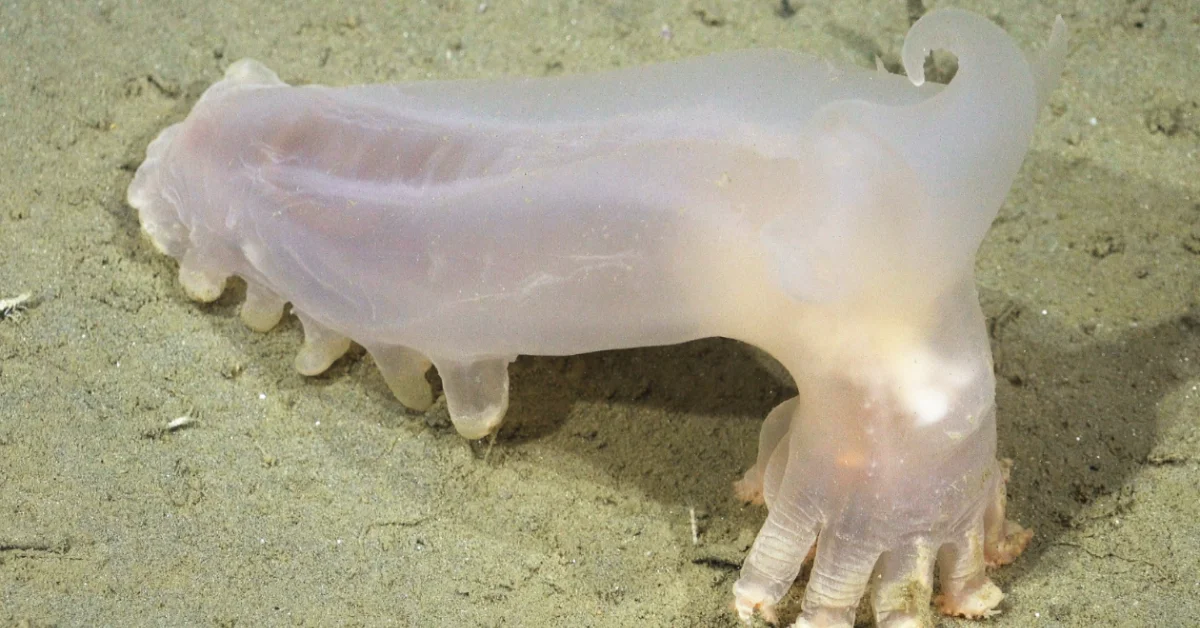
One standout species was the “Loki” sea cucumber, one of up to 10 new holothurian species uncovered during the workshop. The translucent creature, which boasts a curved horn on top of its body, was captured at 2,577 meters deep.
ROV SuBastian/Schmidt Ocean Institute
Other new species included deep-sea corals — like a vivid orange-red octocoral — sea pens, and a copepod collection of 20 tiny, but vital, crustaceans.
“Discovering 57 new species and five new genera in just two weeks demonstrates the speed and power of collaborative taxonomy,” said Dr. Michelle Taylor, Ocean Census’ head of science.
“The deep sea holds some of the least understood ecosystems on Earth,” she continued. “By bringing Latin America’s scientific expertise and international experts together [and] connecting them to the open-access Ocean Census NOVA platform, we are drastically accelerating our understanding of marine biodiversity.”
The Nippon Foundation-Nekton Ocean Census/Schmidt Ocean Institute
You may also like: Scientists discovered 149 new deep-sea species near a collapsed volcano: ‘It was a massive hole in the data’
Featured Image: ROV SuBastian/Schmidt Ocean Institute
