


In fiscal year 2023, as an individual trainee for the Duskin Leadership Training Program, I researched the finances and fundraising of disability organizations, primarily in the United States.
The theme was “Fundraising in the Disability Rights Movement.”
I examined the financial documents of about 20 organizations and agencies, including disability organizations, advocacy agencies, and Centers for Independent Living, and I visited them in person or spoke with staff online.
At the time, what I wanted to know was simple.
Why do disability organizations in the United States receive so much money?
Are they good at collecting donations?
Is their approach to companies different?
Do they have the know-how to secure grants from foundations?
If there are methods that can be used in Japan, I want to learn them.
I started my research with that feeling.
However, as I looked at the flow of money for various organizations, I gradually began to see something different.
It wasn’t just about the “techniques for collecting donations.”
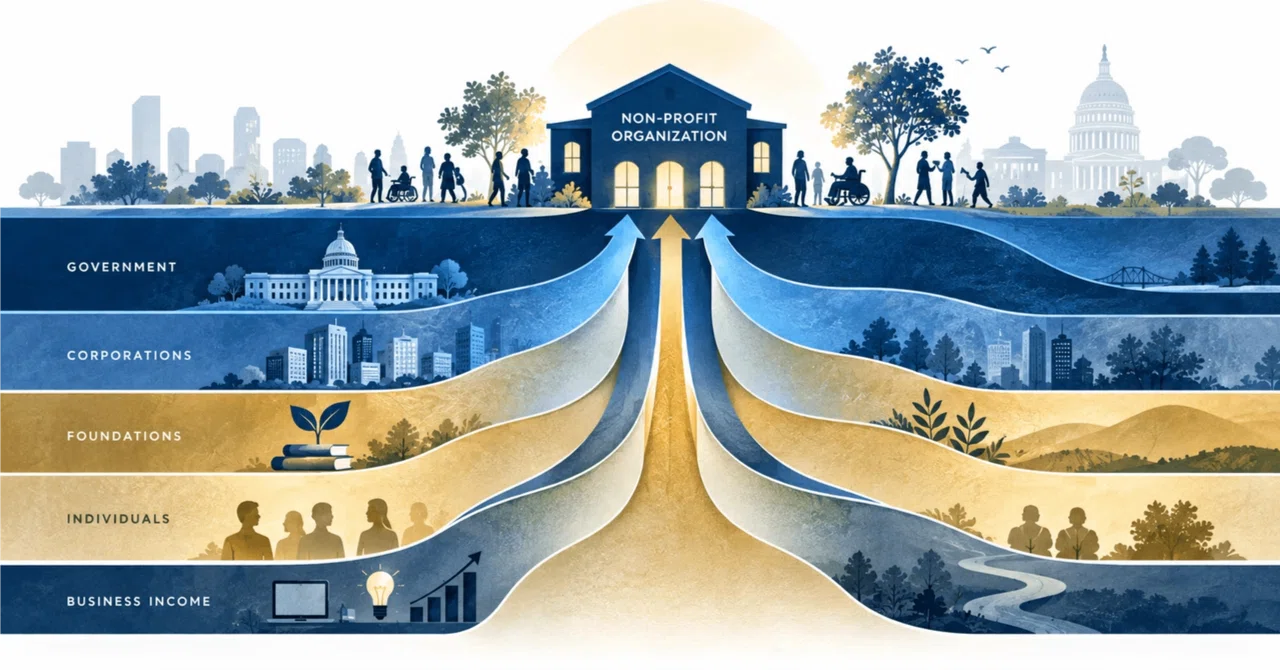
・Government
・Companies
・Foundations
・Individuals
・Events
・Tax systems
・And laws and institutions
In the United States, there was not just one source of money supporting the activities of disability organizations.
1. There is a mechanism that allows them to receive money from the government while also being able to conduct investigations or take legal action against the government if necessary.
What surprised me most was the mechanism called P&A (Protection & Advocacy).
P&A is a disability rights advocacy mechanism established in every state and territory in the U.S., and there are 57 P&A systems nationwide.
They receive public funding based on federal law and conduct investigations into abuse and neglect, policy advocacy, and, when necessary, legal responses against parties including the government.
Disability Rights California, which I visited, is one of them.
A scene from the welcome lunch they held for me when I visited in 2024. The author is in the back right.
What surprised me here was,
that they can receive money from the government while also being able to conduct investigations or take legal action against the government if necessary.
That was the situation.
Instead of making advocacy an activity that can only be done if donations are collected, there is a system in place to support it with public funds.
This was quite impressive to me, having been involved with NPOs in the disability sector in Japan.
2. Companies provide funding
Another thing that left an impression on me was the relationship with companies.
When looking at the events and programs of disability organizations in the United States, many companies such as the Coca-Cola Foundation, Microsoft, United Airlines, and the Arconic Foundation participate as sponsors.
When I interviewed a representative from a disability organization, what struck me was
the idea of viewing companies not just as partners that provide money, but as partners with whom to build a relationship
that they spoke about.
It is not just about asking, “Please donate,” and leaving it at that; it is about what can be done for the company, and what the organization and the company can do together.
They think about fundraising as including the building of such relationships. This was quite impressive to me.
3. GALAs connect money and people
As a place to build relationships with those companies and supporters, the GALA came up many times.
Simply put, it is an event aimed at fundraising.
・Having a meal. ・Introducing activities. ・Honoring supporters. ・Interacting with companies and donors. ・And, collecting funds through participation tickets and corporate sponsors.
What I found interesting was
that fundraising and building relationships with people are carried out in the same place
as that.
It is an event to collect money, but at the same time, it is also a place to build relationships with the next supporters and companies.
4. Foundations are also a major source of funding
Private foundations are also important.
The United States has large-scale foundations that provide grants to non-profits working on various social issues.
The field of disability rights advocacy is also a target for this.
For example, the Ford Foundation positions disability rights as a grant-making area. In 2024, it provided approximately $19.43 million in grants across 69 projects in the disability rights field within the U.S. (Ford Foundation)
I felt this was a scale unimaginable in Japan.
Of course, it is not as simple as just applying and receiving funds. There is competition, and some grants have time limits.
Even so, I was struck by the fact that working on disability rights and social participation itself is established as a theme for receiving funding from foundations.
5. There is also a tax system that supports donations
In the United States, there are tax incentives for donations to non-profit organizations that meet certain requirements, such as 501(c)(3) status.
Many of the disability organizations I visited had also obtained 501(c)(3) status.
The number of eligible organizations is also very large, with over 1.5 million organizations falling under 501(c)(3) in the U.S.
Furthermore, starting in 2026, a system will begin that allows individuals who do not itemize deductions to deduct up to $1,000 per person, or $2,000 for married couples filing jointly, for certain cash donations.
Also, regarding participation fees for galas and charity events, the portion exceeding the value of items received, such as meals, may be treated as a donation.
Japan also has a donation deduction system, but there are differences in the eligible organizations and the scope of what is recognized as a donation.
What I felt in the United States was that the base of organizations collecting donations is broad, and the systems to make donating easier are quite well-developed
as well.
I would like to write in more detail about the differences between this 501(c)(3) and the Japanese system in a future installment.
6. Furthermore, there are laws and systems behind it
As I investigated the funding of various organizations, connections to laws and systems also became apparent.
For example, the ADA (Americans with Disabilities Act) is a landmark U.S. civil rights law that prohibits discrimination on the basis of disability.
The ADA itself does not directly distribute money to disability organizations. However, there is a mechanism that allows for seeking redress through lawsuits in the event of a violation, and in cases of a favorable judgment, it recognizes that attorney’s fees may be paid by the opposing party. (Reference: 42 U.S.C. § 12205 – Attorney’s fees)
Furthermore, in California, state law also allows for seeking damages in certain cases. (Reference: Discrimination at Business Establishments – Unruh Civil Rights Act)
Additionally, there is IDEA, which supports the education of children with disabilities; the Rehabilitation Act, which establishes federal funding for Centers for Independent Living (CIL); and P&A, which also has public funding based on multiple laws.
In other words, in the United States, not only are rights guaranteed by law, but the funding and mechanisms to realize them are also embedded within the system.
I would like to cover the relationship between these laws and funding in more detail in a future installment.
Tracing the flow of money reveals the system
What I felt while looking at the finances of various disability organizations this time was that fundraising is not simply a ‘technique for collecting donations.’
Public funds from the government, corporate sponsors, GALAs, foundations, tax systems for donations, and laws and regulations. Multiple mechanisms overlap to support the activities of disability organizations.
What left a particularly strong impression was the structure where there are laws that define rights, systems that make those rights actually usable, and some of those systems are also attached to public money.
Where does the money to continue the activities of disability organizations come from?
Starting from what I have actually seen in the United States, I would like to think about this from both the perspective of numbers and systems from here on out.
How have the funding and systems surrounding disability organizations changed since the second Trump administration took office in 2025? I will not leave the information I heard and saw on the ground as it is, but will also follow the latest developments, update the numbers, and look at them in conjunction with changes in the system.
▶Next article
I will update this as soon as it is ready.
▶Previous article
