


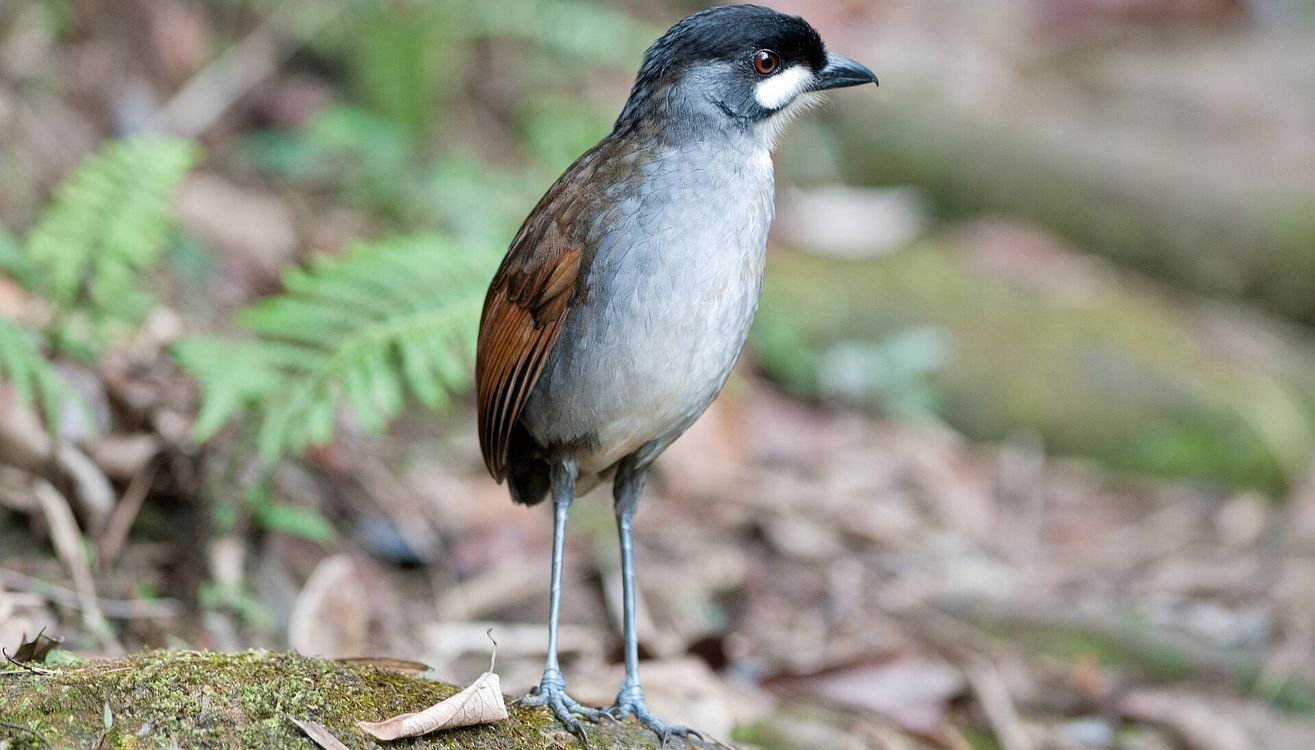
Grallaria ridgelyi, at the Jocotoco Foundation’s Tapichalaca Reserve – credit, Patty McGann CC 2.0. BY
In the late 1990s, a group of scientists were birdwatching in a remote forest in Ecuador when they heard a call like no other. Following the mysterious avian siren, they saw a fairly large bird colored grey, black, and brown standing up on stilted legs like a wading bird.
None of them had ever seen its like, and its discovery was a watershed moment for conservation in the country.
Locals called it a jocotoco, and it would not only turn out to be a completely new species to science, but a catalyst around which to summon conservation funding that would help finance a network of private land purchases within some of the most pristine and biodiverse landscapes in Ecuador.
Managed today in partnership with local communities, the Jocotoco Foundation has decisively shown what one pretty bird can do.
“Every year we discover new species, we rediscover species thought to have already been lost to extinction, and we bring species back from the brink,” the Foundation rightly boasts.
“We protect and restore wildlife habitat from Amazon rainforests to high Andean paramos, into the wet Chocó and the dry Tumbes, and across the ocean to the Galápagos.”
The Jocotoco Antpitta, the largest member of a group of avids called antbirds, was given the name Grallaria ridgelyi in honor of Robert Ridgely, the ornithologist who organized that fateful 1997 trip which resulted in its discovery.
It was first found among the eastern mountainsides of the Andes near the border with Peru, and Ridgely urgently sought funding to buy the land on which they saw it.
PERSONAL MISSIONS: 32 Species of Harlequin Frogs Were Found in Ecuador That We Thought Were Extinct
Their successful fundraising allowed them to establish the Tapichalaca Reserve, the first in what would become a network of 19 private landscapes protecting 123,000 acres, and managed together with another 200,000 acres of community-owned land—all for the purpose of conservation, reforestation, and ecotourism.
Across the reserves, 1,350 bird species have been recorded; a staggering 12.5% of all species in the world. They contain other emblematic Andean animals, including the condor and the Andean bear, and endangered species like the El Oro parakeet and the Galapagos petrel.
ECUADOR’S BEAUTIFUL: ‘Change Has Been Amazing’ For Depleted Mountain: with New Vegetation Comes Deer, Pumas, Andean Bears
“By creating a network of protected habitat ‘arks’, Jocotoco has given these remarkable species a genuine chance not only to endure, but to recover and expand beyond their remaining strongholds,” Ian J. Davidson, Americas regional director for BirdLife International, told the Guardian regarding Jocotoco Foundation’s work.
“Their work stands as a global conservation success story, an inspiring example of what determination, science and long-term stewardship can achieve for nature.”
SHARE This Great Story About Personal Passion Turned Into National Gain…
