


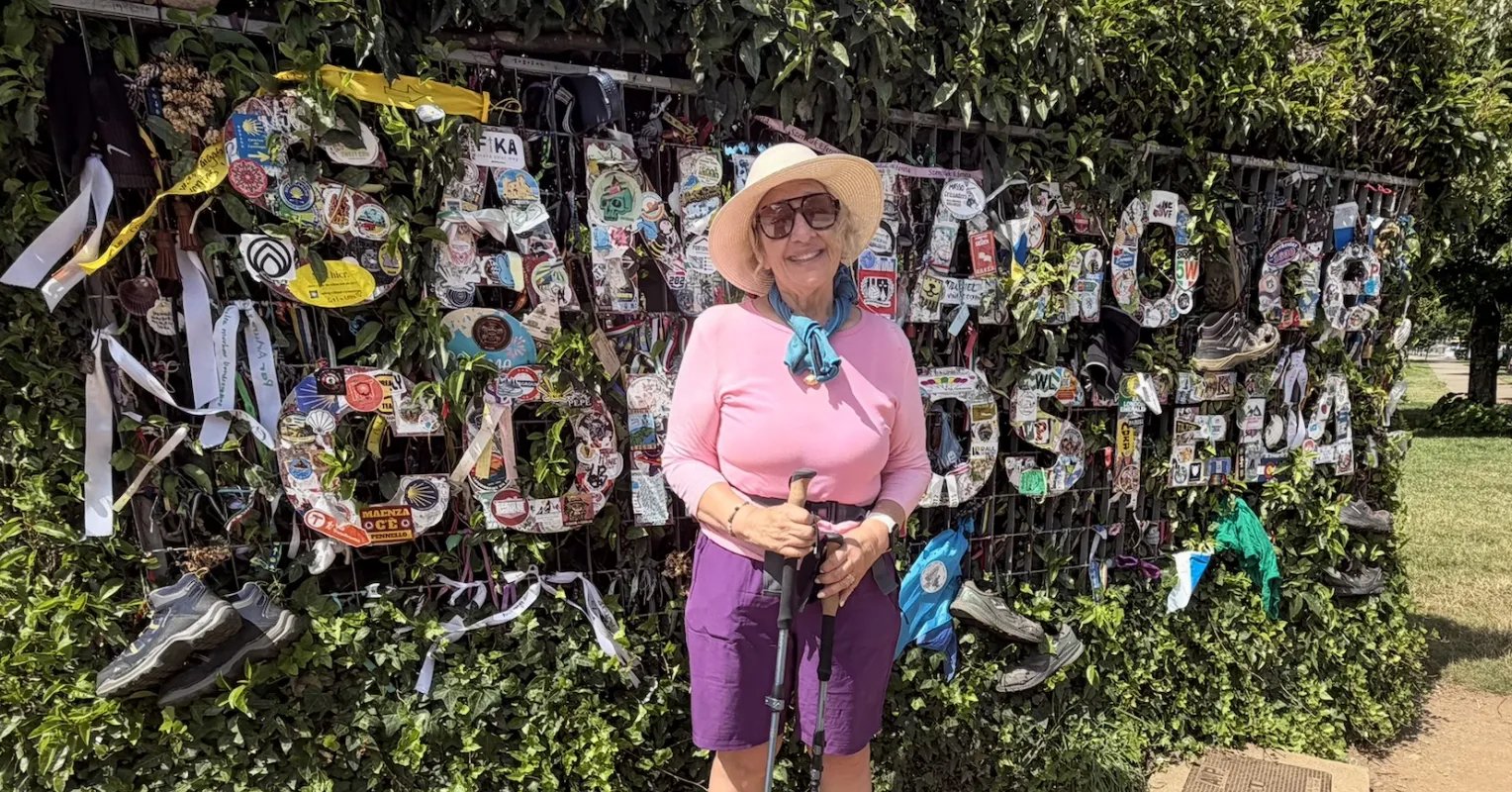
The Camino de Santiago or “The Way,” is one of the world’s oldest pilgrimages. For more than a thousand years, people from every walk of life have traveled across Europe to the Cathedral of Santiago de Compostela in northwestern Spain. Today, people walk the Camino to seek healing, grieve, celebrate, find clarity, challenge themselves physically, or reconnect with what matters most. Whatever brings us to the Camino, it has a remarkable way of becoming the journey we need.
The Fall, and the Helpers
The Camino began teaching me one of its most important lessons on my very first day: I fell.
It was not a graceful stumble. By the time I looked in the mirror, I resembled what I jokingly called a “prizefighter pilgrim,” covered with bruises and scrapes. As someone whose life’s work has been devoted to helping others heal, I am usually the one offering assistance. Yet within moments of my fall, the Camino reminded me that those who spend their lives caring for others must also learn to receive care.
A man named Kenneth and his wife stopped to help me. A taxi driver named Angel appeared when I needed someone to carry me forward. A restaurant owner named Domingo offered warmth and nourishment when my body and spirit needed restoration. Then there was a nurse named Edison—whose name, meaning “the light,” felt especially fitting—who treated my injuries with such compassion that I felt cared for far beyond my physical wounds.
Looking back, I realize they were more than people I happened to meet. They became symbols of grace, appearing exactly when needed. They reminded me that resilience is not about never falling but about allowing ourselves to be held by others until we are ready to walk again.
The Lesson
That first day changed the way I understood the entire pilgrimage. Rather than measuring success by how many kilometers I could complete, I began measuring the journey by moments of connection, gratitude, humility, and presence. The Camino invited me to surrender the illusion that I needed to be strong all the time. Vulnerability, I discovered, is not the opposite of resilience but one of its greatest teachers.
Walking with my son became another gift. There were stretches when we walked together and many when we walked apart, each finding our own rhythm. He was younger and faster; I needed to walk at my own pace. He often arrived two hours before I did and greeted me at our destination. There was something wonderfully symbolic about that. Loving someone does not require walking at the same pace. We can travel differently and still make the journey together.
Only two years earlier, I was not in the physical condition to imagine completing such a journey. I worked hard to prepare, and my family and friends were somewhat surprised by my determination. There were times when I doubted I could reach Santiago. Yet step by step, day after day, I moved closer to my destination. The Camino became living proof that aging is not simply about what we lose. It can also be about discovering capacities we never knew we possessed.
The Possibility of Curiosity with Aging
The nervous system continues to learn and adapt throughout life. Resilience is not a fixed trait we either have or lack; it is a dynamic process of responding, adapting, recovering, and growing through challenges. The Camino affirmed something I have taught for decades through the Community Resiliency Model: Resilience is not the absence of struggle. It is our capacity to return, reconnect, and move forward—even after we have fallen. It involves not only our individual strengths, but also the strengths of our families and communities.
We live in a culture that often associates growing older with becoming less capable, less adventurous, and increasingly fragile. Certainly, aging brings changes. Our bodies change. We may walk more slowly. Recovery can take longer. Loss becomes an increasingly familiar part of life. But this is not the whole story. Resilience does not mean pretending we are 34 when we are 74. It means becoming curious about what this seventy-four-year-old body, brain, heart, and spirit can still learn and do.
Research in lifespan psychology also challenges the assumption that psychological well-being inevitably declines with age. Many older adults maintain considerable emotional well-being and develop sophisticated ways of regulating emotions and responding to life’s challenges. As we grow older and become more aware that our time is finite, many of us become increasingly selective about how we spend it and with whom. Meaningful relationships and experiences can take on greater importance.
We sometimes confuse resilience with fierce independence. But social connection and support are among the important resources that help us adapt to adversity. Resilience is knowing when to reach out a hand—and when to take the hand being offered.
A Gentle Lesson of Hope
I also do not want to turn my experience into another expectation placed upon older adults. Not every 74-year-old can—or should—walk 109 kilometers. Older adults live with vastly different health conditions, abilities, economic circumstances, caregiving responsibilities, losses, and opportunities. The lesson of my Camino is not, “If I can do it, everyone can.”
The lesson is gentler and, I believe, more hopeful: We should not decide what is possible for another person simply because we observe their aged face, a slower gait, or a disability. Instead, let us meet one another with curiosity and respect. Let us ask, “What is possible for you in the here and now?”
Let us ask, “What else is true?” A person may be living with limitation, loss, pain, or the realities of an aging body—and at the same time, there can be strength, purpose, curiosity, wisdom, connection, joy, and possibilities yet to be discovered.
I arrived in Santiago with sore muscles, tired feet, and a grateful heart. I also arrived with a deeper appreciation that healing is rarely a solitary journey. We all need companions like my son. We need moments of surrender, and we need our Kenneths, Angels, Domingos, and Edisons.
The Camino is a reminder of life itself. We begin with a destination in mind, but it is the people we meet, the unexpected detours, the moments of vulnerability, and the kindness we receive along the way that transform us.
