


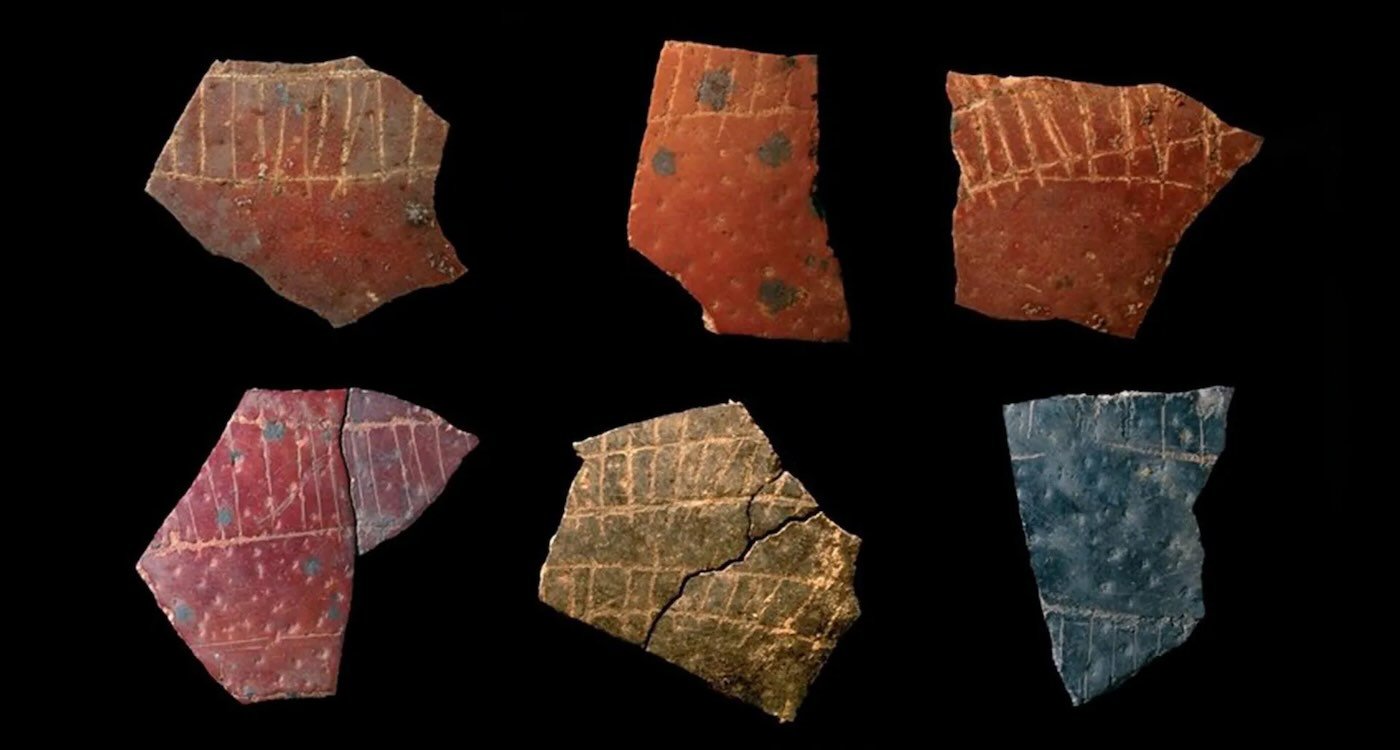
Fragments of ancient etched ostrich eggshells from Diepkloof site -Courtesy of University of Bologna / Pierre-Jean Texier
Dating back more than 60,000 years ago, humans in southern Africa were engraving ostrich eggshells with intricate geometric patterns that—the longer we study them—look more organized than we previously realized.
A new analysis of the markings found on hundreds of eggshell fragments has revealed our ancestors’ remarkable ability to organize visual space according to abstract principles.
Hundreds of the highly unusual egg fragments were found at several archaeological sites where, researchers believe, they were engraved by groups of Homo sapiens who lived in that region.
The investigation team from the University of Bologna concluded for the first time that these engravings on ostrich eggshells were not random or improvised, but followed recurring and surprisingly organized geometric rules, according to the study published in the journal PLOS One.
“We are talking about people who did not simply draw lines, but organized them according to recurring principles — parallelisms, grids, rotations and systematic repetitions: a visual grammar in embryo,” says Professor Silvia Ferrara, from the University of Bologna’s Department of Classical Philology and Italian Studies, who coordinated the study.
“It shows the presence of a genuine cognitive organization of forms, based on parallelism, orthogonality, and the repetition of lines and regular patterns,” says a University press release.
“These signs reveal a surprisingly structured, geometric way of thinking,” continued Ferrara, who says the eggshells were most likely used as water containers.
“The (designs) are organized and consistent, and show mastery of geometric relationships. There is not only a process of repeating signs: there is real visuo-spatial planning, as if the authors already had an overall image of the figure in mind before engraving it.”
The researchers carried out a quantitative and systematic investigation of 112 fragments from two South African archaeological sites—Diepkloof and Klipdrift—and one site in Namibia known as Apollo 11.
By applying methods of geometric and statistical analysis never previously used on these artifacts, the study made it possible to reconstruct in detail the lines, angles and trajectories of the markings.
“Our analysis shows that Homo sapiens 60,000 years ago already possessed a remarkable ability to organize visual space according to abstract principles,” concludes Valentina Decembrini, PhD student at the University’s Department of Classical Philology and Italian Studies and first author of the study.
“Transforming simple forms into complex systems by following defined rules is a deeply human trait that has characterized our history over millennia, from the creation of decorations to the development of symbolic systems and, ultimately, writing.”
MORE COOL PRE-HISTORY:
• Striped Rock Dismissed as Natural in 1928 Reclassified as UK’s Oldest Cave Painting
• Huge Camel Carvings Dating Back 12,000 Years Marked Wet Season Oasis Like Cultural Road Sign
The results show that more than 80% of the configurations display coherent spatial regularities, with repeated use of angles close to 90° and groups of parallel lines. The most complex compositions — such as hatched bands, grids and diamond-shaped motifs — reveal cognitive operations of rotation, translation, repetition and “embedding”, i.e. the ability to build hierarchical levels of signs within the same surface.
Beyond the possible meanings of the markings, the authors stress that the implications of the study concern above all the cognitive foundations that made it possible to create these decorations. The ability to construct visual configurations structured according to specific rules can be seen as a key indicator of the emergence of abstract thought — a crucial step in the evolution of human thinking.
AND, GORGEOUS: Carved 40,000 Years Ago and Found in a Cave, These Are the Oldest-Known Animal Sculptures
SERVE UP THESE EGGS For History Lovers on Social Media–BY SHARING…
