


Discussion
Good implementation is crucial for successful interventions, however, in implementation science, evaluation remains challenging.23 This paper describes the reach, effectiveness, implementation and evolution of an accredited HPE programme in sports medicine in Qatar.
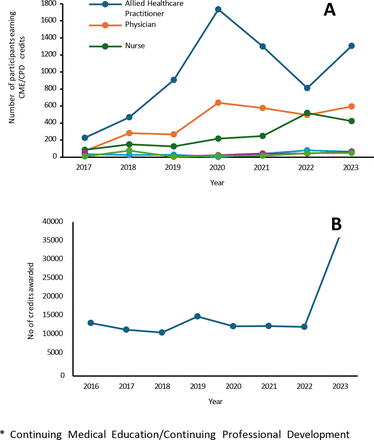
The HPE programme significantly grew and improved since its inception in 2016. Specifically, and based on attendance and number of CPD credits assigned, the programme’s reach expanded. Measuring effectiveness, the content of the CPD activities aligned well with their learning objectives. In addition, participants on average reported perceived improvements in their clinical performance based on CPD activities. While a small percentage of participants indicated perceived barriers to changing clinical practice in response to attending the CPD activities, these barriers decreased over the years. As for the programme’s implementation, the attendance rate of CPD activities increased over the years. The percentage of participants indicating what could improve the programme decreased and plateaued.
The attendance rate of the CPD activities showed a steady increase over the study period with a notable surge in 2020, likely due to the introduction of online activities in March 2020 during the COVID-19 pandemic. The reduction in perceived barriers over time suggests that repeated exposure to CPD activities may facilitate long-term knowledge retention and integration into clinical practice. This could be due to repeated exposure to CPD activities over time, which likely increased familiarity and facilitated the integration of acquired knowledge into clinical practice. Most barriers did not significantly change over time, possibly because the survey was anonymous and completed by different participants over the years. However, it is interesting to note the fluctuations in perceived patient compliance issues and the constant lack of opportunity for patients; the lack of patients likely refers specifically to a shortage of ‘registered athlete patients’, compared with ‘private patients’, thereby limiting the application of sport-specific knowledge. This finding is consistent with previous research, which identified patient characteristics as a major barrier to implementing CME knowledge.24 Future evaluation should continue to explore these trends in future qualitative research. Recognising and addressing barriers to education leads to more effective continuing education programmes and could ultimately improve clinical performance (and patient outcomes).25
A scoping review by Goodall categorised the broad impacts of CPD which included improvement in knowledge and practice change.26 Our study findings demonstrated an overall agreement among participants regarding self-reported perceived improvements in clinical practice in terms of medical knowledge, patient management strategies, effectiveness in clinical skills, communication and identification of different patient values and needs. Over time, these perceived improvements became more evident, aligning with previous studies which show that CPD interventions can improve professional practice. Specifically, those more tailored to the specific needs of health professionals and their clinical settings tend to have a stronger impact on practice.5 This reflects the mission of Aspetar’s HPE programme. Focused on improving clinical practice, our results support the importance of implementing HPE programmes tailor-made for the specific context, including patient profiles and clinical needs.
Highlighted by participants, the top three areas to improve the HPE programme were more practical sessions, more case-based presentations and more patient case discussions. While workshops were the most common activity format, participants strongly indicated that they should incorporate more case-based presentations and patient case discussions. This finding aligns with previous studies, which indicate that team-based and case-based learning methods were more effective learning methods.27
Our study has several strengths. Data were collected over several years and across multiple professions, thus providing a comprehensive evaluation of a multidisciplinary HPE programme in sports medicine. Not only did our participants include multiple professions in sports medicine, but they also practised in different settings—from hospital-based clinics, operating theatres and sports dentistry clinics to field-based clinics at Qatar’s clubs and federations and sporting events like the FIFA World Cup. Furthermore, our data reflects the views of international health professions participants, bolstered by online or hybrid live delivery of CPD activities. Consequently, the evaluation results encompass a wide range of data, offering valuable insights into the programme’s impact over time.
Limitations include the use of retrospective data, originally collected for quality improvement purposes. The fact that participants are required to complete the evaluation survey before receiving the CPD credits may influence the responses and affect the objectivity of the results. In addition, the study outcomes relied on self-reported survey data. As a result, the reported improvements in medical knowledge, clinical skills, patient management and communication should be interpreted with caution, as self-reported measures are susceptible to bias and may overstate the programme’s actual effectiveness. Furthermore, the findings of this study are, to a large extent and despite reaching participants from all over the world, specific to the HPE programme at Aspetar. This limits the generalisability of our results to other settings and contexts. The RE-AIM framework was selected to guide the evaluation, as it is commonly used in sports medicine research.28 29 Given the objectives of this study and the available data, the analysis focused on the reach, adoption and implementation elements of the framework. The effectiveness and maintenance elements were not evaluated, as they were beyond the scope of the current study. Yet, the RE-AIM framework provided guidance for the data collection and analyses.
The current evaluation process follows an iterative feedback model in which data is collected after each CPD activity offering; this leads to large data sets, which can be difficult to manage effectively. Although the Likert scale is a common method to collect survey responses,30 its use is subjective and prone to bias, hence we aim to enhance the programme by addressing these data limitations and refining the evaluation methods used. A key area for improvement involves identifying the best practices for evaluation, particularly in how they benefit participants. We are planning qualitative research to provide an in-depth exploration of participants’ perspectives on a HPE programme and its perceived impact on clinical practice.
