


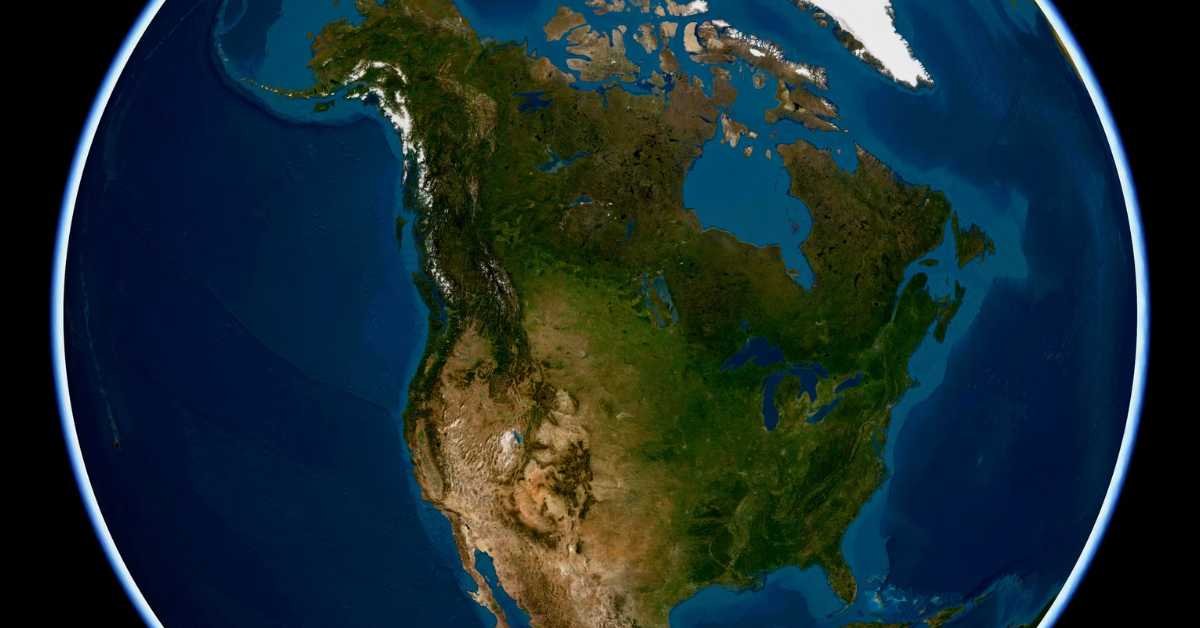
State boundaries can be iconic. Many were drawn by human hands, but some of the most recognizable contours were shaped by nature: the boot of southeastern Louisiana, carved by the Mississippi River, or the ocean waves sculpting the hook of Cape Cod in Massachusetts.
For a moment, imagine that there are no state lines. View the United States through its natural contours. As curators at the Smithsonian’s National Museum of Natural History, we often look at our nation this way, drawing different kinds of maps that trace mountains, watersheds, animal migrations, biomes, ancient seas, and so much more.
These kinds of maps show us how connected we all are by nature, since it transcends state boundaries. That idea is central to our new exhibition, “From These Lands: Sharing Our Natural and Cultural Heritage,” now open at our museum to mark the 250th anniversary of the United States.
We are co-curators of the show, part of a team of exhibit designers and developers who created the exhibition.
“From These Lands” uses items from the museum’s collections to explore these patterns and ideas, offering a way to see the country’s natural and cultural heritage beyond state lines.
Climate, vegetation and animal life vary across the landscapes of the United States, forming distinct biomes. Smithsonian/Esri/RESOLVE, CC BY-NC
One country, many pine cones
Pine cones can be easy to overlook.
When you’re out for a walk in the woods, you see the forest, maybe even the trees, but not always the cones at your feet. For many people, a pine cone is just a pine cone. But when you look closely, subtle differences in the styles of cones carry clues about the trees that produced them and the places where those trees live.
Pine trees grow across many of these regions, and their cones reflect some of the different environments where pines live. James Di Loreto, Smithsonian, CC BY-NC
There are 43 pine species native to the United States, making up nearly a third of the world’s pine tree diversity. Together, they stretch across surprisingly different combinations of climate, terrain, plants, and animals, the regions scientists call biomes.
Something as simple as the pine cone can let you hold that concept in your hand: soils, fire, rain, birds, and rodents all helped shape the tree that made it.
For example, cones from the sand pine can shield seeds for years, only to release them as the heat from low-intensity fires melts their resin and opens their scales. These scrubby and fire-shaped landscapes are one part of the larger temperate evergreen forests that spread through the southeastern U.S.
On the other side of the country, the Coulter pine produces cones that can be more than a foot-and-half long and weigh up to 8 pounds. This large cone size helps its seeds to survive fires, allowing small birds and mammals to then disperse them into new areas in the Mediterranean Scrub of Southern California.
A pine cone comes from one tree in one place, but its form reflects a wide set of environmental conditions. Pine cones provide an interesting way to view the different biomes found in the United States and its territories.
Geologic age maps can reveal ancient landscapes hidden beneath modern ones. Smithsonian/Esri/USGS/GSA, CC BY-NC
An ancient ocean in the middle of the country
The land under your feet can be millions of years old, and it has not always been dry ground.
During the late Mesozoic Era — the time interval made famous by the dinosaurs — a warm, shallow inland sea covered states from North Dakota to Texas. This Western Interior Seaway laid down many of the rocks and sediments that you can see today throughout the Great Plains and Badlands.
The sea was also full of life, and the rocks it left behind are full of fossils.
These ammonite fossils from South Dakota come from an ancient, shallow sea that once covered much of the middle of North America. Phillip R. Lee, Smithsonian, CC BY-NC
There were familiar characters living on this ancient seafloor: clams, snails, and sea stars. But swimming in the waters above were the now-extinct animals called ammonites.
These coiled, shelled relatives of squid and octopuses were abundant predators, hunting in the same waters as fish, turtles, sharks, and extinct marine reptiles called plesiosaurs. Ammonites used the chambers in their shells to control buoyancy, much like the modern nautilus.
Ammonite fossils demonstrate that much of the central U.S. was an ancient ocean. They also remind us that the landscapes we know today are just the latest version of those reshaped over and over by the slow work of geologic time.
Thousands of animals trace migration routes across the United States. Smithsonian/Esri/Movebank Data Repository, CC BY-NC
Unlikely pairing: Shorebirds and horseshoe crabs
Animals move. Some travel only short distances with the seasons, but others travel thousands of miles, crossing not only state lines, but countries, oceans, and hemispheres.
Animal migration routes might look chaotic on a map, but birds, whales, turtles, and more forge these paths for specific reasons.
The ruddy turnstone shorebird times its mid-Atlantic stop with the beachside spawning of the horseshoe crab in Delaware Bay. L: G.Halpin/Pixabay. R: Phillip R. Lee, Smithsonian.
Timing is a key component of migration. Thanks to a critical refueling stop in Delaware Bay, the ruddy turnstone shorebird manages to migrate thousands of miles each year to its breeding grounds in the high Arctic.
These East Coast migrants time their layover with the migration of horseshoe crabs, which come ashore to lay millions of nutrient-packed eggs on beaches. The turnstones gorge themselves on those eggs before continuing their journey north.
It is a strange and wonderful handoff between an ancient marine animal hauling itself out of the ocean and a weary shorebird bound for the Arctic. A single bay brings them together, illustrating how the many migration routes through these lands can hinge on key moments and places.
The topography of North America ranges from broad coastal plains to rugged mountain systems. The ridges, valleys, streams and caves of the Appalachian Mountains create small pockets of habitat for many different plants and animals. Smithsonian/Esri/CEC/USGS, CC BY-NC
Salamander country
Topography is more than scenic landscapes. Everything from the flat coastal plains to the ridges, valleys, and stream-cut mountainsides helps shape where animals can live and how biodiversity accumulates.
The rugged terrain of the Appalachian Mountains creates cool, wet forests, shaded hollows, caves, ponds, and streams. These habitats can differ from each other in elevation, temperature, moisture, and water flow — and salamanders take note.
More salamander species live in the Appalachian Mountains than anywhere else in the world. It can feel as though every other rock you turn over hides yet another species.
A cave salamander from the Appalachian Mountains in Georgia. James Di Loreto, Smithsonian, CC BY-NC
The trio of Plethodon salamanders, the southern gray-cheeked, red-cheeked, and red-legged salamanders, were once thought to be regional variations of the same species. But these salamanders live at varying elevations in different mountain ranges, and genetic sequencing confirmed that each was, in fact, its own species.
Topography and shifting climates had broken up these populations into different habitats, allowing each to evolve into distinct species.
North America’s watersheds cross state and national boundaries, linking distant rivers and landscapes through the flow of water. Smithsonian/Esri/CEC, CC BY-NC
Following the American shad
Chesapeake Bay is the largest estuary in the U.S., fed by a watershed connecting rivers and drainage basins that reach into six states and the District of Columbia. It’s home to more than 3,600 species, including oysters and blue crabs. But one fish in particular has become strongly intertwined with the lives and cultures of many people around the bay.
American shad move between the Atlantic Ocean and the freshwater rivers of the Chesapeake Bay watershed, a migration long tied to the Pamunkey Indian Tribe’s diet, culture and stewardship of nature. James Di Loreto & Tonda Phalen, Smithsonian, CC BY-NC
The American shad spends much of its adult life in the Atlantic Ocean but returns to the freshwater rivers in the upper reaches of the Chesapeake Bay to spawn. For more than 12,000 years, this herring’s spring migration has been part of Pamunkey Indian Tribe diet and culture.
From 1918 to 2019, to mitigate declining populations of herring, the tribe ran a hatchery to “give back to the river.” The Pamunkey Tribe’s fishing rights date back to their 1677 treaty with the British Crown.
Today, only the Pamunkey and citizens of other tribes in Virginia can legally fish for shad in this region.
A single type of fish moving between salt and freshwater, tracing the paths of the watershed, has helped to shape centuries of diet, law, culture, and stewardship, highlighting the many connections between nature and culture.
Different ways to map the country
Pine cones, ammonites, shorebirds, salamanders, and shad tell more than individual stories about particular places. Together, they point to older and larger patterns: varied forests, vanished seas, seasonal migrations, mountain habitats, and rivers that harbor a fantastic diversity of life.
State lines are one way to picture the U.S., but natural history provides another — one that shows the ancient and living connections running across the landscape.
This article was written by Stewart Edie and Torben Rick from the Smithsonian Institution, and was originally published on The Conversation.
Header Image by Smithsonian/Esri, CC BY-ND
