


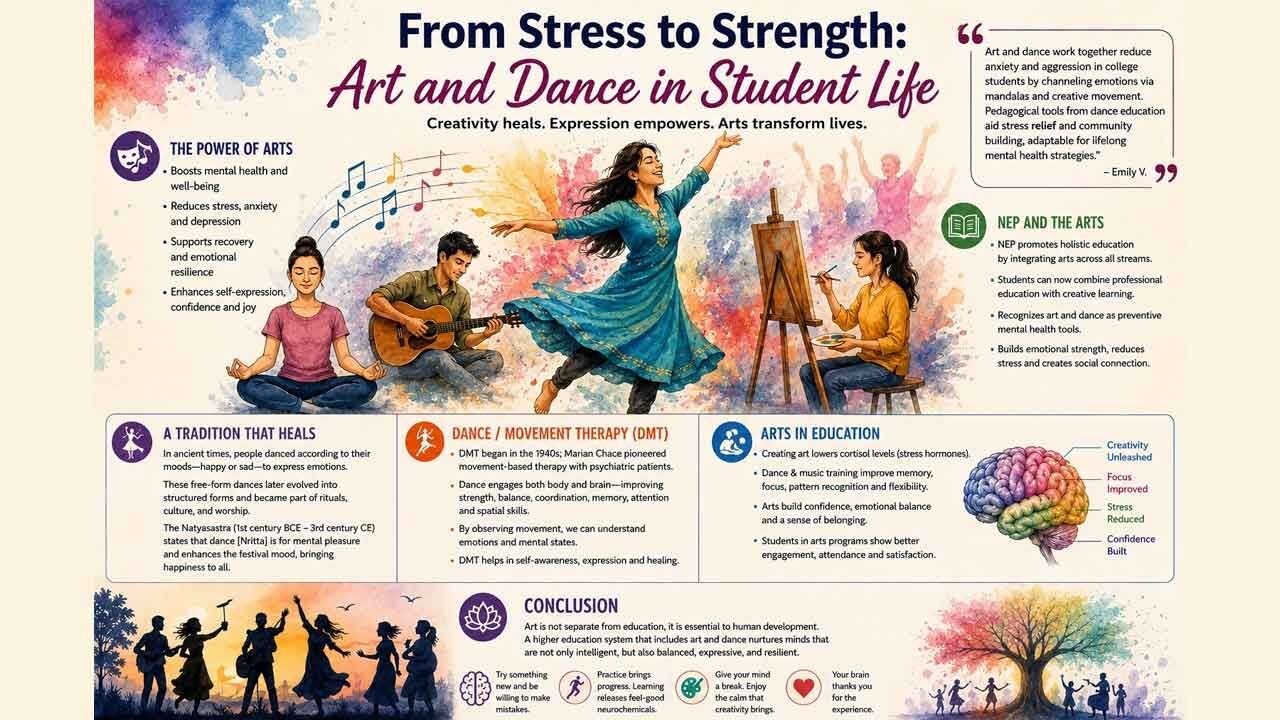
Have you recognized a feeling of joy that you can get when taking part in cultural activities such as music, dance groups, or theatre? Getting involved with the arts can have powerful and lasting effects on health. It can help to protect against a range of mental health conditions, help manage mental illness, and support recovery.
During self-isolation due to the coronavirus, many people were getting involved in arts and art-related activities. Perhaps they are seeking a creative outlet or opportunity for expression, but it’s also possible that their attraction may be driven by an innate desire to use their brains in ways that make them feel good. In ancient times people used to dance according to their moods. Whether it is a happy occasion or sad dancing was meant for conveying their emotions. These dances don’t have any structure. They dance to their own rhythm and movements. They used to dance for themselves instead of others. Slowly these dances developed a kind of formation and patterns. Still, there were no fixed rules on how or where to dance. Slowly dancing became an important part of their ritualistic gatherings and it varied according to each place and culture. In some places, people used to dance as part of their worship of God. So, this is how dancing came into the common man’s life. Even in the Natyasastra written by Sage Bharata in between the 1st century BCE – the 3rd century CE, it says that dance [Nritta] is for mental pleasure and does not convey any particular meaning. It enhances the festival mood and provides happiness to everyone.
Dance/Movement Therapy
Why do we stop dancing when we grow up? Why do we disconnect and alienate ourselves from the body? The field of psychology codified the healing power of dance through an expressive therapy modality known as Dance/Movement Therapy (DMT). Dance/Movement Therapy (DMT) began to take shape as a professional practice in the 1940s. American dancer and choreographer Marian Chace is regarded as one of its foremost pioneers, having introduced movement-based therapeutic work with psychiatric patients around 1942. Dance typically involves learning sequences of steps and movements in space, in coordination with the music. In other words, it requires substantial physical and cognitive engagement and, as such, it should improve not only muscle tone, strength, balance, and coordination, but also memory, attention, and visuospatial processing. By observing the body, we can deduce mental states.
Art in education
There is also growing evidence that the arts can be used in non-therapy contexts for promoting mental health, such as using performing arts to learn about the core subject areas in schools. Emily V. in her work says that – ‘Art and dance work together reduce anxiety and aggression in college students by channeling emotions via mandalas and creative movement. Pedagogical tools from dance education aid stress relief and community building, adaptable for lifelong mental health strategies’
(Work Cited)
Viprino, Emily. “Transforming Education: The Impact of Dance/Movement Therapy in School Settings.” Expressive Therapies Theses. 48., 2025,
One of the key reforms under NEP (National Education Policy) is allowing students from science, commerce, engineering, management, and humanities streams to choose courses across disciplines, enabling students to combine professional education with creative learning. NEP recognises the importance of art and dance as preventive mental health tools by lowering stress, improving mood, building confidence, and creating social connection among students.
Cognitive neuroscientists found that creating art reduces cortisol levels (markers for stress) and that through art people can induce positive mental states. Dance and music training enhance attention span, memory retention, pattern recognition, and cognitive flexibility. These skills transfer positively to academic learning. Students involved in arts programmes are often more connected to campus life, resulting in stronger attendance, participation, and satisfaction with university experience.
Conclusion
Art is not separate from education, it is essential to human development. A higher education system that includes art and dance nurtures minds that are not only intelligent, but also balanced, expressive, and resilient. Try something new and be willing to make mistakes to learn. Most artists practice for years before they are able to render something realistic, and they are willing to make many mistakes along the way, likely because the brain rewards learning. Give those overworked parts of the mind a break, and indulge in the calm relaxation that comes from doing so. The neurochemicals that are released feel good, and that is your brain’s way of thanking you for the experience. (Author Dr. U S Anitha working as assistant professor at Gitam deemed to be university)
