


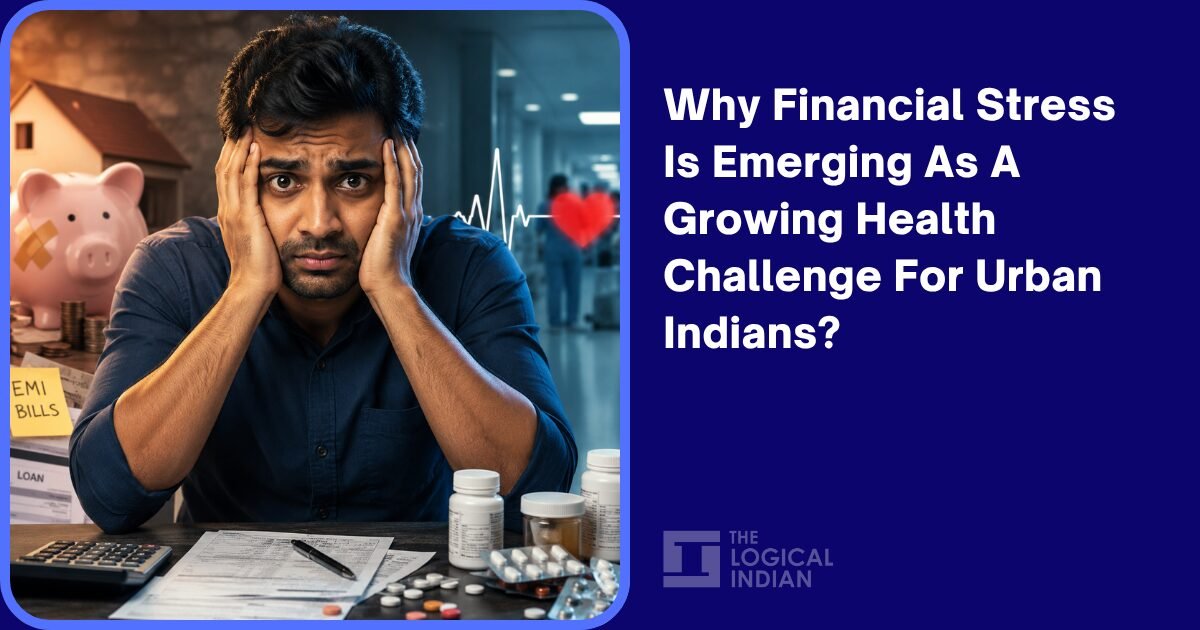
For decades, Indians worried that illness could drain their savings. Now, a growing body of evidence suggests the relationship works both ways. Financial stress itself is becoming a health risk.
A new survey has found that the pursuit of financial security is leaving millions of urban Indians anxious, with the pressure of achieving financial goals increasingly spilling over into physical and mental well-being.
The findings add a new dimension to India’s healthcare debate. The country’s biggest health challenge may no longer be just about disease. It may be about money.
Financial Stress Hits Health
According to the 2026 India Health Quotient survey by ManipalCigna, financial well-being emerged as the weakest dimension of health among urban Indians, scoring 62 out of 100.
The study, conducted among 2,600 respondents across 16 cities, found that 41% of respondents said the pressure of pursuing financial goals causes stress and anxiety. Another 36% said spending on healthy food, supplements and preventive healthcare itself creates financial pressure.
Nearly 40% reported that stress and anxiety were affecting their physical health, while 82% said they experienced stress, with 14% describing it as unmanageable.
Physical health scored 68 out of 100, while mental, occupational and social health each scored in the mid-60s.
The findings point to an emerging reality. Financial health is no longer separate from physical health. The two are increasingly intertwined.
A Health Debt Trap
The survey describes what it calls a “Health Debt Trap”.
Financial stress affects sleep, exercise and lifestyle choices. Poor health then raises healthcare expenses, which in turn worsens financial stress. The cycle reinforces itself.
For many households, the problem is no longer limited to paying hospital bills. Even maintaining healthy habits is becoming expensive.
The findings suggest that health and wealth are no longer independent concerns. They are feeding into each other.
Young Adults Feel The Strain
The burden appears particularly severe among younger adults. People aged 25 to 34 recorded the lowest financial well-being score at 59 out of 100, according to the survey.
This age group often faces multiple financial responsibilities simultaneously, including education loans, home purchases, childcare expenses and retirement planning.
Women also reported lower levels of financial confidence than men, highlighting persistent gender disparities in financial security.
These findings indicate that the pressures associated with upward mobility may themselves be contributing to stress and poorer health outcomes.
Insurance Makes A Difference
One notable finding from the survey was the role of health insurance.
Insured respondents scored eight points higher on financial well-being and six points higher on mental well-being compared with uninsured individuals.
The results suggest that insurance offers benefits beyond reimbursement of medical expenses. It also provides psychological reassurance.
Yet significant gaps remain.
Another recent study found that while 54% of urban Indians currently own health insurance and 8% plan to purchase one, 38% neither have coverage nor intend to buy it.
That protection gap leaves millions vulnerable to unexpected medical costs.
Progress In Health Financing
The survey findings come at a time when India’s health financing indicators are improving.
According to the National Health Accounts 2022-23, out-of-pocket expenditure as a share of total health expenditure declined to 43.4% in FY23 from 64.2% in FY14.
Government health expenditure increased from 28.6% of total health expenditure to 43.7% during the same period. Social security expenditure rose from 6% to 9.9%, while the share of private health insurance increased from 3.4% to 9.2%.
Government health spending also rose to 1.43% of GDP in FY23. These trends suggest that India has made considerable progress in expanding financial protection.
Yet the latest survey points to a paradox. Even as objective indicators improve, many Indians continue to feel financially vulnerable.
Why Families Still Feel Exposed
Part of the answer lies in the distinction between percentages and actual spending.
Health economist Nachiket Mor recently noted that per-capita out-of-pocket expenditure increased from around ₹2,097 in 2017-18 to ₹2,767 in 2022-23.
In other words, households are paying a smaller share of the country’s overall health bill, but they are spending more money in absolute terms.
Healthcare inflation, rising treatment costs and growing dependence on private medical facilities continue to strain household finances.
As incomes rise, expectations around healthcare quality also increase, often pushing families toward costlier treatment options.
Medicines Still Drain Wallets
Hospitalisation is only one part of the financial burden. Recent National Health Accounts data showed Indians spent more than ₹1.6 lakh crore on medicines in FY23.
Pharmaceutical expenditure remains one of the largest components of household healthcare spending. This helps explain why even insured families continue to incur significant out-of-pocket costs.
Medicines, diagnostics and outpatient expenses frequently fall outside insurance coverage, limiting the financial protection available to households.
Insurance Coverage Is Expanding
India has nevertheless made progress in extending coverage.
Findings from the recently released National Family Health Survey-6 showed that over 60% of households now have some form of health insurance or health financing support, up from around 41% during NFHS-5.
Rural households reported slightly higher coverage than urban households. Government programmes and expanding private insurance have contributed to the increase.
However, wider coverage does not automatically translate into financial security. Protection remains uneven, and many families continue to rely on their savings during medical emergencies.
Stress Is Becoming The Epidemic
Perhaps the most striking message from the latest survey is that stress has become nearly universal. Only a tiny fraction of respondents described their health as poor.
Yet more than eight in ten said they experience stress. The contrast illustrates how conventional measures of health may fail to capture the pressures shaping everyday life.
India has made undeniable progress in reducing out-of-pocket expenditure and expanding insurance coverage over the past decade.
But the latest evidence suggests the challenge has evolved. For millions of Indians, the question is no longer simply whether illness will hurt their finances. It is whether the pursuit of financial security itself is beginning to hurt their health.
The Logical Indian’s perspective
health and money are tightly linked. Even with insurance and rising incomes, a medical emergency can still disrupt savings, planned investments, and monthly budgets. Many families prioritise financial goals like home loans or education funds, sometimes delaying preventive healthcare.
At the same time, rising medical costs and stress create anxiety about both future security and current wellbeing. The result is a constant balancing act between staying healthy and staying financially stable.
Also Read: Delhi Shopkeeper Who Risked ₹2 Lakh Stock to Save Fire Victims Honoured With ₹1 Lakh Reward
