


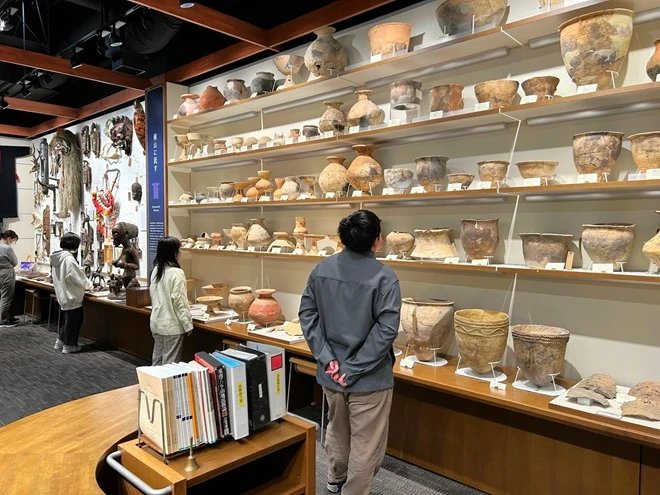
Spending time at a museum while taking in the exhibits can improve a person’s mental and physical well-being, even if only for a short visit, according to a new study.
Izumi Ogata, a specially appointed professor of museology at Kyushu Sangyo University, wondered how public cultural facilities contribute to overall psychological and bodily well-being in society.
The question drove the advocate of the “museum bathing” concept to embark on his study, to scientifically probe the healing effects of museums.
Ogata gathered data on 1,850 visitors through empirical trials at 111 establishments across Japan, including the National Museum of Western Art and the Nagoya University Museum.
“We have successfully demonstrated the likelihood that museum bathing may turn out to be effective in addressing social issues in this country, inclusive of the challenges associated with a super-aged population as well as students’ refusal to attend school or leave their homes,” Ogata said.
The concept of museum bathing aims to take full advantage of the positive influence of institutes devoted to subjects such as history, art and natural history to promote public health and well-being.
Ogata said museums have long provided citizens with “places for intellectual stimulation, learning and excitement.” But he added that museum operators are financially struggling these days.
“The findings of a survey carried out by the National Center for Art Research showed that 51.7 percent of respondents from younger generations expressed an indifference to museums, highlighting their lagging popularity today,” Ogata said.
He said the concept of museum bathing represents an initiative to “create new value and appeal” of exhibition facilities under such a circumstance.
To support his theory, Ogata utilized the effectiveness evaluation method for forest bathing to objectively assess the benefits of museum exploration.
Ogata specifically applied this technique to the pilot experiment project he launched in 2020, as forest bathing had already been well confirmed to produce preventative health benefits.
Ogata’s study combined physiological measurements of blood pressure and pulse with the psychological assessment method known as the profile of mood states (POMS), which utilizes a standardized scale to numerically gauge emotional shifts, including anxiety, depression, anger and vitality.
The research covered a wide range of museumgoers, from junior and senior high schoolers and college and university students to working adults and elderly individuals.
The visitors’ styles to view exhibits similarly differed: some explored museums in silence, while others conversed with one another during their tours.
Participating in the verification test were 111 establishments with diverse backgrounds. They were, for example, themed on history, art, archaeology, folklore and natural history.
The Nagoya University Museum was not the only participating institution from the Tokai region.
In addition to the Nagoya City Art Museum and the Nanzan University Museum of Anthropology in Nagoya, the Showa Era Lifestyle Museum in Kita-Nagoya, Aichi Prefecture, and the Minokamo City Museum in Minokamo, Gifu Prefecture, lent a helping hand as well.
Analysis of data from the 1,850 visitors showed that museum tours are useful in improving their mood. Museumgoers alike exhibited well-regulated physiological homeostasis, thereby succeeding in maintaining a stable condition within the body.
Examining mood improvement in greater detail, the indicators for anger, depression and tension, among other negative emotions, declined following museum visits. In the meantime, boosted levels of vitality were also observed.
Elderly people, in particular, recorded mood gains of up to 17.72 points during a survey conducted at the National Museum of Western Art in Tokyo between June and July 2024.
“Relaxing effects were reported even for short tours lasting only 10 to 30 minutes,” Ogata said.
In terms of physiological homeostasis, regulatory benefits for the autonomic nervous system were confirmed. Young visitors with low blood pressure saw their pulse rate rise into the healthy range, while the pressure level decreased significantly among elderly individuals with hypertension.
The study discovered that viewing contemporary art resulted in dramatic physiological improvements in participants with low blood pressure. Folklore exhibitions, meanwhile, contributed particularly to lessening blood pressure for elderly museumgoers.
Archaeological and historical materials were found to gradually bring on favorable changes.
With the survey results in mind, Ogata stressed the importance of museum bathing.
“A long-term survey in Britain has clarified that engagement with culture and art can reduce the risk of death in elderly people by 31 percent, as the nation is known for its advanced research in this field,” Ogata said. “Dedicated efforts are accordingly underway in Canada to prescribe museum visits at medical institutions.”
He shared his vision for the future.
“We will be forging ahead with research from now toward the social implementation of the concept while cooperating with initiatives supporting truant children and preventive medicine,” Ogata said. “Personalizing museum appreciation experiences through individual optimization with artificial intelligence is possible as well.”
The notion of museum bathing is expected to serve as a prescription for survival and a form of cultural infrastructure in the years ahead, as exhibition facilities today are increasingly forced to generate substantial revenue to keep their doors open.
