


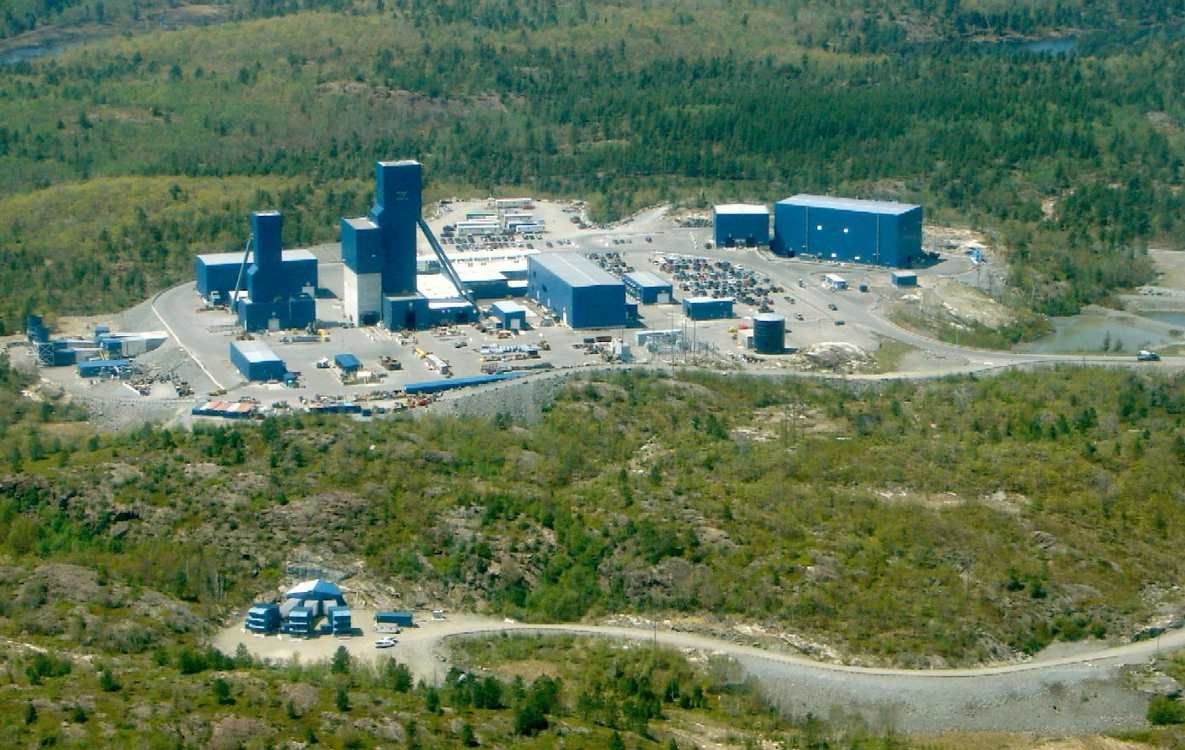
The Nickel Rim Mine in Ontario, the only other Western source for Nickel – credit, P199 via Wikimedia, CC 3.0.
On July 31st, mine developer Canada Nickel Company announced it had received final permitting approval from the Ontario government for its gargantuan nickel mining/carbon capture project
The approval is the first issued under Canada’s amended Impact Assessment Act, a reform of extractive industry regulations designed to allow the highest-quality projects to be permitted fast.
Financing for the project will come in part through the sale of carbon credits, as Canada Nickel develop what is now a proprietary carbon storage method that allows it to store atmospheric carbon within the milled stone out of which the nickel is separated.
Needed for stainless steel, plating, high-quality allows, and emerging as a must-have for next-generation EV batteries, the market for nickel as a globally-traded commodity is sequestered almost entirely within Indonesia, where poor tropical soils make mining nickel easy.
Some 67% of nickel is mined in the country, a greater share of market control than OPEC has over global oil production. Additionally, in 2024, nickel mining was identified as a primary national cause of deforestation on the islands of Sulawesi and Halmahera.
Yet for decades there has been just one Western-based source of nickel. Many manufacturers have had to source from Indonesia, the Philippines, and China, where environmental and social effects of rural nickel mining can rarely be scrutinized, and even more rarely influenced.
Canada Nickel’s Crawford Project aims to be not only the largest nickel source accessible to Western markets, but one of the largest in the world; one where deforestation, erosion, and pollution can be properly prevented.
Indeed the Prime Minister of Canada himself believes that Crawford will set a new a worldwide standard for responsible mining.
Located in Ontario’s legendary Timmins mining district, the Crawford Project is estimated to contain 3.8 million tons of nickel, set within a total land package that could contain as much as 12 million tons according to published resource estimates. It holds a byproduct credit of chromium, and will be the only significant Western source of this metal as well.
Canada Nickel CEO Mark Selby alerted shareholders to the news of permitting success on the last trading day of the week.
CARBON CAPTURE PROJECTS: World-First South Korean Natural Gas Project Paves a Route to More Power and Cheaper Carbon Capture
“Today’s decision recognizes the strategic importance of responsibly developing Canada’s critical mineral resources in partnership with all levels of government and Indigenous Nations while maintaining rigorous environmental standards,” said Selby.
“We look forward to continuing to advance Crawford towards a construction decision in 2027.”
Building the Crawford operation will require some $1.9 billion. The projected return on this capital is expected to benefit from the company receiving as much as 50% in tax credits for incentivizing carbon storage.
CLEANING UP MINING: Scientists Develop Enzyme to Limit Environmental Impact of Mine Waste, Testing Underway
Canada Nickel’s In-Process Tailings (IPT) Carbonization technology involves injecting a concentrated source of CO2 into tailings generated by milling for a brief period, fixing the carbon geologically while the material is still in the processing circuit rather than after final deposition.
Lab-scale tests have demonstrated that this method is 8 to 12-times faster than passive carbon capture approaches, achieving net-zero carbon capture targets in less than 36 hours and gross capture rates of at least 26 tons of CO2 per ton of nickel in 6 days.
MODERN MINING: Quebec Firm Pioneers Cyanide-Free Gold Extraction and Arsenic-Capture to Clean up Mining Industry
That translates to an expected storage of 1.5 million tons of CO2 per year of operations.
To put this into perspective, that equates, according to the US Environmental Protection Agency to removing 350,000 gas-powered cars from the roads for a whole year, or around 200,000 average family homes’ electricity use, or, perhaps the most eye-opening equivalent, the carbon-savings from a whopping 450 wind turbines running for a year.
Given the quantity of mine tailings that will be generated by the 48,000 tons of material running through the mill every day, Canada Nickel estimates that the carbon storage potential across the 41-year mine life of Crawford could extend to 15 million tons per annum. At that point one is talking about a generational opportunity to remove carbon from the atmosphere.
SHARE This Story Of A Mine Becoming A Carbon Storage Powerhouse…
Editor’s Note: This story should not be construed as investment advice, always perform due diligence and consult with your financial advisor before making any investment decision.
