


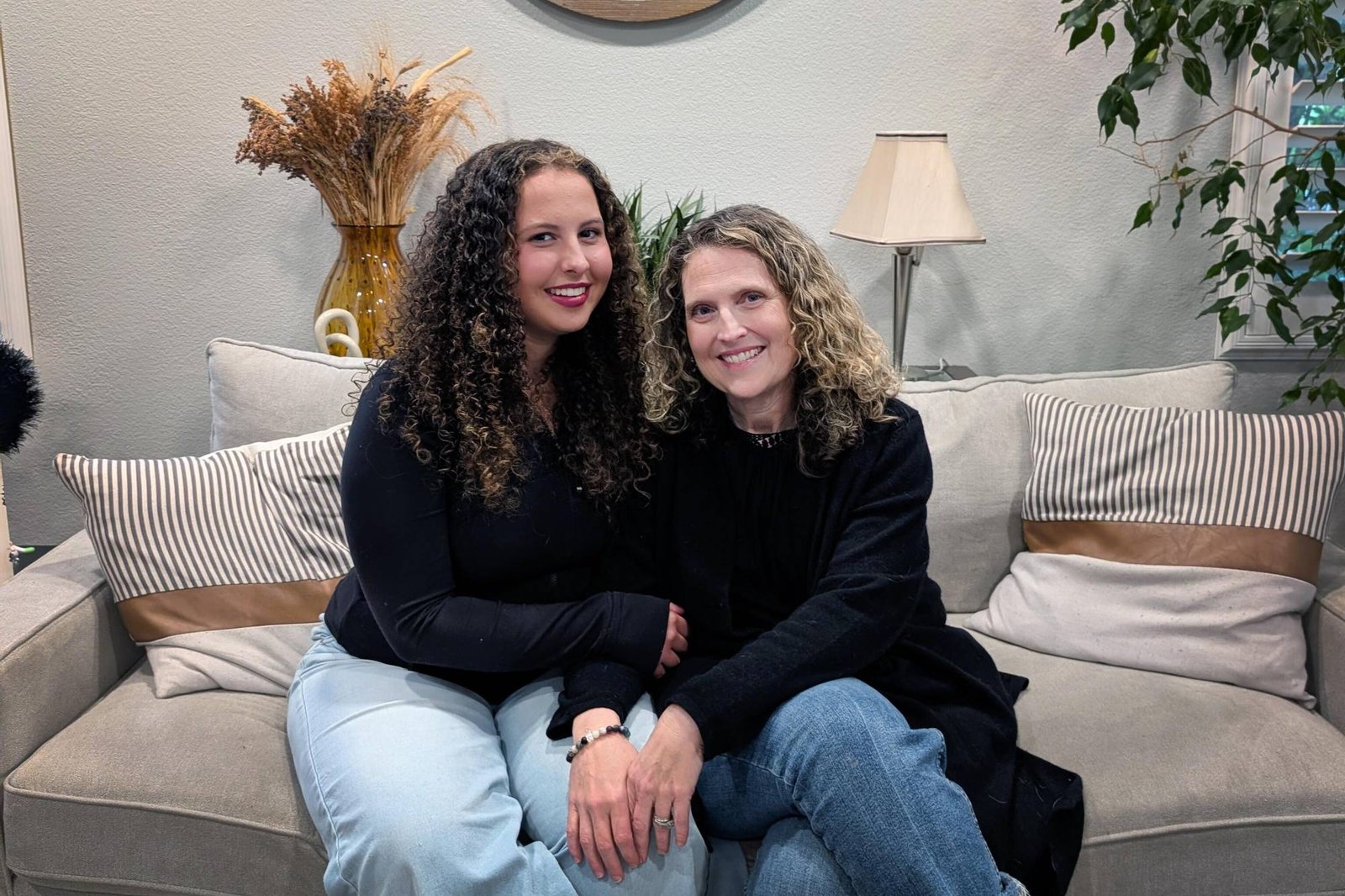
“I started getting really good grades,” she says. “It made me feel like … I’m not stupid, I have so much to say and it just made me like ‘I can do this, I can do school and I can be good at it.”
This, her mom, Heather Martin, says, is the kind of promise screens hold for students like her daughter — students she worries are being forgotten in the nationwide backlash against screens in schools. Screens are increasingly being blamed for getting in the way of student learning: More than 30 states have banned cellphones in school. Some states have gone further with proposals or policies to entirely remove screens like laptops and tablets from classrooms. In late May, the U.S. Department of Health and Human Services issued a surgeon general’s advisory warning of the “harms of screen use,” citing its effects on children’s health and educational outcomes.
Much of the pivot away from screens in schools has come from parents who are concerned screen use is getting in the way of their children’s learning — an argument Heather Martin hears in her own community in Concord, 30 miles northeast of San Francisco. She shares some of those concerns, but says, “Never once in the conversation has there been a discussion, except for me bringing it up with the other parents, about kids with disabilities.”
Advocates worry those students are also being left out of the national conversation.
Screen-time policy proposals are often “a blunt instrument”
Students with disabilities make up a quickly growing share of students in this country — there are more than 8 million of them. Many rely on assistive technology to get through the school day, including for note-taking, reading and writing. For example, blind and low-vision students may use screen reading or magnifying software to read. Others, like Soraya, use speech-to-text and audiobooks.
States including Alabama, Tennessee and Utah already have laws limiting screens that take effect as early as July.
“My concern is that that’s a really fast period of time for this to happen,” says Lindsay Jones, CEO of the Center for Applied Special Technology (CAST), an education research nonprofit that focuses on making learning environments accessible.
Jones points out that some of these laws do make exceptions to restrictions on screens for students with disabilities — often a line in the text mentions assistive technology. But she says that should be the bare minimum and worries many policy proposals are “a very blunt instrument.”
“They’ve moved so fast that we’ve really left our educators and our communities of people with disabilities this summer to figure it out,” she says. Perhaps with more time and input from disabled people, policies would better protect their rights, Jones adds.
Beyond concerns about state- and school-level bans on cellphones and screens, disability advocates point out that the shrunken U.S. Department of Education is far less equipped to enforce civil rights. Those rights include access to assistive technology for students with disabilities. The Trump administration also recently delayed a long-expected digital accessibility rule for public institutions, including schools.
“For some kids, the screen is their accessibility tool”
At Soraya’s high school in northern California, this past school year was the first that students’ phones were locked up in pouches for the entirety of the school day — as they are in many schools across the country. Heather Martin worries the phone ban could open the door to a broader ban on screens at her daughter’s school.
“A completely screen-free environment feels like it’s throwing the baby out with the bathwater,” she says. “It’s not looking at ‘screen free’ versus ‘accessibility free.’ And for some kids, the screen is their accessibility tool.”
As she talks about the change at her school, Soraya tenses up. “I hate them,” she says of the locked pouches. She says her phone isn’t just a distraction, it’s a safety net to call her parents if she has a panic attack, for example. And she feels singled out when she has to ask to get her phone out of its locked pouch for note-taking.
Soraya’s individualized education program (IEP), a legal document that outlines the accommodations and modifications she is supposed to receive at school, says she can use her phone for note-taking, along with other assistive technology. But because the cellphone ban is new, her teachers are still adjusting. Because she has several different classes and teachers throughout the day, she says it’s easy for some teachers to be unfamiliar with her accommodations.
This is the kind of “unintended consequence” Jones worries about as she considers a near future in which more schools move away from technology that she says has been game-changing for people with disabilities. When technology is used intentionally, she says, it can “actually allow us to create much more flexible environments, and those are really needed for people with disabilities.”
Jones’ organization, CAST, invented an educational framework called Universal Design for Learning that encourages educators to design their classrooms to account for the different ways students learn. For instance, a teacher might give a math lesson using blocks, a diagram and a video to help impress the same lesson upon diverse learners. Or perhaps class reading is provided as an e-book so students with low-vision can magnify the text, while those with dyslexia can listen.
As screen limits ripple through the nation’s schools, Jones hopes people with disabilities aren’t forgotten. “We need educators, we need people with disabilities, we need assistive technology providers,” to weigh in on how such policies are implemented in the classroom, says Jones. “That is going to be the best way forward for everyone to achieve their goals without trampling on people’s rights.”
For Soraya, using these kinds of tools has led her to embrace her learning differences. In fact, she just finished researching and writing a series of essays exploring how people with dyslexia learn. She has straight As for the first time in her life, but more importantly, she says she can express herself in a deeper, more meaningful way.
“I have so much more to say … It made me feel more confident in myself.”
