


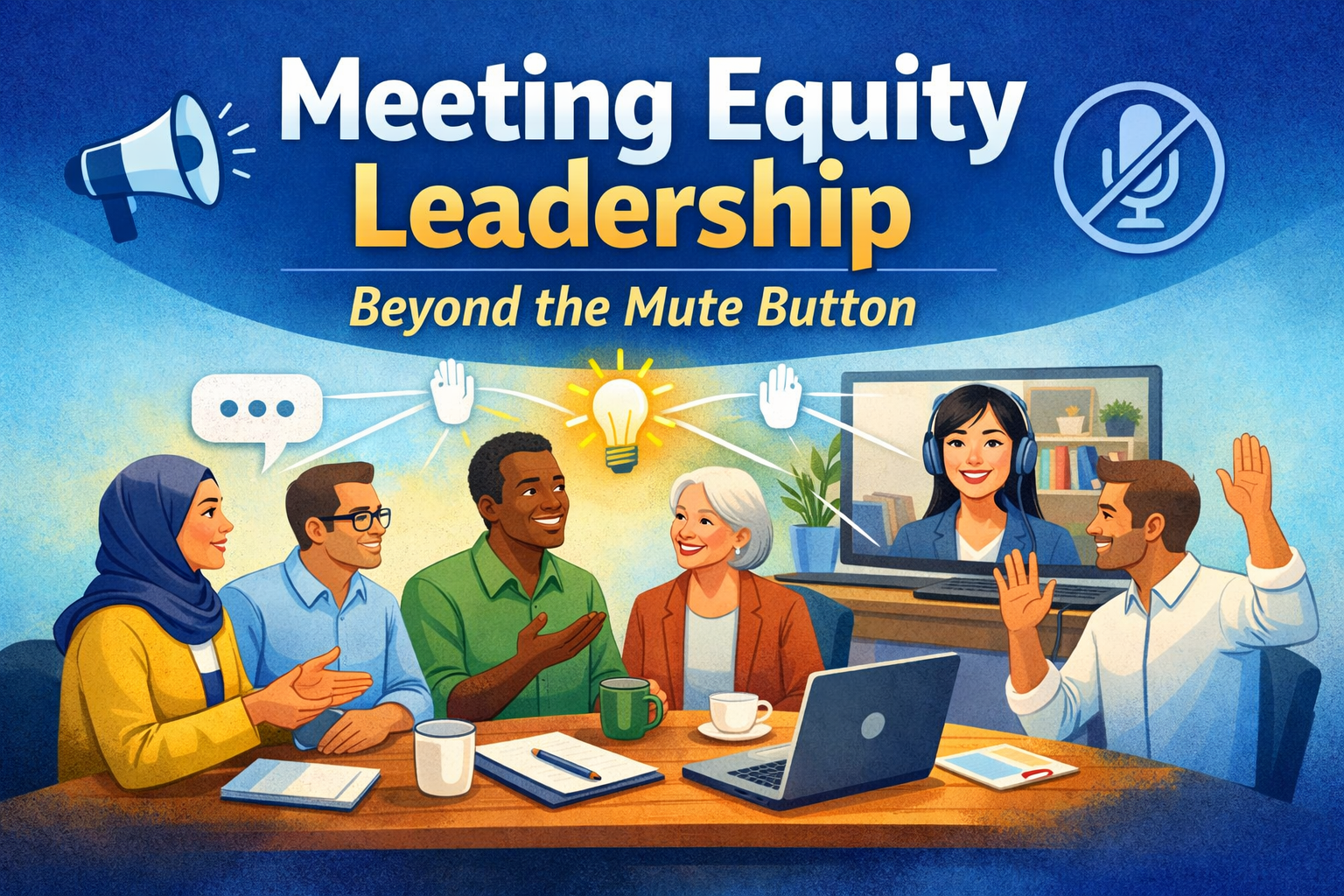
Introduction: Why Some Voices Still Stay Muted
Have you ever sat in a meeting where a few people dominate while others quietly disappear into the background?
Maybe you’ve seen it in online calls—cameras off, mics muted, ideas unspoken. Or in physical rooms where hierarchy silently decides who gets heard. You nod along, but deep inside, you wonder—Is this really collaboration?
This is exactly where Meeting Equity Leadership comes in.
In today’s rapid fire age, hybrid work culture, meetings are everywhere. Yet, most of them fail to create equal participation, psychological safety, and shared ownership. According to research from Harvard Business School, up to 70% of meeting time is dominated by a few individuals. That means the majority of voices remain unheard.
As a trainer working with teams across corporate and community sectors, I’ve personally seen how small changes in meeting culture can completely transform team energy. One rural women’s group I worked with went from silent participation to active decision-making—simply by restructuring how meetings were facilitated.
That’s the power of Meeting Equity Leadership.
This guide is not just theory. It’s a deep, practical roadmap backed by behavioral science, real-life experiences, and actionable tools you can start using today.
Let’s move beyond the mute button—and create meetings where every voice counts.
Meeting Equity Leadership is the practice of designing and facilitating meetings where every participant has a fair opportunity to contribute, influence, and be heard.
It combines principles from:
Key Elements of Meeting Equity Leadership
- Equal speaking opportunities
- Respect for diverse perspectives
- Psychological safety
- Structured participation
- Conscious facilitation
👉 In simple words:
“It’s not about who speaks the loudest, but who gets the space to speak.”
Let’s be honest—most meetings are not designed for equity.
Common Problems
- Dominant personalities take over
- Introverts remain silent
- Hierarchy blocks honest input
- Virtual fatigue reduces engagement
- No clear facilitation structure
Real Example from Training
During a leadership workshop, I asked a team:
“Who speaks the most in your meetings?”
Everyone laughed—and pointed at the same two people.
When I asked, “Who has ideas but doesn’t speak?”
Almost half the room raised their hands.
That’s the hidden cost of poor Meeting Equity Leadership—lost innovation.
When you implement Meeting Equity Leadership, everything changes.
1. Better Decision-Making
Diverse perspectives lead to smarter decisions.
2. Increased Engagement
People feel valued—and they show up fully.
3. Stronger Team Trust
Psychological safety builds deeper connections.
4. Innovation Boost
New ideas come from unheard voices.
5. Reduced Conflict
Everyone feels included, reducing resentment.
👉 According to research from Google’s Project Aristotle, psychological safety is the #1 factor for high-performing teams.
Let’s get practical.
Step 1: Set Clear Meeting Intentions
Before the meeting, ask:
- What is the goal?
- Who needs to speak?
- What decisions are expected?
👉 Without clarity, meetings become chaotic.
Step 2: Design Participation, Don’t Leave It to Chance
Use structured methods:
- Round-robin sharing
- Breakout discussions
- Anonymous input tools
Pro Tip:
Use digital tools like
👉 Mentimeter
👉 Mural
These encourage equal participation.
Step 3: Create Psychological Safety
People speak when they feel safe.
How to build it:
- Acknowledge all ideas
- Avoid interrupting
- Encourage dissent
- Appreciate contributions
👉 “No idea is a bad idea” is not just a phrase—it’s a culture.
Step 4: Manage Dominant Voices
As a leader, you must gently balance participation.
Techniques:
- “Let’s hear from someone who hasn’t spoken yet.”
- Time limits for responses
- Redirecting conversation
Step 5: Use Inclusive Language
Replace:
- “Does anyone have anything?” ❌
With - “Let’s hear from each person briefly.” ✅
Language shapes behavior.
Step 6: Rotate Facilitation Roles
Don’t always lead yourself.
Let others:
- Facilitate
- Take notes
- Summarize
👉 This builds ownership and confidence.
Step 7: Close with Reflection
End meetings with:
- What worked?
- What can improve?
This creates continuous improvement in Meeting Equity Leadership.
Here are some powerful tools:
ToolPurposeMentimeterAnonymous inputZoom PollsQuick engagementMiroVisual collaborationGoogle DocsShared note-taking
👉 Explore more tools at Atlassian Team Playbook
Case: Rural Women SHG Group
I worked with a Self-Help Group where:
- Only leaders spoke
- Others stayed silent
- Decisions were one-sided
Intervention:
- Introduced round-robin sharing
- Used visual voting
- Encouraged storytelling
Result:
- 80% participation increase
- Better financial decisions
- Stronger group trust
This is the real impact of Meeting Equity Leadership.
1. Social Loafing Theory
People disengage when they feel invisible.
2. Psychological Safety (Amy Edmondson)
Teams perform better when people feel safe to speak.
3. Equity Theory
Fairness drives motivation and satisfaction.
👉 Read more at Harvard Business Review
How Does Meeting Equity Leadership Work in Virtual Meetings?
Virtual meetings need extra care.
Challenges:
- Camera fatigue
- Silent participants
- Multitasking
Solutions:
- Use chat actively
- Polls and reactions
- Smaller breakout rooms
👉 Always ask:
“Who hasn’t had a chance to speak?”
Common Mistakes in Meeting Equity Leadership
Avoid these:
- Assuming silence means agreement
- Ignoring introverts
- Over-structuring meetings
- Not following up
Meeting Equity Leadership vs Traditional Leadership
TraditionalMeeting Equity LeadershipLeader speaks mostEveryone participatesHierarchy-drivenInclusion-drivenPassive attendeesActive contributorsFixed rolesShared ownership
Powerful Quotes to Remember
“Inclusion is not bringing people into what already exists—it’s creating something new.”
“A meeting is successful when everyone feels heard—not just when decisions are made.”
Practical Exercises to Build Meeting Equity Leadership
Exercise 1: 1-Minute Voice Round
Everyone speaks for 1 minute.
Exercise 2: Silent Brainstorming
Write ideas before speaking.
Exercise 3: Rotate Leader
New facilitator every meeting.
How Leaders Can Build Meeting Equity Culture
- Model inclusive behavior
- Reward participation
- Train teams regularly
- Use feedback loops
Conclusion: The Future of Meetings Is Equitable
Meetings are not just about agendas—they are about people.
When you practice Meeting Equity Leadership, you unlock:
- Hidden ideas
- Untapped potential
- Stronger teams
You move from control → collaboration
From silence → expression
From hierarchy → humanity
👉 And that’s where real transformation begins.
Thank you for exploring this insightful article.
If you’re hungry for more knowledge, don’t miss out on our other engaging articles waiting for you. Dive into our treasure trove of wisdom and discover new perspectives on related topics.
Click ‘Our Blog’ and ‘How to Guide’ to embark on your next adventure.
Happy reading!
FAQs: Meeting Equity Leadership
1. What is Meeting Equity Leadership in simple terms?
It means creating meetings where everyone gets a fair chance to speak, share ideas, and influence decisions. It focuses on inclusion, fairness, and participation rather than hierarchy or dominance.
2. Why is Meeting Equity Leadership important?
Because many meetings silence valuable voices. When everyone participates, decisions improve, engagement increases, and teams become more innovative and collaborative.
3. How can I implement Meeting Equity Leadership quickly?
Start with simple steps—use round-robin speaking, encourage quieter members, and set clear rules for participation. Small changes create big impact.
4. What are the biggest barriers to Meeting Equity Leadership?
Hierarchy, dominant personalities, lack of facilitation skills, and poor meeting design are the main barriers that prevent equitable participation.
5. Is Meeting Equity Leadership only for corporate teams?
No. It works in community groups, NGOs, classrooms, and even family discussions—anywhere people come together to make decisions.
6. How does Meeting Equity Leadership improve productivity?
By reducing wasted time, increasing engagement, and ensuring better decisions, meetings become more efficient and outcome-focused.
7. Can introverts benefit from Meeting Equity Leadership?
Absolutely. It creates structured opportunities for introverts to share ideas without pressure or interruption.
8. What tools support Meeting Equity Leadership?
Tools like Mentimeter, Miro, Zoom polls, and shared documents help ensure equal participation and engagement.
9. How can leaders measure Meeting Equity Leadership success?
By tracking participation levels, feedback scores, and quality of decisions made during meetings.
10. What is the future of Meeting Equity Leadership?
With hybrid work rising, equitable meetings will become essential for effective collaboration and team success.
Like this:
Loading…
