


Results
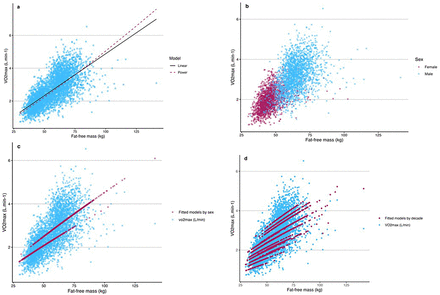
The strong, positive association between VO2max (L.min−1) and FFM (kg) is observed in figure 1a. Indeed, ignoring age and sex, the simple Pearson’s correlation between VO2max and FFM was r=0.704, compared with the correlation between VO2max and M given by r=0.385. The fitted simple allometric model parameters (log-transformed, see Eq.2) are given in table 3a.
However, this simple allometric model (table 3a) overlooks/ignores the sex and age differences in VO2max (see figure 1b, c and d). When we introduce the association between VO2max and FFM allowing for these sex and age differences using Eq.2, we obtained the parameters in table 3b.
Table 2b reveals a systematic decline in the age group intercepts (by decade), a feature clearly seen in figure 1d. Note also that the FFM exponent is b=0.658 (95% CIs 0.614 to 0.701) with an explained variance of R2=0.718 or 71.8%.
To compare the quality of fit predicting VO2max reported in table 3b using FFM alone (Eq.2), with the quality of fit predicting VO2max using M and BF% separately, we reanalysed the data using both Eq. 2 and Eq.4. The fitted parameters for FFM alone and M and BF% separately are given in table 3a and b, respectively. Note that the discrete age decline observed in table 3b was confirmed in table 3a and b but rather using the discrete age decade category reported in table 3b, we adopted a continuous quadratic age2 term, as recommended by Nevill and Cooke16 (see table 3a and b).
Table 3a gives the FFM exponent to be b=0.643 (95% CI 0.60 to 0.685) with an explained variance R2=0.727 or 72.7% and an AIC=−1986.63. Table 3b identified the M exponent to be similar b=0.636 (95% CI 0.595 to 0.678) together with a negative BF% decline c=−0.012. The explained variance in table 4b was greater than that reported in table 4a, R2=0.733 or 73.3% versus R2=0.727 or 72.7%. This difference in R2 may appear trivial; however, a more convincing model comparison (or model fit) was obtained using the AIC=−2077.4 reported in table 4b, which was considerably lower than that reported in table 3a, given as AIC=−1882.52 (difference in AIC=194.88) or in table 4a, given by AIC=−1986.63 (difference in AIC=90.77). Note that a difference in AIC between two competing models of less than 2 is insignificant; differences >2 ≤ 6, evidence for the lower model is somewhat positive; differences >6 ≤ 10, the evidence for the model with the lower AIC value is strong; differences>10, the evidence for the model with the lower AIC is very strong.17 18 VIFs were examined for all ANCOVA specifications; for the final table 4 models, all VIFs were below 3 (with the highest being 2.95 (Sex), followed by 2.64 (BF%), 2.35 (ln[mass]) and 1.13 (Age²), indicating no evidence of numerically problematic collinearity in those fitted models.
When we repeat the analysis reported in table 4a predicting Ln (VO2max) using Ln(FFM) BUT also incorporating BF% (see fitted parameters in table 4c), the FFM exponent is similar to that reported in table 4a, b=0.646 (95% CI 0.604 to 0.688), but the BF% term remained significantly negative (B=−0.003; 95% CI −0.004 to −0.003). The explained variance (table 4c) is very similar R2=0.733 or 73.3% to that reported in table 4b. This suggests that by incorporating FFM alone in the models given in table 3b, both models fail to remove all the negative/adverse effects of excessive BF%, and that a further/additional component of BF% in addition to FFM is required to be removed (−0.003) to optimally predict VO2max (see the parameters in table 4c).
To help explain the likely cause of this ‘additional’ negative BF% effect reported in table 3b and c, and to answer our secondary aim outlined in the Introduction, that is, to explore the effect that other variables have to help optimise the prediction of VO2max, we introduced some additional variables into our prediction models, some already reported by Nevill et al.19 These included three additional categorical factors (type of body fat measure, type of exercise test and active vs inactive participants) plus the two continuous predictors of FVC and WC. These ‘more inclusive’ prediction models are given in table 4a and b, the former with M and the latter with FFM as the body size dimension variables.
It appears that the estimated M exponent and FFM exponents in table 4a and b are very similar, given as 0.673 and 0.677, respectively. This supports the exponent anticipated by Åstrand and Rodahl2 who provided a plausible explanation as to why VO2max (L.min−1) of trained athletes should scale to body mass M2/3. In the current dataset, where most participants were certainly not trained athletes, provided we can adjust M and FFM for the excess body fat, the adjusted FFM or M exponents should also scale to the same exponent (b=2/3).
Clearly, the models reported in table 4a and b are reported primarily for information purposes only, providing the readers with insight into the mechanisms associated with predicting VO2max. However, these ‘more inclusive’ models are much too intricate for practical purposes. For example, details of lung function are unlikely to be available in most population studies. As such, much simpler prediction models are required to predict VO2max, see more practical additive (linear) models by Myers et al or the equivalent allometric (curvilinear) models by Nevill et al, but to include FFM or BF%, given the focus of the current study.20 21
Based on the fitted parameters in table 4b, the log-transformed allometric model becomes Ln (VO2max) = −1.173–0.235 × sex+0.636 · Ln(M) −0.0012 · BF% − 0.0000984 × age2, where sex is entered as a [0,1] indicator variable (male=0 and female=1). The prediction equation to predict VO2max (L.min−1) becomes
VO2max (L ⋅ min−1) = exp(−1.173–0.235 × sex) × M0.636 × exp(−0.012 × BF%−0.0000984 × age2). (Eq.5)
As described by Nevill et al because we are fitting a log-linear regression model (Eq. 4), if we wished to predict the ratio standard VO2peak (L·kg−1·min−1), all the fitted parameters in table 4b would remain the same with the exception of the log-transformed body mass term, which would simply become Ln(Mass) = (0.636–1) = −0.364.22 Algebraically, this result can be derived simply by dividing both sides of Eq. 5 by Mass, or by taking Ln(Mass) from both sides of Eq. 4, resulting in the following allometric prediction equations,
VO2max (L ⋅ kg−1 ⋅ min−1) = exp(−1.173–0.235 × sex) × M−0.364 × exp(−0.012 × BF%−0.0000984 × age2),
or weight-related VO2max (mL ⋅ kg−1 ⋅min−1) as follows:
VO2max (mL ⋅ kg−1 ⋅min−1) = 1000 × exp(−1.173–0.235 × sex) × M−0.364 × exp(−0.012 × BF%−0.0000984 × age2). (Eq. 6)
Repeated 10-fold cross-validation (50 repeats) confirmed stable out-of-sample performance of this prediction model (mean cross-validated R² = 0.794 and RMSE=0.163 on the ln(VO₂max) scale). For example, a 20-year-old male who weighs 80 kg (mid-range weight) and has 25% body fat, the equation (Eq. 5 and Eq. 6) predicts his VO2max to be 3.58 (L ⋅ min−1) and 44.72 (mL.kg−1.min−1), respectively. Similarly, a 50-year-old female weighing 120 kg (overweight) with 35% body fat, the equations predict her VO2max to be 2.64 (L ⋅ min−1) and 22.0 (mL.kg−1.min−1), respectively. Download the following excel sheet to illustrate these examples interactively (https://doi.org/10.6084/m9.figshare.30306631). Note that the additive model reported by Myers et al predicted the same two individuals to have VO2max = 49.75 and 13.17 (mL.kg−1.min−1), respectively.20 Using the linear model proposed by Myers et al, results in an over-estimation of the mid-range or average weight male but an under-estimation of the (overweight) female.20 The need for non-linear models such as the power-function curves can be clearly seen in figure 2a and b, respectively.
The association between maximum oxygen uptake (VO2max) (mL.kg−1.min−1) and body mass (kg) using linear and power function models for (a) male and (b) female participants.
