


Sue Smalley, PhD, used to consider herself a “staunch materialist.”
“I thought the only thing that mattered was the material world and … (was) extremely anti-everything outside the lens of science,” said the UCLA behavioral geneticist.
In other words, she’s the last person she would have expected to extol the consciousness-shifting power of meditation. Dr. Smalley poured herself into the practice after being diagnosed with melanoma in 2002 and said she experienced a “bliss state” so profound, she was inspired to study the science of mindfulness.
After taking a sabbatical, Dr. Smalley returned to UCLA and got permission to turn an old Xerox room into a meditation room, which drew a few like-minded colleagues.
“We started meeting secretly,” she said with a laugh.
That led Dr. Smalley to connect with a colleague interested in exploring how mindfulness practice might impact young people with ADHD. Together, they met Diana Winston, a meditation teacher who’d written a book on mindfulness for teens.
After working together on the study, Dr. Smalley recruited Winston to be the founding teacher at UCLA’s newly established Mindful Awareness Research Center (MARC). Winston now leads UCLA Mindful as part of UCLA Health, and Michael Irwin, MD, continues to head research at MARC in the Jane and Terry Semel Institute for Neuroscience and Human Behavior. UCLA is celebrating 20 years of mindfulness in 2026.
Over the past two decades, the two centers have supported dozens of research studies, offered hundreds of mindfulness classes to the public, trained more than 500 mindfulness facilitators internationally, created an app that offers guided meditations in 20 languages and developed programs to support UCLA students and UCLA Health patients and healthcare providers.
“If I went back in time to the young woman who was meditating in a monastery in Asia in the late ‘80s and told her what was going to happen, she would fall out of her seat,” said Winston, who discovered meditation as a college student and spent a year as a Buddhist nun.
When MARC was first established, mindfulness was still a mysterious concept to many, she said.
“I felt like I was just knocking on doors and saying, ‘Hey, there’s this thing called mindfulness and it’s really helpful,” and people would cautiously let us in,” Winston said. “Now it’s become a kind of household name.”
An ancient practice originating in Vedic and Buddhist traditions, meditation gained popularity in the West in the 1960s and ‘70s. The Beatles famously studied Transcendental Meditation at an Indian ashram in the late 1960s. American practitioners including John Kabat-Zinn, who would go on to develop Mindfulness-Based Stress Reduction at the University of Massachusetts Medical School, helped secularize Buddhist teachings and make them accessible to Westerners.
But UCLA’s mindfulness center was groundbreaking in offering continuing public education in mindfulness and free guided meditations in multiple languages, Winston said.
Here’s a look at some of the work MARC and UCLA Mindful have done over the past 20 years and a peek at what’s to come.
Mindfulness research
Winston and colleagues, including longtime friend and retired UCLA professor Marvin Belzer, PhD, developed Mindful Awareness Practices (MAPs), MARC’s flagship public educational programs. Thousands of people participated in these evidence-based, six-week courses, which offered an introduction to mindfulness as well as more advanced instruction in cultivating positive emotions, developing self-compassion and fostering mindfulness in relationships.
The level-one MAPs course, Introduction to Mindfulness, taught participants basic mindfulness principles — learning to pay attention to present-moment experiences with openness, curiosity and a willingness to be with those experiences — and how to build a daily practice. Researchers have examined the effects of this six-week program on such populations and conditions as:
Julienne Bower, PhD, a researcher with the Department of Psychiatry and Biobehavioral Sciences, the Cousins Center for Psychoneuroimmunlogy and the UCLA Health Jonsson Comprehensive Cancer Center, has conducted multiple studies exploring the effects of mindfulness on breast cancer survivors and other populations.
These include a randomized trial conducted in partnership with colleagues at Johns Hopkins and Harvard universities that found that mindfulness training for young breast cancer survivors reduced depressive symptoms, improved fatigue and insomnia, boosted well-being and had a positive effect on inflammatory biology. Dr. Bower is currently working on another nationwide study investigating whether delivering mindfulness instruction to breast cancer survivors through a self-paced app is as effective as an online group class. She is also co-leading a study examining the effects of mindfulness training on UCLA undergraduate students experiencing sleep problems.
Having access to a mindfulness center at the university — and the expertise of Winston and Dr. Belzer — helps make these studies possible, Dr. Bower said.
“It’s just completely enabled us to do this research,” she said. “To be able to get that kind of expert input and guidance has been instrumental.”
The UCLA Mindful app
In 2017, a MARC student suggested the center create an app. A few years later, the UCLA Mindful app was born, and has logged more than 750,000 downloads to date.
Free and accessible globally, it offers guided meditations in 20 languages, including basic practices, meditations for pain and sleep, as well as lectures and live meditations updated weekly. No subscription is required to access the ad-free content, which is provided by Winston, Dr. Belzer and other UCLA Mindful teachers.
The app is regularly recommended by healthcare providers at UCLA Health and is on the bedside tablets at all UCLA hospitals and the University of California, San Francisco Medical Center. It has been studied for its effects on compassion fatigue among family caregivers. Researchers found that daily use of the app for six weeks resulted in a significant reduction in stress and a “marginal” reduction in depression and anxiety.
Mindfulness in healthcare
UCLA Mindful is further expanding into serving the healthcare population with new programs for patients and providers.
Winston and colleagues have created a program for UCLA Health patients called “Mindfulness and You” set to launch by the end of 2026.
Designed for both inpatient and outpatient populations, the six-module video course will be available for free on hospital room tablets in Westwood, Santa Monica and West Valley. Patients who are not hospitalized can access the program on their own devices for a fee, Winston said. A live, online version will be introduced in 2027, she added.
The center has also been running a program for physicians called “Building Emotional Strength Training.” Aimed at reducing stress and physician burnout, it teaches mindfulness basics and helps cultivate the emotional qualities of kindness, compassion, equanimity and joy, Winston said. More than 70 physicians have participated in the six-session, hourlong lunchtime program so far. The center is collecting data about the program’s utility and ultimately plans to make it available to all healthcare providers at UCLA Health, she said.
Making mindfulness accessible
Since its inception, UCLA’s mindfulness center has championed what Dr. Belzer calls “radical accessibility,” offering free and low-cost mindfulness instruction to people in Los Angeles and beyond.
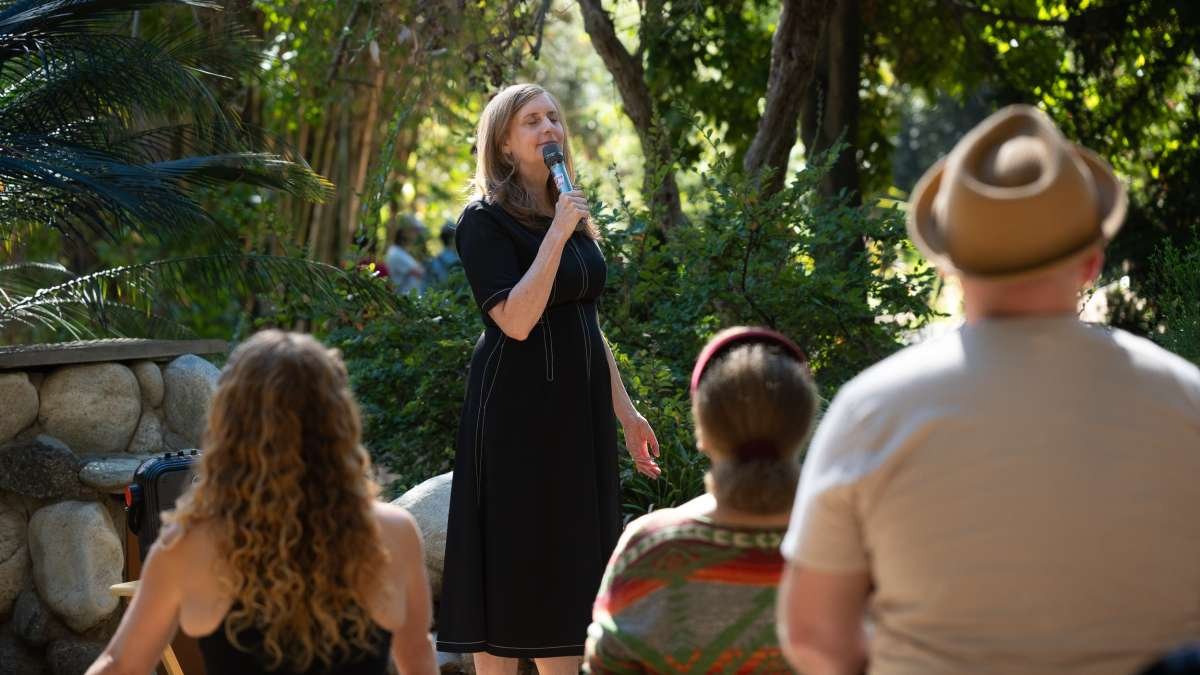
In that spirit, UCLA Mindful recently offered a free Day of Mindfulness to celebrate 20 years of mindfulness at UCLA. Held online and on campus, the event drew close to 500 registrants, who participated in guided meditations and activities including walking meditation, forest bathing, qigong, mindful photography and relational mindfulness.
The center also continues to offer myriad free programs, including drop-in meditations three times a week and a weekly 90-minute class that includes lectures and practice. There are also self-paced digital courses, occasional retreats for more extended practice, and more in-person offerings planned for 2027, Winston said.
As public and academic interest in mindfulness continues to grow, Dr. Smalley reflected on UCLA’s role in making the practice more accessible. Establishing the Mindful Awareness Research Center set the stage for more scientific research and more public interest, she said.
“That was a big accomplishment at this university, to make it not too weird,” she said. “And I remember when we were teaching the early-stage classes, I overheard a person from the community come in and say, ‘If UCLA says it’s OK to meditate, then I’m going to try it.”
