


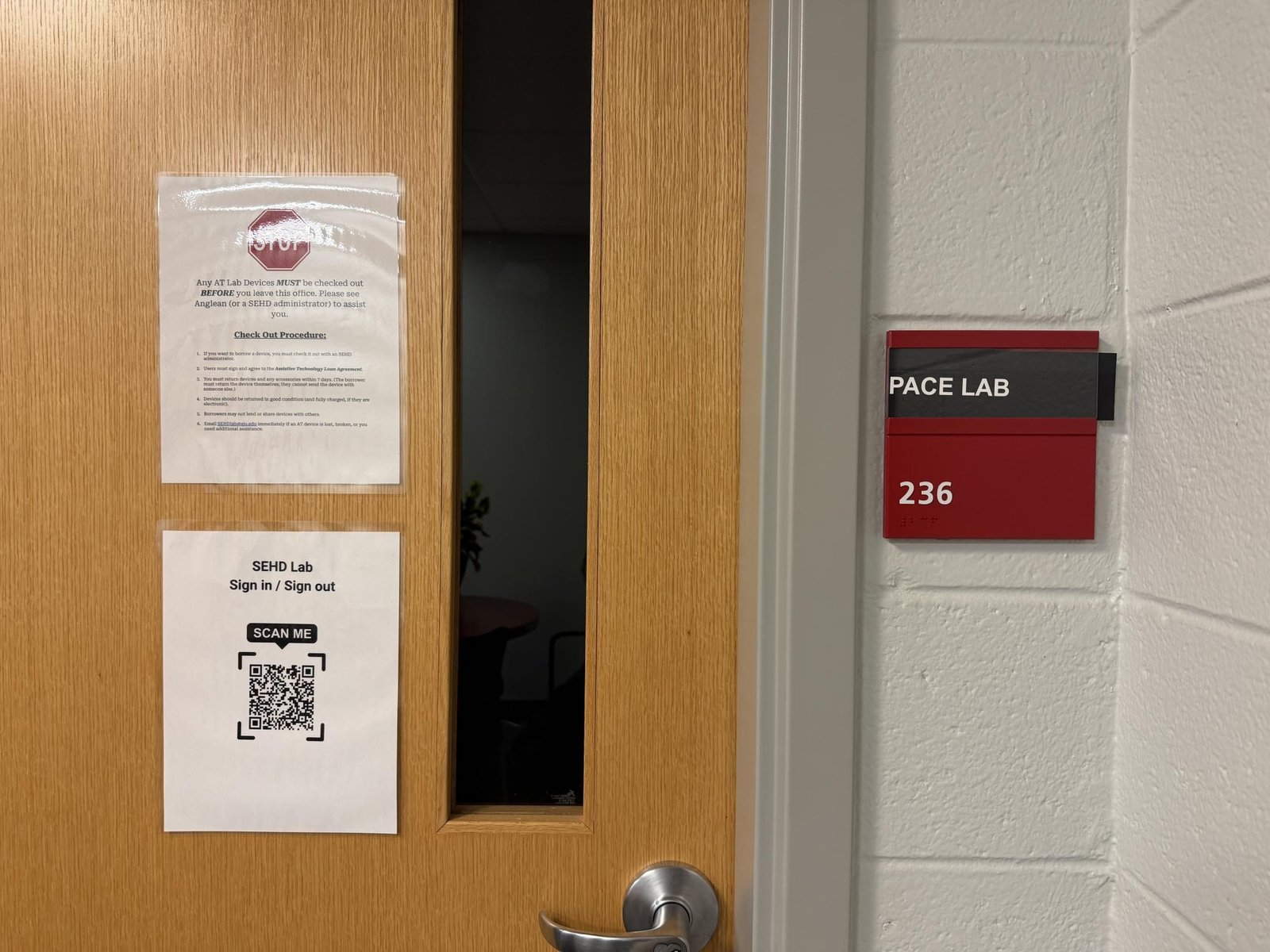
This semester, the Pathways to Authentic College Experiences program funded a new assistive technology lab, open to all members of the St. Joe’s community.
Located in Merion Hall 236, the lab contains over 50 different augmentative and alternative communication systems, assistive technology and assessments, including a desktop computer which offers accessible software such as Kurzweil, Dragon, Fusion, TDSnap and Boardmaker, according to an email to The Hawk from Megan Coleman, administrative assistant for PACE.
AAC is used by non-speaking individuals with disabilities to aid in communication, and refers to devices or technology that help people with disabilities with working, learning and other daily tasks, according to Kaitlyn Martin ’16, program director for PACE and adjunct professor in the department of teaching, learning and behavioral studies.
Martin said the PACE program wanted the lab to provide a variety of technology for students with diverse needs, and to prepare future teachers.
“Part of PACE is we’re working with people with disabilities, so we have a passion for also ensuring that the next generation of teachers can work with students like people in the PACE program,” Martin said. “So, we wanted a wide variety of tools so that people, students and even professors in the School of Education and Human Development, could have access to this technology, so they could be better teachers.”
Martin said the lab was funded by an unexpected extension to one of PACE’s grants. Along with Mollie Sheppard, Ed.D., department chair of teaching, learning and behavioral studies, Martin decided to put the grant toward expanding accessibility on campus.
Martin then reached out to Jennifer Kleinow, Ph.D., clinical associate professor in the department of educational leadership and human services and director of the graduate speech-language pathology program, which will begin in the fall 2027 semester, for help coordinating the lab.
PACE then identified the different AAC and AT objects that could be purchased for the lab, and it opened at the beginning of this semester.
Renting out equipment from the lab is free, Martin said. The rental process includes scanning a QR code to access a sign-out sheet, taking the equipment to the front desk and signing a borrower agreement. Rental periods last up to one week.
Kleinow wrote in an email to The Hawk that AT “can help remove barriers to fully engaging in the academic community.” Kleinow incorporates AT into her own classes by including captions on videos and creating PowerPoint presentations that can be read by a screen reader.
“My philosophy is that if something is helpful for one student in a class, it’s generally helpful for many students in the class,” Kleinow said.
Martin said she has implemented “Tech Fridays” into her Introduction to Special Education class. Every couple of weeks, Martin brings a box of assistive technology from the lab and lets students practice using it and apply what they’ve learned about that technology in class.
Kleinow said it’s important for students to get this practice.
“It lets people practice with novel tech in safe, non-judgmental environments,” Kleinow said. “Maybe a student will have a new idea for a tool that hasn’t been developed yet.”
Meredith McKenna ’27, a dual major in early education (PK-4) and special education (K-12), is currently student teaching in a learning support classroom and has students with varying needs. Her classroom focuses on inclusion and creating the “least restrictive environment” for students, she said, and AT helps them do this. While substituting in other classrooms, McKenna said she has also encountered students who use AAC.
“I’ve had students who use devices and different boards to communicate, and it’s helped them so much,” McKenna said. “Even when I don’t even know them, if I sub and I’m able to communicate with them because they have these technologies, and without them, like some of them are nonverbal, how would I be able to communicate?”
McKenna added that she has seen firsthand how access to AAC specifically has helped students progress toward their goals.
“I’ve seen it and I believe it,” McKenna said.
PACE does not yet have data for the number of rentals from the lab so far, but Martin said the number is increasing with faculty incorporating the technology into their classes.
As more people learn about the lab, Martin said she hopes people outside of the PACE program and SEHD begin to utilize it, including those in nursing, physical therapy and occupational therapy. Fostering “intercollaboration” between these programs, she said, will benefit everyone involved.
“I think having the lab here really starts the conversation of how we support people with disabilities from infancy to adulthood,” Martin said.
