


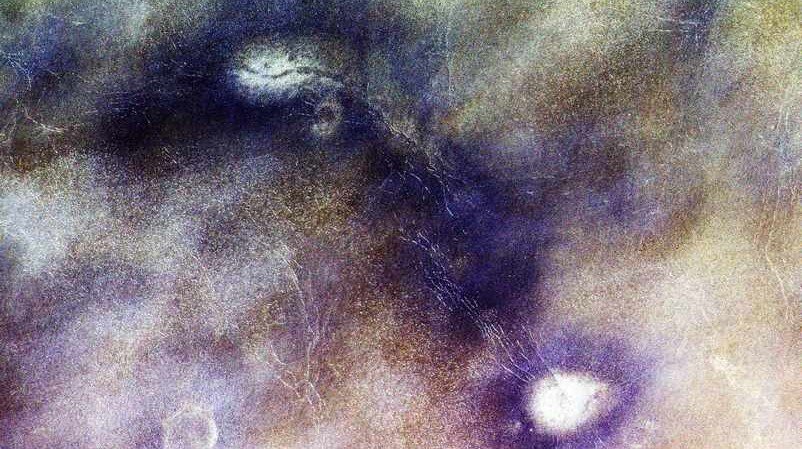
This image shows a region of Mars lying on the northern flanks of the Alba Mons volcano. The white spots may be caused by deposition around vents where magmatic gases may be escaping from Mars’s interior – ESA/TGO/CaSSIS, CC BY-SA
“It was like looking for a needle in a haystack.”
That’s how Professor Daniel Mège described the discovery of trace volcanic gases on Mars that could be key to finding life on the Red Planet.
The discovery centers around hydrogen chloride gas seeping out through volcanic rifts—something of a “smoking gun” that suggests Mars is not geologically dead, but merely sleeping.
These gases hint at magma, which, when coming into contact with groundwater can produce warm habitable niches for organisms beneath the Red Planet’s surface.
“If hydrothermal systems are active, they could contain the ingredients and energy needed for microorganisms to develop, and shield microorganisms from the hostile and changing environment above the surface,” one of the scientists behind the discovery hypothesized.
Mars is studded with the largest volcanoes in the solar system, and fresh fissures on the surface of one of the largest, called Alba Mons, hint at volcanically active spots under the surface.
Detected by a European Space Agency (ESA) orbiter, an international research team believes that the release of hydrogen chloride from these fissures comes from hot magma beneath the surface.
The ExoMars Trace Gas Orbiter (TGO) first reported hydrogen chloride gas in the Martian atmosphere in 2021. The gas is commonly found escaping from magmatic vents on Earth, leading researchers to wonder whether the same was happening on Mars.
Evidence for active volcanism on Mars has always been extremely elusive, yet enough has been identified in the form of geologically-recent lava flows and “marsquakes” over the last 50 years, so as never to rule it out.
Now again, researchers noticed spikes of hydrogen chloride where they shouldn’t have been, and during an odd season in the northern hemisphere of Mars.
Study co-leader Professor Daniel Mège, from the Space Research Center of the Polish Academy of Sciences, said the gas varies seasonally on Mars, reaching its maximum in the northern winter, then mostly disappearing in the summer.
– credit, MEX/HRSC global color mosaic, ESA/DLR/FU Berlin, G. Michael. Inset: Blended MOLA-HRSC digital elevation model, Fergason et al 2018
But there was one exception to the pattern, always in the same season and at the same place: above volcanic fissures on the flanks of the Alba Mons volcano, in early summer.
A close look at the Alba Mons region using TGO’s infrared spectroscopy instrument showed fresh and narrow fissures, in some cases hundreds of yards in length, associated with color changes on the surface.
– credit, ESA standard license
The new discovery, published in the journal Science Advances, is the result of combined atmospheric and geological analysis, and professor Mège cleverly called it “a smoking gun.”
THE MARTIAN TIMES: Mars Perseverance Rover Completes a Marathon on Mars to Cap Off Extraordinary 5 Years
“It’s truly amazing that it spotted a handful of molecules from a perhaps intermittent source, whilst moving continuously along its orbit to monitor the whole Martian atmosphere,” said the scientist. “It was like looking for a needle in a haystack.”
Their paper introduces the idea that magmatic gases might be rising through the fissures on Alba Mons. The research team believe the discoloration around the fissures could come from deposits left behind by gases escaping from Mars’ interior.
“Looking at the spatial distribution of the seeping, it became instantly obvious to me that there was something volcanic behind it, but it had to be demonstrated,” said Mège.
“A huge part of the work consisted of examining all the possible chemical processes going on in the Martian atmosphere. We needed to be rigorous, critical, and creative to explain the presence of hydrogen chloride.”
MORE STORIES LIKE THIS: Water Detected on Mars Could Harbor Life 12 Miles Underground
The team suggests that the seepage is connected to a dormant magma chamber, a type of volcanic plumbing system under the Martian surface.
“Looking for Martian life in the seeping fissures of the Alba Mons region would make a lot of sense,” said Mège.
Dr. Colin Wilson, European Space Agency project scientist for the ExoMars TGO, hailed the findings as potentially “TGO’s greatest success yet.”
WATCH a video explainer below…
SHARE This Great News From The Red Planet With Your Friends…
