


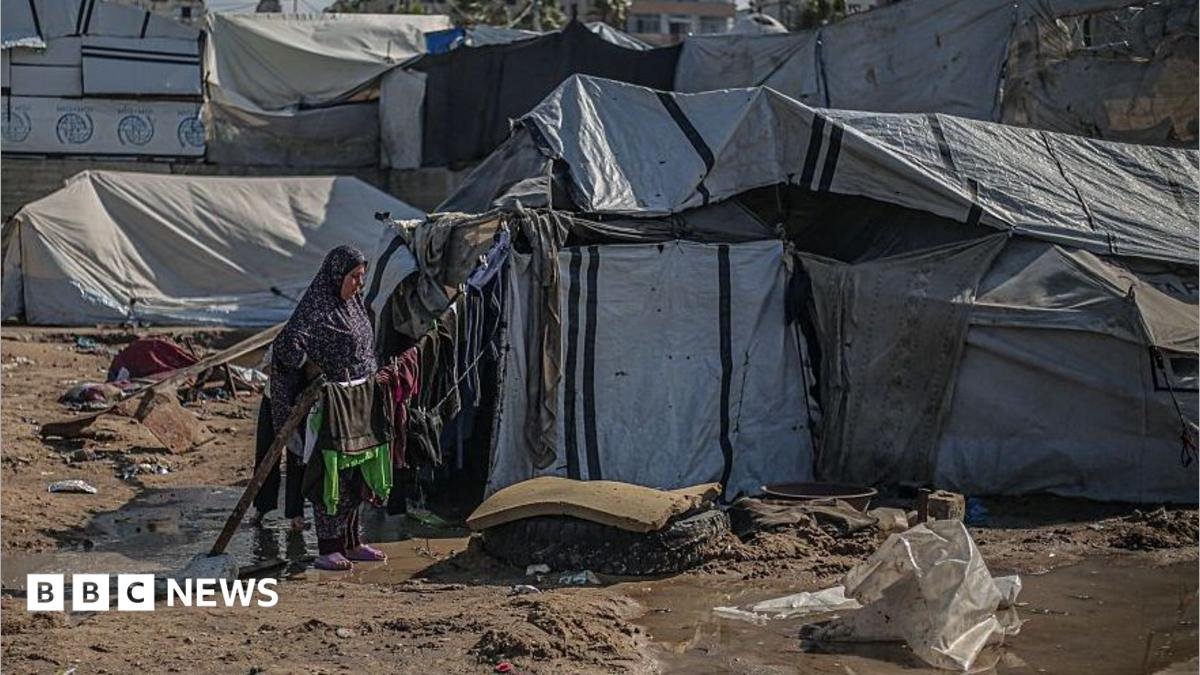
In rare criticism of Israel, the Board of Peace said it had been urging the Israeli government to authorise the entry of essential goods for temporary shelter and water and sanitation infrastructure.
The Board added that delays in approving the entry of supplies “exacerbated the consequences of a foreseeable humanitarian challenge” and delayed the start of decommissioning weapons and transferring Hamas authority to a transitional government.
It also said Hamas’s failure to disarm and transfer power had compounded the difficulties facing Gaza’s civilians.
The UN’s humanitarian agency OCHA said more than 150,000 tents were outside Gaza ready to go in, but aid efforts were constrained “by Israeli restrictions on the entry of supplies and equipment and funding shortfalls”.
UN humanitarian coordinator Ramiz Alakbarov said on Monday that stocks of essential shelter and winter items inside Gaza had been exhausted.
“Israeli authorities must immediately lift all restrictions on entry of the supplies,” he said, adding “we have run out of time”.
Israel’s foreign ministry spokeswoman Michal Maayan on Monday said Israel had in recent months put in place a winter plan in coordination with the Board of Peace and international charities.
That plan has brought in more than 91,000 tents and 8,200-plus trucks with tarpaulins, blankets, winter clothing, and other equipment, according to Cogat, the Israeli military body responsible for aid.
Cogat said it would not allow in equipment that could be used for military purposes.
Maayon accused Hamas of hoarding aid, saying: “Hamas is responsible for the delays in making more progress in the Strip, and winter-related hardships are a consequence of Hamas’s action and policy.”
In response to the Board of Peace, Hamas said in a statement published on Palestinian media that its comment “presents a distorted account of the causes of the disaster”. The group denied it was responsible for ceasefire delays, pointing to a statement in August , externalfrom Egyptian, Qatari and Turkish mediators that accused Israel of violations.
Hamas said Israeli restrictions prevent the entry of materials necessary for shelter and recovery – and added the Board as the ceasefire implementor should look at its own “serious shortcoming”.
Under the deal to end the two-year-long war in October 2025, Hamas agreed to give up governance and its weapons in exchange for a phased Israeli troop withdrawal from the 60% of Gaza it still occupied. Israel, however, has insisted Hamas must fully disarm before withdrawal.
The dispute has left the next stages of the peace plan stalled, with both sides blaming each other.
The war in Gaza began after the Hamas-led attack on Israel on 7 October 2023 when around 1,200 people were killed and 251 others taken hostage.
The Israeli military campaign in response has killed 74,645 people, according to the Hamas-run health ministry, whose figures the UN considers reliable. More than 1,600 people have been killed since the ceasefire in October last year.
Israel says six of its soldiers have been killed in Gaza since then.
