


– credit, Lars Görze MA / Hesse State Office for Monument Preservation
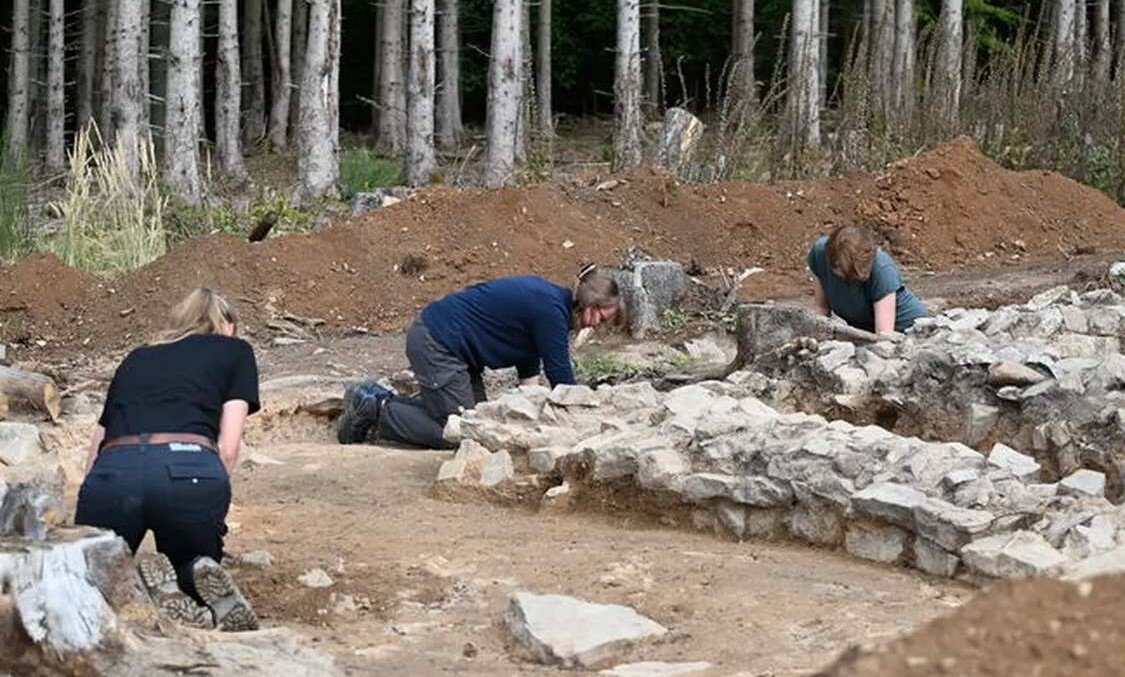
Along a series of Roman fortifications cutting across Germany just north of Frankfurt, archeological excavations have revealed extensive floorplans belonging to a temple, a military camp, and craft center.
The discovery, lying in wait just a few inches beneath the soil of the forest, provides extensive insight into what life was like along this frontier, as well as the area’s use following their abandonment.
Since 2024, Hessian state archeologists and colleagues from the University of Frankfurt have been excavating Kapersburg—a Roman fort located in the foothills of the eastern Taunus Mountains.
Kapersburg is located along the Upper Germanic-Rhaetian Limes, a 342-mile fortified border stretching from the Rhine to the Danube that marked the end of Rome’s military and cultural influence. Designated a UNESCO World Heritage Site in 2005, the limes have produced dozens of important archeological discoveries.
“We have conservation layers here that are otherwise unparalleled in Hesse, because no agriculture has passed over them,” Dr. Kai Mückenberger, a state archeologist with the title “Limes Coordinator” said in a translated statement.
“The forest has preserved everything over the last few centuries and largely preserved it for us in such a way that we find layers that are otherwise always gone.”
Most recently, the Hessian archeologists turned up the military camp, called a vicus, where a troop that held Kapersburg would have lived. Inside the vicus, archeologists found the floorplans of living areas, craft centers, and a temple that’s now believed to have been dedicated to Mars, the god of war.
– credit, Lars Görze MA / Hesse State Office for Monument Preservation
The rectangular temple was about 16 feet long, and contained a smaller, three-walled room at its center where worship would have taken place. Inside, inscriptions make reference to Mars, while fragments of a statue of Victoria, the Roman goddess of victory with her wings and laurel wreath, were found on the site.
ROMAN NEWS, CLOSER TO HOME: Hall of Peacock Frescoes Restored at Pompeii Villa Belonging to Emperor Nero’s Wife
Victoria and Mars were often worshiped together, both by Romans in general, and particularly among the military for obvious reasons.
The temple captures how long-lived Kapersburg was. Built during the reign of either emperor Trajan or Hadrian, it held the frontier for 150 years, much of the time via the strength of a military unit called “Numerus Nidensium.”
The “Nide” in “Nidensium” referred to a nearby Roman settlement called Nida, which would become a quarter of Frankfurt now called Heddernheim. Numerus Nidensium is believed to have numbered around 160 soldiers, with the vicus hosting perhaps as many as 700 support staff and hangers-on.
ROMAN NEWS, FAR FROM ROME: Luxurious Bath Complex Used by Roman Emperor Found in Serbia
Further exciting new insights were made into the history of the vicus before its abandonment in the 3rd century. Extensive remains of craft activities were discovered, including the area of a blacksmith’s shop. Evidence was also found that the Romans leveled part of the camp village and later replaced it with residential development.
SHARE This Great Discovery And The Insights It Will Provide…
