


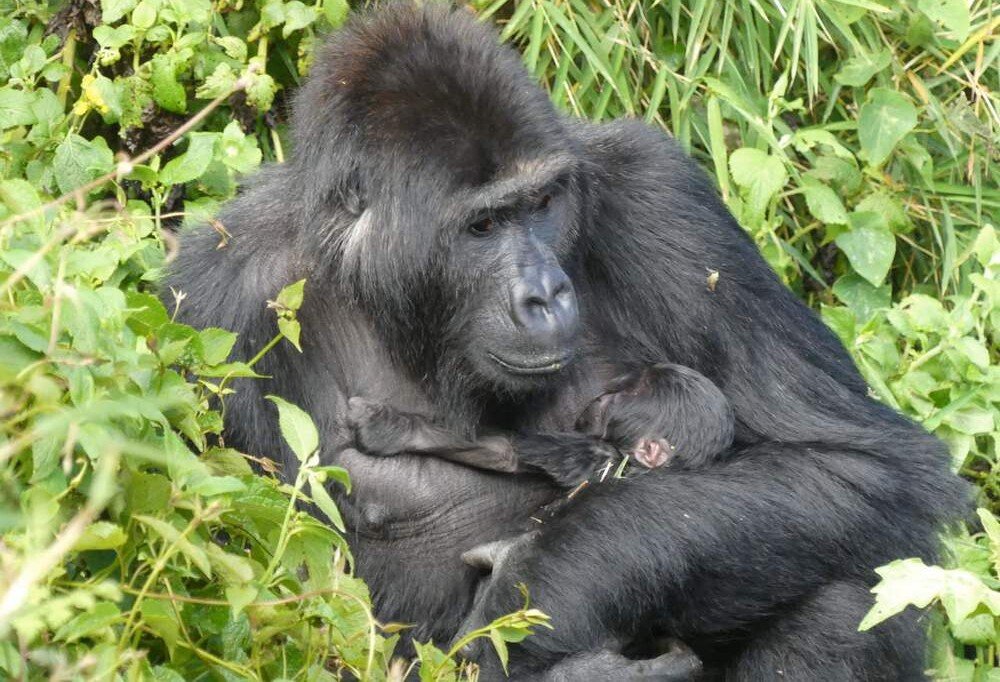
Lulingu and her infant – credit, Rewild, released
One of the first-ever eastern lowland gorillas to be successfully returned to the wild gave birth on May 21st in her new/old home of Virunga National Park in the Democratic Republic of the Congo (DRC).
Every new gorilla infant is its own conservation success story, but coming as the baby has from a mother who was almost cut off from her mountain home entirely, it becomes all the more special.
The mother, Lulingu, was one of four female gorillas moved at the end of 2024 from the GRACE sanctuary for rescued gorillas in North Kivu province to Virunga. Her baby was fathered by a wild silverback living on Mount Tshiaberimu, a sign that Lulingu had successfully integrated into the wild population.
Rescuers recovered Lulingu when she was just 18 months old after being taken from her family and sold into the illegal wildlife trade. She was the youngest orphaned gorilla ever brought to GRACE, the only sanctuary in the world for rescued eastern lowland gorillas.
GRACE provided Lulingu with around-the-clock care before another gorilla, Pinga, took over as her surrogate mother and welcomed her into the larger gorilla family at GRACE. That family included Mapendo, Ndjingala and Isangi—the other 3 females who would eventually return to the wild.
The release of these 4 females, all of whom have joined the silverback’s family group, was the culmination of a more-than-5-year rewilding process led by GRACE, Virunga National Park and local communities, with support from Gorilla Doctors, and Re:wild.
“This is a milestone for the gorillas,” said Katie Fawcett, executive and science director of GRACE Gorillas. “They’ve adjusted to living in the wild extremely well so far, but raising an infant in the wild can be a challenge even for experienced mothers. We’re cautiously optimistic that Lulingu will navigate motherhood well and that the baby will continue to survive. No matter what happens, this is another historic first for eastern lowland gorilla conservation.”
The birth is also an important step toward the conservation project’s central goals: providing a critical genetic boost to the small and isolated gorilla population on Tshiaberimu.
A gorilla monitoring team has been tracking the family group closely since the 4 females were released into the wild in December 2024 and has observed them mating with the dominant male. In addition to monitoring the gorillas’ feeding behavior, the team has been collecting urine samples non-invasively from leaves and using human pregnancy tests to detect elevated levels of hormones associated with pregnancy.
“None of the 4 females have required veterinary treatment for illness or injury since being rewilded—the outcome we always hope for,” said Dr. Cedric Kibengo, a field veterinarian with Gorilla Doctors involved in the reintroduction effort from the start. “With the arrival of Lulingu’s infant, we now have one more ‘patient’ under our care, and both mother and infant are healthy and doing well.”
CONGO’S WILDLIFE: New Species of Monkey Found in DR Congo Shows How Much There’s Left to Discover
Lulingu has already navigated a series of firsts since returning to the wild, adapting to a new habitat, diet, and social environment. These successes have made the monitoring team optimistic as she navigates another first: raising an infant.
“We have seen her nursing, cradling, and playing with the baby. The other young gorilla in her group has shown interest in the baby, and Lulingu has been very patient with him,” said Benoit Ishaba, park ranger, and head of gorilla monitoring on Mt. Tshiaberimu.
Lulingu’s new infant is also giving scientists and conservationists a rare opportunity to observe a rewilded eastern lowland gorilla raising her first infant and to better understand how the reintroduced females respond to and interact with a new baby.
MORE PRECIOUS CARGO: S. Carolina Aquarium Celebrates ‘Baby Boom’ of Critically-Endangered Penguin Chicks
Gorilla pregnancies typically last between 8 and 9 months. At least one of the other rewilded females may also be pregnant and could give birth in the coming weeks or months.
“Each healthy infant represents more than an addition to the population—it is a sign of resilience, recovery, and what is possible through long-term care, collaboration, and targeted protection,” said Mary Brown, Re:wild’s Africa program lead.
The partners will continue to closely monitor Lulingu and her baby as they take their place in the future of this Critically-Endangered primate.
SHARE This Amazing Turn Of Fortune For Lulingu And Her New Baby…
