


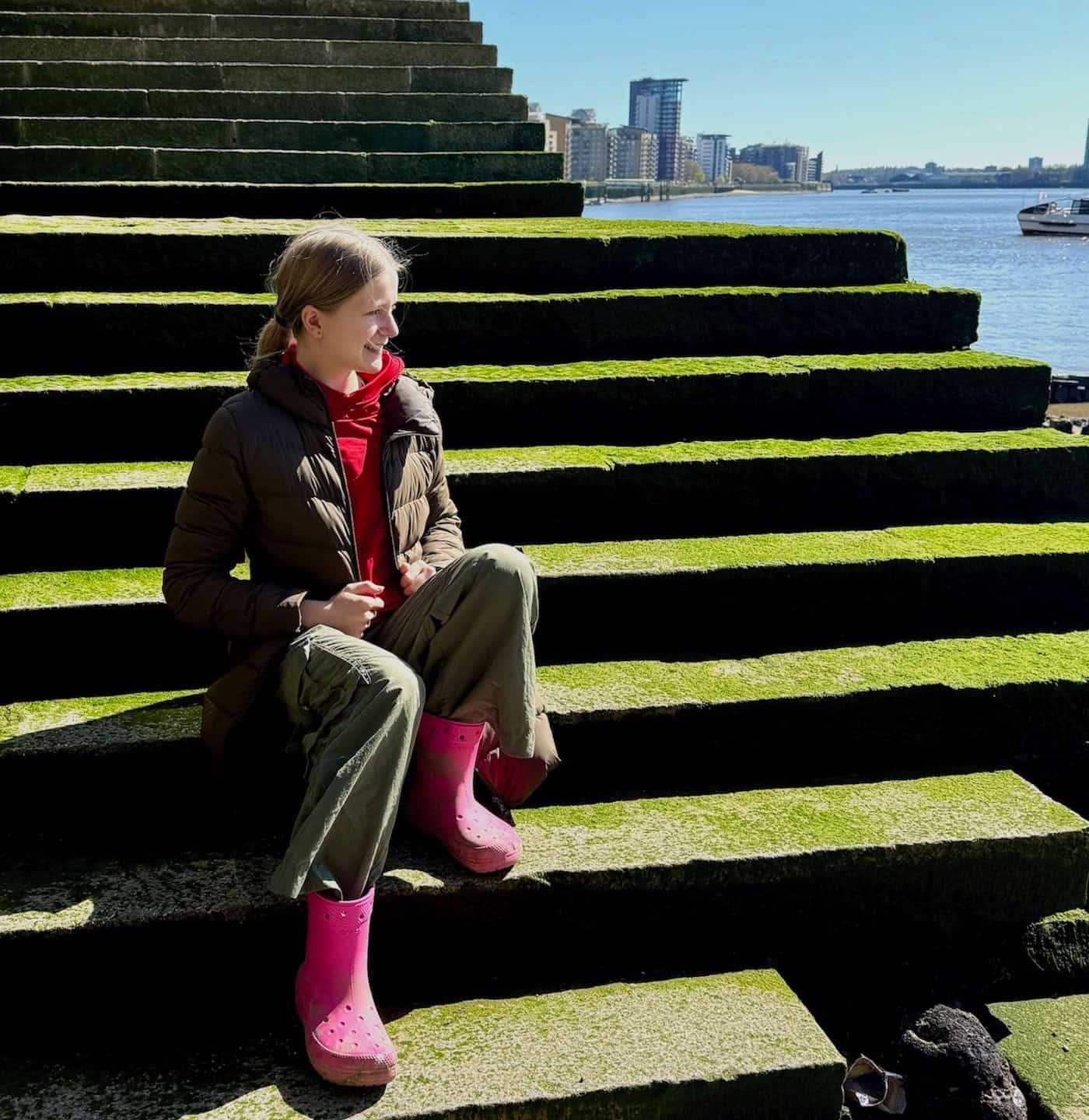
Schoolgirl, author and seasoned mudlark Emmylou Vaxby has spent nearly a decade searching the Thames foreshore for fragments of the city’s past. Fleur Britten joins her at low tide to see what turns up
It’s a mild Sunday morning in late September, and I’m on the north bank of the Thames near Wapping. It’s surprisingly tranquil down here – the din of the city has been replaced with the sound of gently lapping waves; the bustling crowds with an occasional dog walker. I’m with 14-year-old Emmylou Vaxby, a London schoolgirl, mudlark – a forager of artefacts on a riverbank – and author of A Guide to Mudlarking on the River Thames. We are here, of course, to mudlark.
As we walk slowly over the silt and rocks exposed by the low tide, she teaches me how to “train my eye” for treasure. First, she explains, you have to bend down and get close to the ground (children clearly have an advantage here). Then, sweeping her eyes left and right across the foreshore – the land between the low- and high-tide marks – she advises looking for “something that’s a different colour”.
We soon chance upon a mud-brown bone. Emmylou explains that it could have belonged to a sheep, dog, or even a horse or cow. How on earth did it get here? I ask. “It may have been cast out by a butcher, after removing the meat, or it could have simply died, then been thrown into the river.” It’s hard to guess its age, she adds, but it’s certainly been there for many years. “It’s like in the Great Stink,” she adds, referring to the hot, dry summer of 1858, when the Thames – and all the raw sewage and rubbish dumped into it, rotting flesh and all – became a foul-smelling health hazard.
Solutions every Saturday
Uplift your inbox with our weekly newsletter. Positive News editors select the week’s top stories of progress, bringing you the essential briefing about what’s going right
Sign up
It’s obvious that Emmylou has amassed a remarkable knowledge of the Thames, tidal science and a very human version of history, inspired by the everyday objects used by our ancestors and the things she has been collecting for nearly a decade. All mudlarkers are required to have a permit from the Port of London Authority, by the way, though it’s currently operating a waiting list.
Her unusual hobby began aged “five or six”, she writes in her book, “when my best friend’s mother took us both down to the foreshore in east London to look for pottery and glass”. But it was during lockdown that it became a passion, as her parents – both musicians – and her brother, now 10, would spend their daily hour outside down on the Thames foreshore.
Emmylou was so inspired by what she found – cobalt-glazed chinoiserie pottery, for example, possibly Georgian or Victorian; clay tobacco pipes, which could date from the 16th century to the 1930s; and all manner of shells, from oysters to whelks to scallops – that she began recording her experiences and research on her blog and, later, YouTube. She goes by Emmylou the Mudlark on social media.
Last year, a publisher approached her to write a book. With the contract signed, she spent the summer holidays of 2025 writing between 1,000 and 2,800 words a day – an extraordinary feat for a writer of any age. In 2021, she also founded the Wapping Plastic-Free Community through Surfers Against Sewage, having been upset by the sight of a swan mistaking a piece of plastic for food. With 60 people on her mailing list, she organises twice-yearly riverbank clean-ups and also “tags along” on the WaSh Wombles’ litter picks (WaSh stands for Wapping and Shadwell).
It might all sound like terribly hard work, but for Emmylou, mudlarking restores her. As we stand near the calming wash of waves, she explains: “It’s an hour where I am not doing something stressful like schoolwork. I am just walking around.” Mudlarking is necessarily slow – a meditative pastime based on careful observation. It is, she writes, her “happy place”.
It’s not disappointing if I don’t find anything. I get to do this for fun, while Victorian children would have to do this to make a livelihood
Plus, of course, there’s the “excitement” and “satisfiedness” of discovery. One of her favourite finds is a pipe bowl, which would have been bought filled with tobacco, made by the prominent 18th-century pipemaker William Manby, “who actually lived down the road”, she says. “That’s probably one of my oldest pieces.” Mudlarkers are required to record and report their finds through the Portable Antiquities Scheme, following the advice of their Finds Liaison Officer. But, she adds, “It’s not disappointing if I don’t find anything.” Her hobby also brings her “gratitude”, she says: “I get to do this for fun, while Victorian children would have to do this to make a livelihood. Back then it would have been a lot more dangerous.”
Forging this entirely self-taught specialist interest also appears to have given Emmylou an easy self-assurance. She maintains eye contact, answers questions thoughtfully and is entirely at home talking about her subject, while the freedom she has been given to pursue an unusual interest has allowed her to become genuinely expert in it. I’ll definitely be leaving her book lying around for my own teen.
A Guide to Mudlarking on the River Thames is out now, published by Fonthill; £16.99.
Images: Fonthill
Because the world needs it
Positive News reports on the people and ideas driving progress. We believe that giving attention to solutions helps them spread.
Our journalism is independent and powered by our readers. There are no media moguls or shareholders extracting profits: your contribution funds our work to investigate what’s working, understand why, and bring those stories to a wider audience.
If you value a fuller picture of what’s happening in the world, please become a Positive News supporter today.
Support Positive News
