


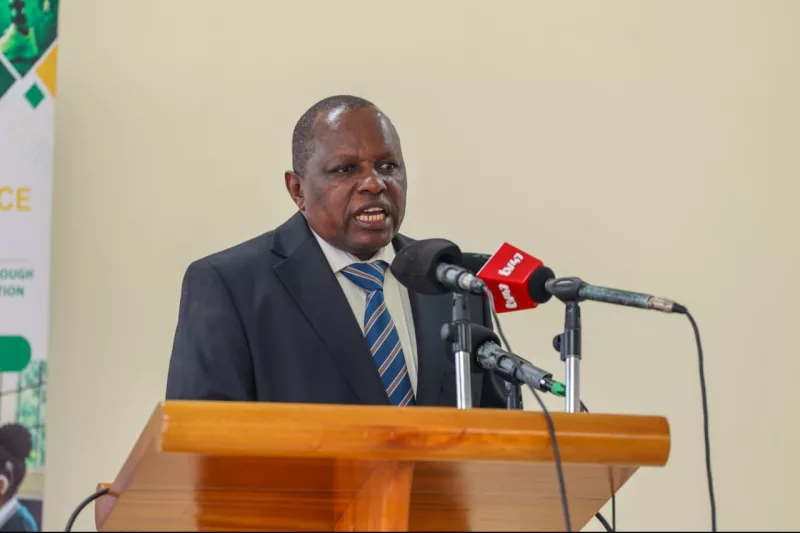
Kenya Institute of Special Education Director Norman Kiogora speaking during a media roundtable in Kasarani on September 29, 2026 / HANDOUT
The Kenya Institute of Special Education (KISE) is pushing for increased access to affordable assistive technology to enable persons with disabilities to participate fully in education and society.
KISE director Norman Kiogora said assistive devices should be provided based on individual assessments rather than simply because a person has a disability.
Kiogora said every learner has unique needs, making assessment a critical step in determining the most appropriate technology to support learning, communication, mobility and independence.
“A learner should not simply receive a device because they have a disability. The device should respond to the learner’s assessment needs and support their participation in learning through communication, mobility or independence,” Kiogora said.
He said KISE’s work goes beyond teaching and training, with the institution providing assessment, rehabilitation, teacher training, research, outreach, advocacy and assistive technology services.
Kiogora said the institute was working to strengthen access to assistive devices by supporting local production, which would help reduce the cost of equipment that has traditionally been imported.
He said the government-sponsored Assistive Device Factory at KISE, which is nearing completion, is expected to increase local capacity to produce and assemble devices suited to the needs of persons with disabilities.
“The devices which were initially imported are supposed to be produced here so they can become affordable to every person. The government has put a lot of resources in the factory to produce, assemble and manufacture devices for everyone in the whole country.”
Kiogora said the initiative would help address the cost barrier faced by families seeking assistive devices, while also making it possible for people with disabilities to access technology regardless of where they live.
He said the government intends to ensure that assistive devices reach people in different settings, including informal settlements and refugee camps.
“Whether you are in an informal settlement or a formal one, whether you are in a refugee camp or not, it is a disability. Therefore, when it comes to making it possible for every person, it is not where you are,” he added.
Kiogora said the factory is expected to produce at least 500 wheelchairs a month once it becomes fully operational.
According to Kiogora, emerging technologies such as robotics and smart mobility devices can help persons with disabilities navigate their environments and perform tasks more independently.
He said technology should also be informed by the experiences of persons with disabilities, who should be involved in the design and development of solutions intended for them.
“Persons with disabilities are not simply the users of devices; they are part of the innovation process. Their lives, experiences and individual needs must inform how solutions are designed, developed and improved,” he said.
Kiogora was speaking on Tuesday during a media roundtable ahead of the KISE 2026 conference, scheduled for October 6 and 7, which will focus on advancing inclusion through assistive device technology.
The conference will bring together education practitioners, researchers, innovators, policymakers, persons with disabilities, healthcare providers, technology experts, government agencies and development partners.
The event will explore the role of assistive technology in strengthening inclusion, independence and participation across different areas of life.
Its themes will include assistive technology innovation and digital inclusion, empowerment of parents and caregivers, systems strengthening, and disability inclusion through technology across the life course.
Discussions on innovation will cover emerging technologies including artificial intelligence, robotics, digital accessibility tools, augmentative and alternative communication systems, smart mobility solutions and Universal Design for Learning.
KISE lecturer and lead support for the Assistive Device Factory Mercy Yegon, speaking during a media roundtable in Kasarani on September 29 / HANDOUT
The conference will also examine how parents, teachers, therapists and other service providers can be equipped with the skills needed to identify, access, use and maintain appropriate assistive technologies.
KISE lecturer and lead support for the Assistive Device Factory Mercy Yegon said the conference would provide a platform for innovators to engage with the government and other stakeholders on developing solutions for persons with disabilities.
Yegon, who is also chairperson of the KISE 2026 conference on advancing inclusion through assistive device technology, said the event would focus on removing barriers and strengthening independence.
“The main objective is to remove the barriers, to ensure inclusion and independence is acquired, and also to create awareness about the platform that is now available through the government provision of the Assistive Device Factory. You are now able to have a platform where you have your idea and innovation being given design and going forward to having an impact in society,” she said.
Yegon said the conference is expected to attract government institutions, the National Council for Persons with Disabilities, UNICEF, CBM, special schools, hospitals and other agencies.
She said participants from outside Kenya, including Ethiopia, the United States and Nigeria, are also expected to attend.
The conference will further examine how assistive technology can support persons with disabilities throughout the life course, including in education, employment, healthcare, recreation and community participation.
KISE said the event will provide an opportunity for stakeholders to share research, innovations and practical approaches linking assessment, education and assistive technology.
