


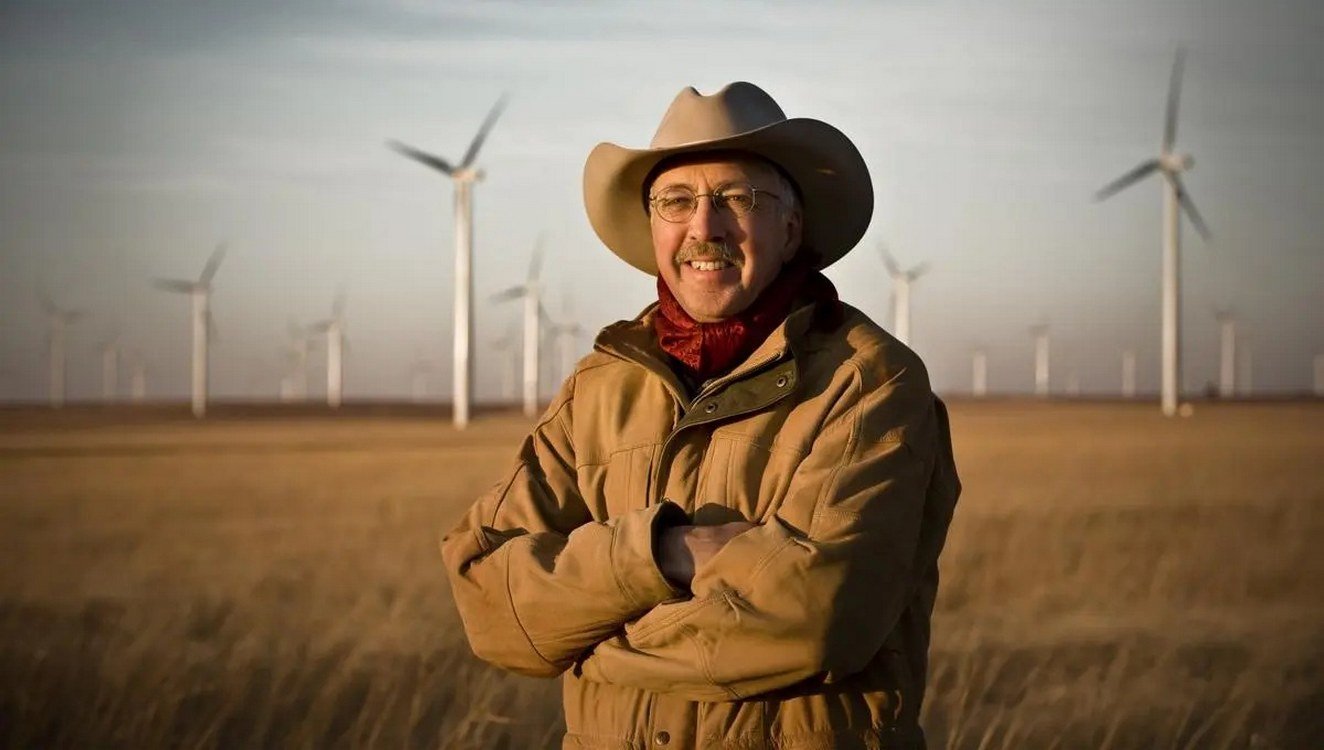
– credit, supplied to the Environmental Defense Fund as a courtesy by Pete Ferrell
In 2006, the largest wind power project in Kansas was turned on among the Flint Hills. Today, the royalties it has generated for rancher Peter Ferrell are allowing him to pass the farm down to his children.
The 50 turbines—which Ferrell barely notices these days—have provided half of his income since then, insulating him and his family from the volatile nature of ranching.
“I am the fourth generation to ranch on this property,” said Ferrell in a statement released by Avangrid to mark the completion of the Elk River Wind Power project 20 years ago.
“My family has been here since 1888 and that weighs heavily on my decision to engage in practices that can be carried on generation after generation without depleting the resources. Both the grass and the wind will be here for generations.”
Ferrell needed some convincing to agree to have the turbines built over his 7,000 acre tallgrass prairie ranch. Pointing out a cultural pressure against them, he remembers there were numerous concerns: they’d ruin the landscape, some said; they’d harm the local prairie chicken population, vulnerable to habitat loss; the royalty money was essentially an honor-less handout.
These concerns jostled around his head until a fellow rancher helped dispel them. After he decided to break rank, the irony was that the original wind project proposal fell through, and Ferrell himself had to go interviewing for a new developer.
Ferrell’s cattle, his land, and the turbines – credit, supplied to the Environmental Defense Fund as a courtesy by Pete Ferrell
He signed with Greenlight Energy Resources, whose eventual project along Elk River powers 60,000 homes.
Today his cattle still graze as they’ve always done. The turbines still turn on the western-half of his property. The prairie chickens still nest. Very little has changed apart from Ferrell’s financial security.
LANDOWNERS OF AMERICA: Man Gathers Up Family Acres- Home to Moose and Mountain Lion– and Returns Them to Indian Tribe
“I have two grown children and four grandkids, and they love this place,” Ferrell told the Environmental Defense Fund recently. “Because of the wind farm, they’ll be able to perpetuate it without financial burden.”
Without those royalties, he said, it would be difficult to imagine this would be possible. Indeed, it’s nigh impossible to pass the entirety of a farm down to the next generation—as millions of farmers have done before—if the farmer or rancher is carrying debt, which most are.
STORIES ON THE WIND: USA’s Largest Renewable Project Comes Online–With More Power Than the Hoover Dam
Along with tending his cattle, Ferrell also helps other ranchers navigate the fateful choice he made all those years ago.
“After the wind farm was built, my phone rang off the hook. Farmers and ranchers asking, ‘How’d you do it? Could we get one?’”
SHARE This Amazing Up-Close-And-Personal Tale Of A Rancher And His Land…
