


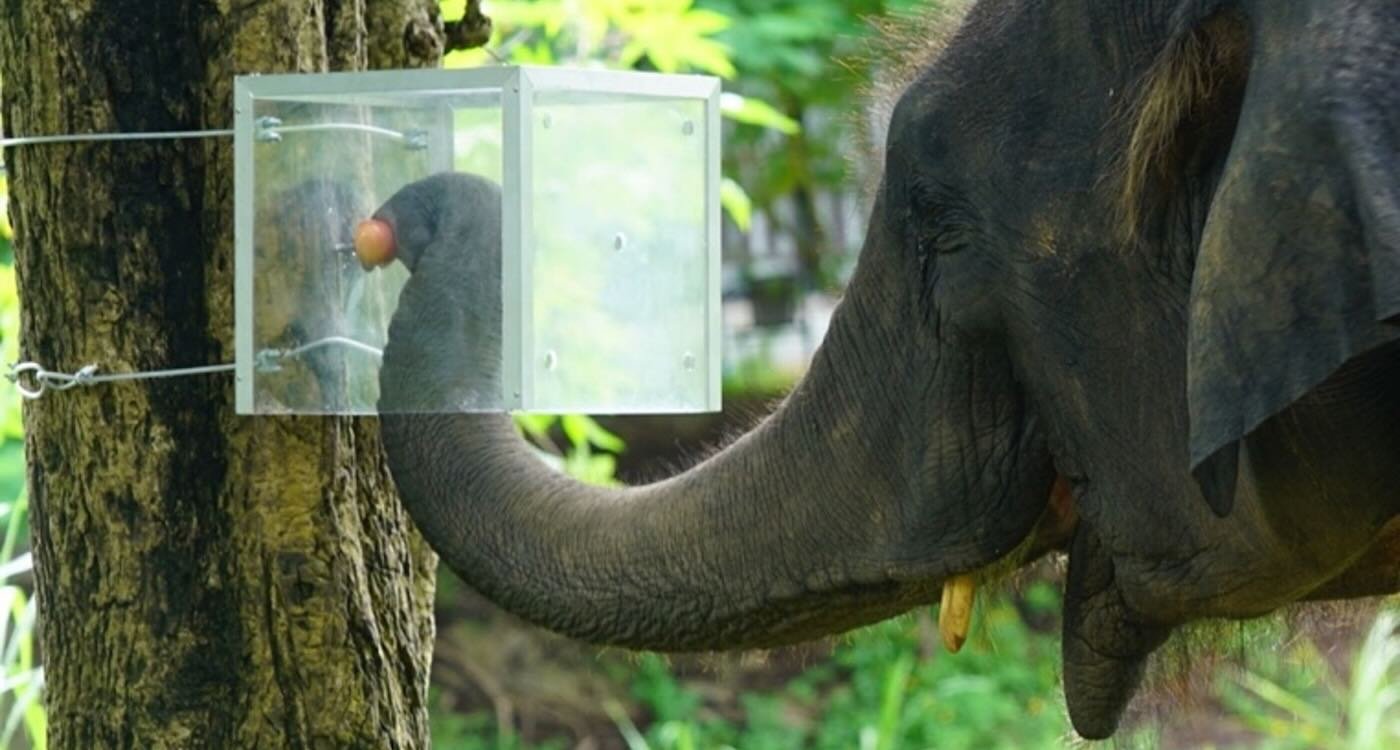
Elephant interacts in experiment –Credit: Hope et al., 2026, PLOS One via SWNS
Elephants can think before they act, as well as resist impulsive behavior, reveals new research that adds to growing evidence of elephants possessing sophisticated cognitive skills.
Experiments at the National Elephant Institute in Thailand show Asian pachyderms are able to deny their impulses and choose a more rational course of action, in order to solve problems.
Researchers say the study, published in the journal PLOS One, provides the first evidence of inhibitory control in elephants and offers insights into how they make decisions and adapt to changing environments.
They explained that inhibitory control—the ability to resist an impulse in favor of more effective behavior—is an important part of decision-making and cognitive flexibility in humans and other animals.
The skill has previously been observed in various birds and mammals, often during detour tests in which subjects must ignore an obvious but ineffective path to a treat in favor of an indirect route.
In the new study, the Hunter College research team documented the first such behavior in elephants.
When presented with a transparent box with small holes through which they could see and smell fruit inside, the elephants consistently were able to resist the temptation to try to reach directly for the food and instead chose an opening on the side of the box as they had been taught earlier.
When the box was later rotated, the elephants at first succumbed to the impulse to reach for the previous position of the opening before quickly correcting their behavior.
2 elephants in experiment – by Hope et al ., 2026, PLOS One via SWNS
The adjustment was slower in older individuals, with one possible explanation being cognitive decline with age.
Study co-author Professor Joshua Plotnik, from City University of New York (CUNY), has studied elephant intelligence, personality, and social behavior in Thailand for nearly two decades, combining experimental research with conservation efforts.
His work examines not only what elephants can do, but also how their cognitive abilities and behavioral differences may lead to conservation strategies aimed at reducing conflict with humans who share the same landscapes.
Prof. Plotnik’s research has shown that elephants can recognize themselves in mirrors, console distressed companions, coordinate actions with partners, and solve novel problems.
His team has also found that elephants living near human communities tend to be more willing to take risks and explore unfamiliar situations—behaviors that could help explain why some elephants repeatedly enter agricultural areas and come into conflict with people.
“The more we understand about how elephants think, make decisions about risk, and adapt to human-driven environmental change, the better we can predict ‘what they’ll do next’ and the better designed our strategies for human-elephant coexistence can be,” said Prof. Plotnik.
MORE ELEPHANT GOOD NEWS:
• Last Circus Elephant in Portugal Can Now Romp-and-Roll on 1000-Acre Sanctuary After 40 Years of Working
• When Zoo Elephants Are Rewilded in Africa, Here’s How Good Their Coping Skills Are
The researchers say that inhibitory control may be a “key” part of elephants’ famed problem-solving and socializing skills.
“When elephants were faced with a situation in which they needed to suppress an impulsive behavior—either the impulse to reach directly toward a food reward behind a transparent barrier or the impulse to continue using a previously effective technique—they were generally able to suppress the impulse,” said study co-author Dr. Sydney Hope, of New York’s Hunter College.
“This ability may be important for elephants’ problem-solving.”
ELEPHANTS NEVER FORGET HOW TO ACT–Share the News on Social Media…
