


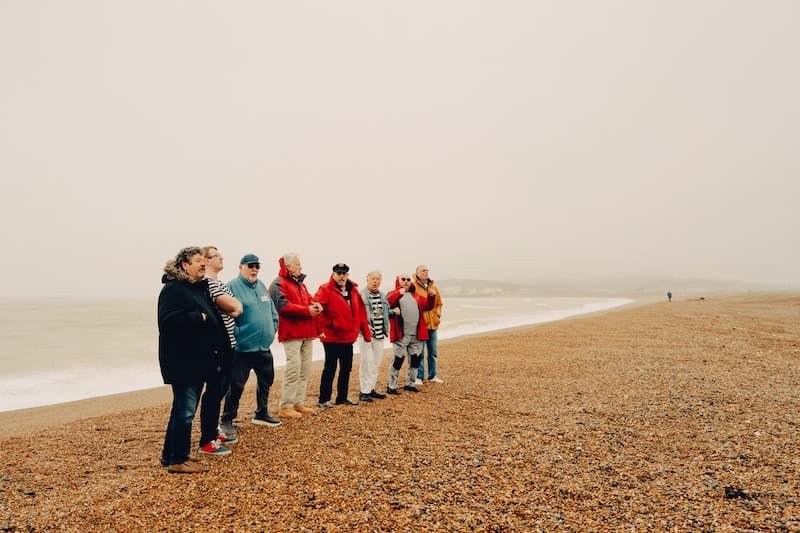
After TikTok turned sea shanties into an online craze, community groups around the UK found a new audience. Our writer joins the Wreckers to discover why these old working songs are doing more than filling dancefloors
Sitting on the top deck of the RNLI station at Newhaven on England’s south coast, Tony Lewis is surrounded by atmospheric charts, historic photos and models of old lifeboats. He is chatting to me with half an eye on the harbour, watching the boats come and go, cocking an ear to listen whenever the radio crackles.
At one point he gets up to watch the cross-Channel ferry practise a tricky manoeuvre, akin to a three-point turn in a very narrow street, which he talks me through in impressive detail. Suffice to say, he has a lot of love for the sea.
He’s volunteered at the lifeboat station as an operations manager for a number of years, but he never imagined his affection for the ocean would turn him into a singer. Especially as he’d never sung, or had the desire to sing, in public before. Yet that’s exactly what he does every month or so with seven other men, as part of a local sea shanty group called the Wreckers.
Solutions every Saturday
Uplift your inbox with our weekly newsletter. Positive News editors select the week’s top stories of progress, bringing you the essential briefing about what’s going right.
Sign up
Lewis tells me that their Wednesday night rehearsals, in a shed at the bottom of one of their gardens, are the highlight of his week. And he’s not alone. In recent years, hundreds of sea shanty bands have sprung up in coastal towns and cities around the UK, with some groups forming inland, too, from Oxford to West Yorkshire and London.
The singers may skew predominantly male and over 40, but the audiences are much broader. When I watch the Wreckers play in the clubhouse of a local yacht club, kitted out in Breton tops and sailors’ hats, there are plenty of kids joining the mat the front to sing along, while teenagers and twentysomethings nod their heads at the back.
Homeward Bound, a Brighton-based shanty band, play regular gigs in craft beer spots, and run popular sea shanty workshops for hen and stag dos. And the organisers of the Falmouth International Sea Shanty Festival, which was founded in 2003 and now attracts more than 65,000 visitors, say their event has never been more popular with young people, who make up large swathes of the audience.
Many shanty bands attribute this to Wellerman, a New Zealand whaling song that went viral in 2021, when it was sung by the Scottish postman Nathan Evans. This kickstarted a shanty TikTok craze that was fuelled by Spotify’s algorithms recommending more and more shanties to listeners who were enjoying the track.
Sea shanties were originally rhythm-centric working songs, sung by sailors on large merchant ships, most notably in the 19th century, to keep their spirits up and their minds on the job in an era long before portable music players, let alone streaming apps on mobile phones, could play us whatever we wanted whenever we wanted to hear it.
“Sailors relied on sea shanties – it was brutal work, often in really horrible weather and sea conditions, far from home,” says Lewis. “You’d have the shanty man on the boat leading the song – he’d choose the best song for the particular job, whether that was hauling ropes, pulling masts or whatever – and the crew would respond by singing the chorus.”
The Orwellermen perform from their extensive repertoir. Image: The Orwellermen
The Wreckers formed in 2023 and Lewis joined a year later, having enjoyed seeing them perform. “I loved their sound though it’s not a pleasant choir,” he warns. “We call it rum-bunctious and it’s such a good laugh, we get the audience clapping, stamping their feet and singing along with the choruses.”
Lewis likes the idea that the Wreckers are keeping the history of the old seafarers alive and maintaining that local relationship to the sea, at a time when few jobs are directly connected to maritime work and coastal communities are often neglected. Last November, lifelong fisherman Martin Yorwarth wrote a protest ska shanty about the plight of small fishing boats driven to ruin by industrial-sized bottom trawlers.
Lewis also thinks that singing together regularly has brought numerous mental health benefits to the group of eight, who range in age from 22 to 82, though are mostly retired, as it did for the sailors of yore.
We get the audience clapping, stamping their feet and singing along with the choruses
“Some of us have got health issues or partners with health issues, or we’ve lost partners, but through shanty we’ve found roots to understand our place in life,” he says. “Singing is definitely good for the spirit, it makes you feel like you’re breathing, and because we rely on each other to come in at the right time, we’re always working together. It’s like a fellowship.”
Some shanty bands are more folk music-inspired and professional, but for Lewis and the Wreckers it’s all about entertainment rather than the quality of the singing or the polish of the performance. “We always start our concerts by reminding people these are working shanties. They weren’t sung by choir boys or renowned singers, they were sung by hard-working sailors.”
Unlike Lewis in Newhaven, Gareth Roberts, founder of the Orwellermen in Ipswich, had a background in community choirs and no direct connection to the sea. Before Covid, he was a member of a barbershop quartet, which folded, and after the pandemic he was looking to get back into singing in a way that might also help his local community.
“I wondered if singing could be a good way to get men out of the house and supporting each other,” he says. Somebody had lent him the Fisherman’s Friends movie, which tells the true story of the Cornish sea shanty group of the same name, who signed a record deal with Universal Music in 2010 and still tour the world playing shanties to packed-out venues.
“Sea shanties seemed to fit the bill as they’re easy to learn and accessible,” says Roberts, even though the only shanty he really knew the lyrics to was Drunken Sailor, a crowd favourite when I watch the Wreckers. But he did some research online, suggested the idea to some friends and was surprised at how receptive they were.
They frst met on a Wednesday night at the Steamboat Tavern on the banks of the River Orwell. The river, along with Wellerman, which everyone was a fan of, lent the band their name, and they have kept to that weekly routine since.
Singing is definitely good for the spirit, it makes you feel like you’re breathing
“I’d always thought singing shanties was something you did with a pint of beer in your hand, sitting around a table with a few mates,” he says. “People always used to come together to sing in pubs, but we’ve lost that tradition. So, we open the sessions to everybody and it’s a very welcoming and non-cliquey group.”
The group of 25 includes four women. Roberts had wanted to appeal to men originally, but saw no reason why women couldn’t join in. He thinks their ability to sing different harmonies adds to the group’s sound. The Orwellermen’s oldest member is 83 but the group includes some teenagers, and young people often frequent their gigs and festival appearances around the country, which Roberts puts down to Wellerman, but also to the video game Assassin’s Creed IV: Black Flag, which features a number of sea shanties.
Roberts’ wife has taken to calling him a “shanty evangelist”, such is his belief in the power of these local music groups to bring all different kinds of people together in a positive way. “Members have said they sleep better, it takes their mind off their day to day, and their confidence builds. We have some singers who’d never have imagined they’d be able to lead a song in front of an audience but now they’re up there doing it and it’s amazing to see.”
The Orwellermen have a huge repertoire of songs. Roberts thinks they’ve sung 180 different songs since forming, including one they wrote themselves about Ipswich and the Suffolk coast for the shanty festival in Falmouth, and a Japanese sea shanty about a samurai fishing, which came from one of their group who has Japanese ancestry.
But he stresses they have no desire to follow Fisherman’s Friends and get rich as musical artists in their own right. Instead, like most shanty bands, they are more than happy to keep meeting regularly, giving local audiences a good time at their gigs, raising money for charity and proving that a song built for hard work at sea can still bring people together on dry land.
Photography by Peter Flude
Be part of the solution
At Positive News, we’re not chasing clicks or profits for media moguls – we’re here to serve you and have a positive social impact. We can’t do this unless enough people like you choose to support our journalism.
Give once from just £1, or join 1,800+ others who contribute an average of £3 or more per month. Together, we can build a healthier form of media – one that focuses on solutions, progress and possibilities, and empowers people to create positive change.
Support Positive News
