


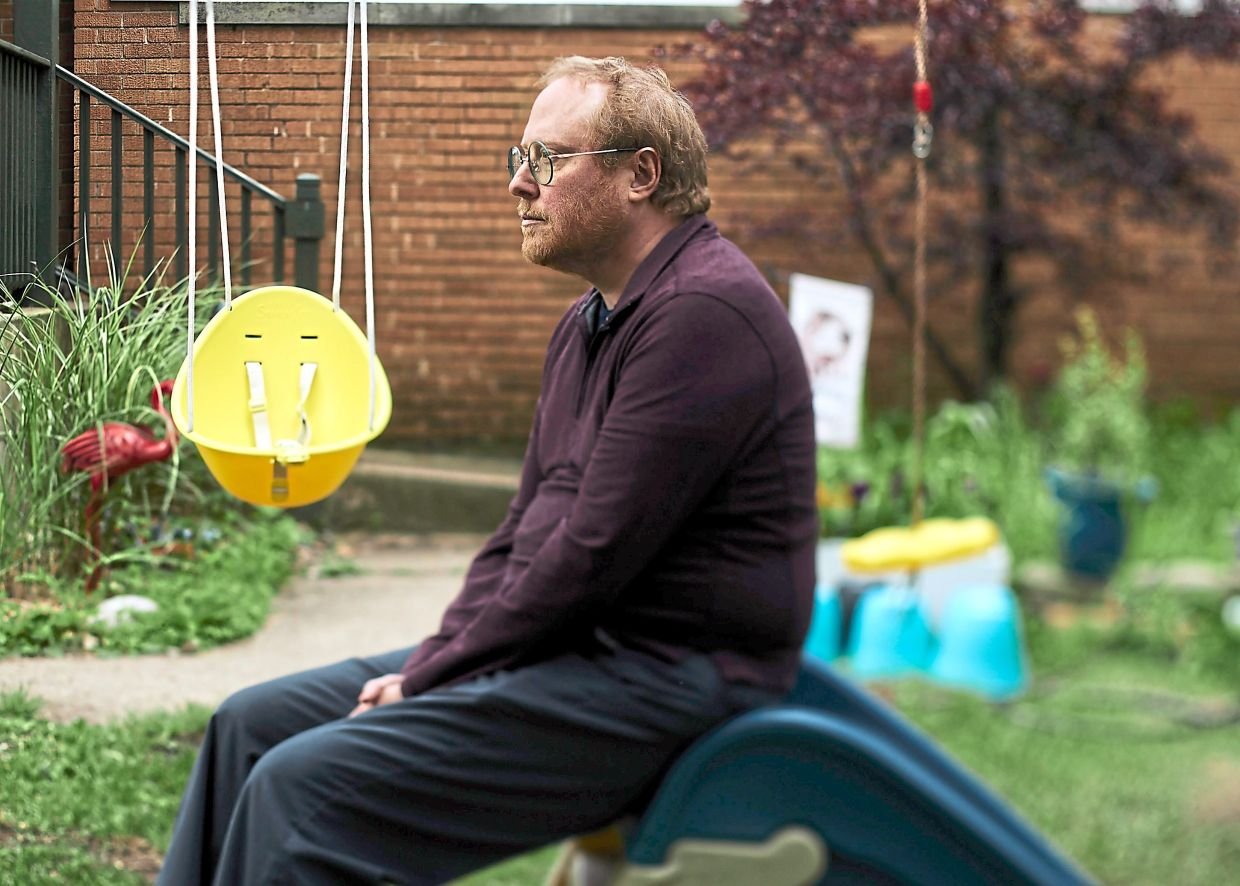
Jeffrey Gantwerker always wanted to be a father and was elated when his first child was born. He can clearly remember the first few minutes of his son’s life, the delight of cradling him skin to skin and booping his tiny nose.
But soon, Gantwerker said, he began feeling an “impending sense of crushing doom,” became overwhelmingly anxious and wanted to be with the baby constantly.
He was fixated on how each moment represented a version of his son that would vanish too fast. “I got this idea stuck in my head that he changed so quickly that every time it was him dying,” he said. He knew there would be a new version, “and of course I was going to love the new one, but I was going to miss the old one, who was dead.”
Gantwerker, 46, a programme manager for the Mars candy company in Chicago, told himself, “I need to enjoy this with him and teach him and make him feel loved.” But, he said, he was “trying so hard to make the most out of every minute, I couldn’t even appreciate it.”
Eventually, a psychologist told him he was experiencing a form of postpartum depression, which researchers are increasingly finding can be experienced by fathers too.
“Dads are at risk for the same things that mothers go through,” said Sheehan Fisher, a perinatal clinical psychologist at Northwestern University. He said an estimated 10% of fathers develop symptoms like depression and anxiety during the perinatal period, from pregnancy through the first year after childbirth.
That’s about half the percentage of mothers who develop such symptoms, Fisher said, noting that for women and men, “postpartum depression” is often shorthand for perinatal mood and anxiety disorders, a category that includes conditions like anxiety and obsessive-compulsive disorder.
Some experts say such conditions in fathers may be more common than the numbers suggest, partly because men may be less likely to seek help than women are and often have different symptoms.
Manifestation of paternal depression
Daniel Singley, a psychologist in San Diego who founded a therapy centre for men, said depressed fathers are more prone to express aggravation, annoyance or even rage. “Under that is feeling hurt, sad, afraid, ashamed, helpless, hopeless, but what we see externally is anger and irritability,” he said.
Paternal depression may manifest in physical symptoms like muscle tension or stomach pain. And men are considered more likely to mask symptoms with behaviors that can be detrimental, including drugs, alcohol or gambling, Singley said.
Fisher said some men believe they should only prioritise supporting the baby’s mother’s concerns over their symptoms, and some have “a hesitancy to admit” that they are struggling.
Christopher Choukalas, the author of Even The Darkest Night, a book about his experience with what he calls postnatal depression, said he felt overwhelmed and disconnected. Grasping for control over what he considered to be the chaos of raising twin daughters, he rigidly tracked their sleep and feeding schedules, snapping at his wife if outings interfered with naptime. “Only when they were asleep could I breathe,” he said.
“I thought other people were the problem,” he added. “I thought this is how you’re supposed to do it, and the fact that my wife can’t get on board, it means that she’s the problem; she’s too casual, and I’m normal.”
Choukalas, 51, an anaesthesiologist who is a professor at the University of California, San Francisco, said it might seem surprising that a doctor accustomed to high-stress situations would be daunted by parenting healthy babies.
In his book, he suggested some possible factors: his childhood with a depressed mother and an absent father, and a frightening episode in which his wife required urgent treatment for life-threatening blood loss after childbirth.
During the twins’ infancy, he would retreat to the garage, “where I’d sit in the dark, alone and afraid,” he wrote in the book.
“I’d wait as long as I could before going into the house,” he wrote, “balancing my need to not be around the girls with the guilt and shame I’d feel for not ‘pitching in,’ for not ‘being a good dad and husband.’”
Sometimes, he said, when his wife was out with the babies and he could not reach her, “my immediate thought was they got in a car crash and they’re all gone, and there was kind of this almost escapism about feeling that way, because then I could be free.”
Eventually, at his wife’s suggestion, he began seeing a therapist, which, along with an antidepressant, gradually helped.
Rose says both he and his wife showed ‘signs of depression, anxiety, OCD and rage’. Photo: The New York Times
Men’s space too
Choukalas said he has heard some women say he should not describe his symptoms as postnatal depression, because they consider it a women’s condition and “this is not men’s space.” But other women tell him their husbands have experienced similar issues.
Darby Saxbe, a psychology professor at the University of Southern California and the author of Dad Brain: The New Science Of Fatherhood And How It Shapes Men’s Lives, said perinatal depression in both sexes probably stems from several factors, including changes to routines, responsibilities, sleep, relationships and one’s sense of identity.
Societal messages that “having a new baby is an unalloyed good,” Saxbe said, can make it difficult to accept negative aspects like feeling isolated or drained. And some men may wrestle to balance expectations that fathers be hands-on with childcare but also be breadwinners, she said.
Hormones also play a role. Oestrogen surges during pregnancy and plunges with childbirth, a drop-off that appears to drive depression for some women. In men, testosterone levels drop with fatherhood, especially when fathers engage in childcare, research shows. (Scientists think this might be an evolutionary adaptation that encourages men to become more involved in the family instead of sowing their oats.)
Saxbe said studies suggest links between lower testosterone and depression, but the picture is complex, because high testosterone can also have negative effects on family relationships and on a father’s adaptation to parenting.
About half of perinatal depression cases in women start in pregnancy, and the first postpartum weeks are considered a high-risk period. For men, Fisher said, the riskiest window is three to six months after babies are born, possibly related to the infants’ growing needs and activity or to the mothers returning to work.
Previous depression increases risk, and one parent’s mental health often affects the other. “The No. 1 risk factor for paternal postpartum depression is maternal postpartum depression,” Singley said.
Breaking thought loops
When Christopher Rose, 44, a video game producer in Richmond, California, experienced depression, his wife, Lisette Lopez-Rose, was also struggling, and both showed “signs of depression, anxiety, OCD, rage,” he said.
After his wife joined support groups run by Postpartum Support International, a nonprofit, he began attending a fathers group, ultimately leading one himself. He saw a therapist, who suggested strategies like checking the baby monitor less often and recognising that getting angry at his cats for meowing was unreasonable.
Gantwerker sought help from Fisher months after his son’s birth in 2019, when his wife said he looked miserable, shattering his illusion that he had managed to hide his anxiety.
By that point, he would often sleep holding his son on the floor of the walk-in closet that was the baby’s bedroom and would cook or cut vegetables one-handed while holding the baby.
Fisher suggested ways to “break out of those thought loops” that drove his anxiety, Gantwerker said. Learning that other men had similar issues, that he wasn’t “broken” or “from the island of misfit toys” also helped, he said.
When the couple’s daughter was born in 2022, he was better at short-circuiting his symptoms.
“I’ve never gotten the intrusive thoughts to not come anymore,” Gantwerker said. But when they arise, “I think ‘That feels terrible. OK, now I’m going to go to another thing.’” – ©2026 The New York Times Company
The article originally appeared in https://www.nytimes.com/2026/06/19/well/postpartum-depression-men-fathers.html The New York Times.
