


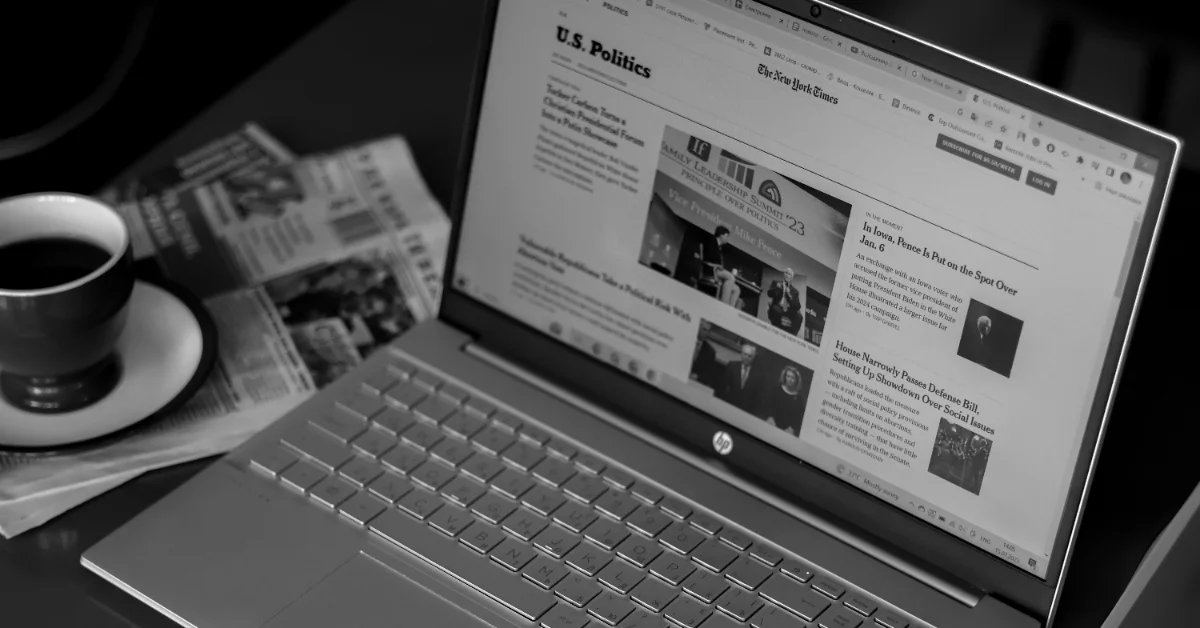
In the past decade, study after study has come to a troubling conclusion: Trust in news and journalism has declined dramatically.
The public’s loss of trust corresponds with the explosive development of our information ecosystem. The more options audiences have to find news elsewhere, the less trust the public has placed in traditional forms of journalism.
However, trust in journalism was displaced long before the rise of digital and social media.
That’s especially true for Black communities that have been harmfully misrepresented by mainstream outlets. Research, for example, has consistently shown how the news media has contributed to overrepresentation of Black people in crime coverage, which contributes to a litany of negative outcomes and perceptions.
Scholars, including me, have detailed how mainstream journalism continues to marginalize and misrepresent Black people. That especially happens in protest, crime, and health coverage. It’s no surprise that Black communities have a long history of turning away from mainstream journalism.
As such, a closer look at these communities can also give us insights into how to win some of that trust back.
Trust takes two
Despite past harmful coverage, some Black people trust media anyway.
In a recent study I conducted with colleagues, we identified places where people do still trust media and focused on the next essential question: Why?
To answer this, we turned to Minneapolis and Saint Paul, Minnesota, to learn from journalists trusted by Black communities. In 2022, two years after the murder of George Floyd, our research team began surveying over 100 Black community members and residents to ask them about whom they trusted to tell them the news.
munshots/Unsplash
Although news organizations weren’t the No. 1 answer, community members named many journalists, including those working at mainstream outlets and community papers. So we connected with 17 trusted journalists who reported in the area after the murder — or during the police officer trials — to learn more about how they built trust.
We learned that the trusted journalists in this community embraced an ethic of love, a set of principles proposed by Black feminist scholar bell hooks that weave together the dimensions of care, commitment, responsibility, knowledge, and respect.
We also found that building trust takes the engagement of two parties. No one practice from journalists can fix the trust crisis; it takes communities to engage, forgive, and voice concern.
What communities do to make trust possible
We found that the most overlooked piece to building media trust is the willingness of a community to engage with journalists. Instead of saying “no comment” or avoiding the camera, community members offered their perspectives and knowledge openly. Sometimes these discussions served as essential background knowledge. Other times, it led to being quoted directly in news coverage.
Journalists also perceived communities’ willingness to provide feedback as an opportunity to build and retain trust. Sometimes the feedback was critical. When a reader was upset about how a story was framed, they pushed back. Other times the feedback provided affirming support.
From these journalists’ perspectives, their trusted status was a product of the community’s willingness to share both knowledge and feedback.
How journalists built trust
There are some key practices that helped journalists gain trust with audiences: active listening, being accurate and demonstrating care. But we also found two distinct practices that were helpful for building meaningful community relationships: diligence and deference.
For trusted journalists, diligence meant spending more time with the community. Some attended hours-long events from beginning to end. Others waited until the end of an event to connect with sources, waiting and observing as time passed. Diligence also often demanded a continuous presence in the community — beyond what the job required.
In one instance, a journalist described staying at a community protest long after the event they were covering ended. For another journalist, it meant reporting on the same public safety beat for years, so long that everyone in the community he covered knew his name. Whatever the case, diligence always equated to time.
Diligent journalists couldn’t just connect with the community over a tragedy; they had to connect well beyond the event that made the news. For some, this meant riding on public transportation and being a regular at the local shops.
For others, it meant showing up at events and community spaces during their time off. This showed communities that journalists cared about people, not just the headline.
Deference was a conscious task that involved honoring the boundaries, rules, and expectations of community members. If someone said no pictures, a camera was pointed elsewhere — even if everyone was in a public space. If a community member asked for silence, those boundaries were respected.
The cultural boundaries that bind many Black communities, such as the respect for elders and aunties alike, were honored and respected in informal communication — and sometimes in coverage.
Importantly, deference required that journalists drop the assumption that they had all the answers. For many, this required a practice of intentional humility. Instead of assuming they already knew the narrative, trusted journalists deferred to the lived experiences of the community and allowed people the autonomy to tell their own stories in their own words.
The future of trust
I believe what we learned from these trusting relationships can serve as a blueprint for a more inclusive understanding of how trust is built and sustained.
For journalists and Black communities in Minnesota, this approach helped reduce harm and build personal connection. Most journalists we spoke to thought it was essential work to fulfill the democratic promise to serve and inform the public.
But these lessons aren’t a one-size-fits-all formula for the entire media industry or for all communities. The journalists in our study acknowledged this, too, noting that they are trusted by some community members, not all.
Building trust is highly contextual. For journalists, practicing deference and yielding authority are necessary steps when repairing relationships in communities that have experienced historical harm. But those same practices might not work with all groups.
For example, yielding authority to individuals or communities intentionally trying to spread misinformation could lead to complicity and diverge from the goals of journalism.
People often treat trust as a universal good, but whom journalists and communities choose to trust matters just as much as how they build it.
This article was written by Danielle K. Brown from Michigan State University and was originally published on The Conversation.
Featured Image: Anna Keibalo/Unsplash
