


Discussion
This level IV mixed methods study evaluated the Future is NOW, a primary violence prevention program, specifically focusing on its impact on participants and ways to improve the program. Findings from the demographic questions of the questionnaires demonstrated that the study participants were reflective of the Future is NOW program participants. Feelings towards healthcare and prior experiences with doctors were overall neutral to positive, but with feelings and experiences of inequity; these findings were consistent with the more in-depth interview responses, therefore enhancing the credibility of the interview data. The interview analysis demonstrated that the Future is NOW program may encourage program participants to consider careers in healthcare and positively influence family perspectives of healthcare. Aspects described as most impactful were the hands-on activities, exposure to different topics and careers, and interactions with the volunteers. Recommendations for improvement included incorporating education about bullying and violence prevention and bringing in more representative guest speakers.
Programs most comparable to Future is NOW that have been studied are mainly school-based and target high school students. These studies predominantly utilized survey-based research methods to assess the impact of their programs, focusing on knowledge about health topics, academic success, and interest in or pursuit of healthcare careers.9–15 Strategies more commonly utilized to address gun violence include policies and measures affecting firearm access, physician screening and counseling of patients regarding gun safety, hospital-based programs providing resources and follow-up for victims/perpetrators of gun violence, and, most well-established, community violence intervention programs. These community violence intervention programs consist of staff from within the communities themselves who focus on directly interrupting acts of violence and offering rehabilitation programs and pathways.16 In contrast, our study of the Future is NOW program offers insight into a primary violence prevention effort that partners directly with community organizations and law enforcement, rather than schools, to engage children in the local community. Given the younger age of our participants, we relied on data from guardians.
As mentioned, the Future is NOW is the first outside chapter and expansion of the Future Healers Program, which is a partnership between a medical school, trauma center, academic surgery department, and a local non-profit community organization. The Future Healers aim to introduce youth most impacted by violence to medicine and build healthier futures—the inspiration for Future is NOW. The Future Healers Program conducted a research study surveying their participants and caregivers, which showed a large majority were exposed to firearm violence and had a positive perception of healthcare. This work demonstrated that partnership with local community organizations was effective for recruiting youth impacted by violence and that healthcare entities were trusted partners for intervening.17
Few research studies have evaluated the impact of educational programs for children on reducing gun violence; those that exist have primarily focused on Latino children and general adverse childhood experiences.18 Other studies have shown that educational sessions directly teaching children about firearm safety are ineffective at preventing unsafe handling of firearms.19
Our study’s findings suggest that while many guardians reported exposure to multiple social stressors, including gun violence, bullying and race-based medical mistrust; it remains unclear whether these factors directly influenced participation in the Future is NOW program. Across interviews, guardians expressed that their primary motivation for enrolling their children was to provide exposure to new opportunities, hands-on experiences and potential careers.
Results indicate that both the children and guardians had positive perceptions of the Future is NOW program. Guardians consistently reported that children expressed enthusiasm and engagement with the program, with some children beginning to consider new career pathways perhaps associated with their participation. This result aligns with prior research on programs that introduced children to healthcare careers; notably, however, the Future is NOW appeared to have a similar influence even though its sessions do not emphasize careers specifically. It is uncertain whether the Future is NOW influenced children’s academic performances, given guardians reported that most were already performing well in school.
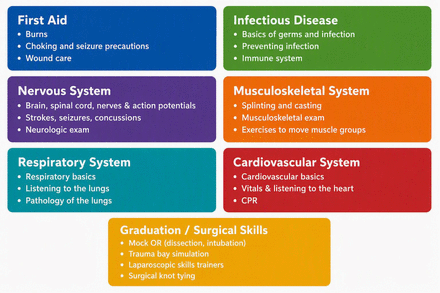
Additionally, guardians’ perceptions of physicians and the intentions of physicians seemed to be positively influenced by the program. According to interview responses, the aspects of the program most frequently cited as impactful included the hands-on activities, exposure to different topics and careers, and the way volunteers engage with the children. These findings are consistent with a prior study in which students’ favorite aspects included time with mentors and hands-on experiences.9 It does contrast with our initial hypothesis that physician guest speakers would have a greater influence than the volunteers. Additionally, while guardians did not specifically identify aspects they found least impactful, they offered suggestions for improvement—most notably the inclusion of more representative guest speakers and additional content on bullying and gun safety.
This study has several limitations. The feedback was not anonymous to the authors, which could have influenced the results by social desirability bias or acquiescence bias. The small sample size limits generalizability of the findings and suggests that results should be interpreted with caution. Participation in this study was voluntary, so participants who did not have a favorable perspective towards Future is NOW and/or healthcare may have been less likely to participate. Additionally, gun violence is a sensitive and potentially triggering topic; questions about gun violence may have deterred some guardians from participating in the initial survey recruitment. Furthermore, this study focused primarily on the perceptions of children and guardians and did not evaluate outcomes such as violence reduction.
These limitations highlight the need for future studies to more comprehensively assess the impact of the Future is NOW program. Such studies could incorporate expanded recruitment strategies to increase sample size, provide compensation to study participants, involve interviewing the children, identify a control/comparison group, and/or engage new community partners. Alternatively, the study could be conducted again with the same participants at a later timepoint to assess the program’s longitudinal impact, particularly whether the original goal of the program, to prevent gun violence, was met.
Ensuring that the research team reflects the demographics of program participants may help encourage study participation and enhance comfort during interviews, particularly when discussing potentially sensitive issues such as gun violence.
The findings from this study provide preliminary insight into the experiences of children and guardians of the Future is NOW program and reveal areas for program improvement. Efforts that can further support program impact involve including more representative speakers, expanding the curriculum, and collaborating with community partners specifically targeting youth most impacted by gun violence. Ultimately, we anticipate that these efforts could serve as a model for other similar programs seeking to evaluate, improve and expand to better serve their communities.
