


Every day the Good Good Good team collects the best good news in the world and shares it with our community. Here are the highlights for this week!
If you want to get good news in your inbox every day, join the Goodnewsletter — the free daily newsletter designed to leave you feeling hopeful.
The Best Positive News We’re Celebrating This Week —
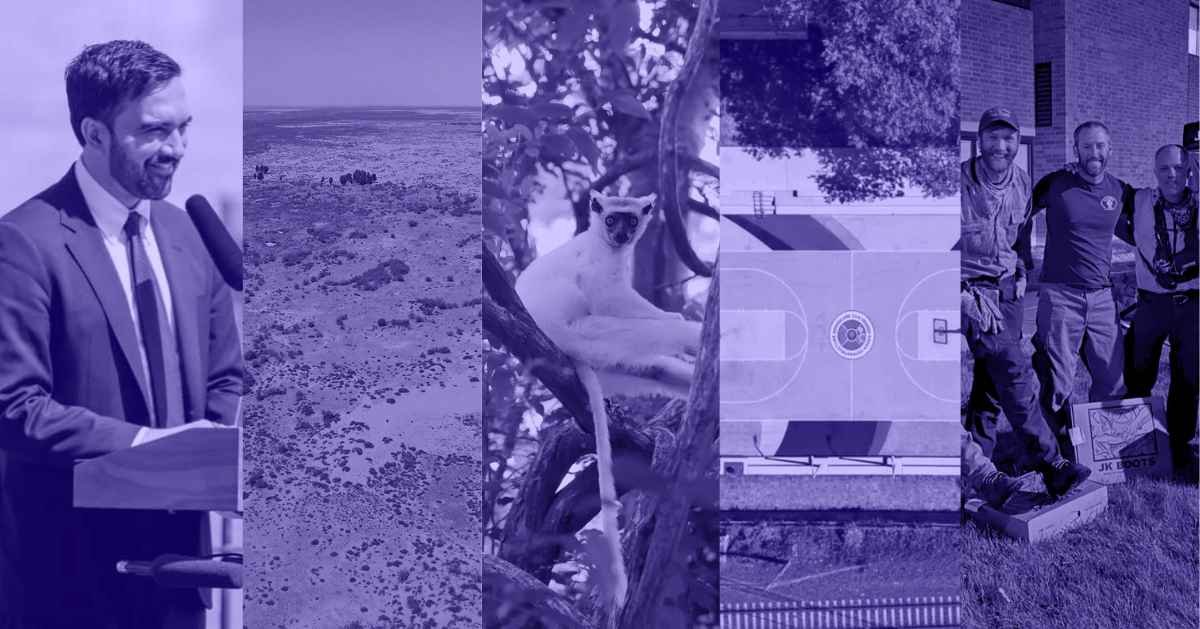
China has planted 66 billion trees in its ‘Great Green Wall’ — they appear to be growing faster than natural forests
Since 1978, China has planted 66 billion trees — with another 34 billion planned by 2050 — as part of its “Great Green Wall” aimed at slowing the Gobi and Taklamakan deserts from spreading.
Now, a new study found that planted forests, like the Great Green Wall, increased their leaf area 66% faster than natural ones. While young trees grow faster than old ones, even when comparing similar-aged forests, planted ones still grew 4.6% faster.
Reforestation efforts have been touted as a helpful solution to absorb carbon emissions and help reverse the devastating impacts of climate change — this study backs up that strategy.
What’s the nuance? The research found that the growth rate levels out when the new trees reach about 30 to 40 years old, with noticeable declines after age 40. So, while natural forests may have the advantage in the long run — planted ones could still offer huge carbon absorption benefits.
→ Read more
Kentucky asked 40 people to figure out what to do about childcare. They just achieved bipartisan reform
→ Read more
Forest fires in the Amazon rainforest fell to an all-time low in 2025
After peaking in 2024, forest fires in the Brazilian Amazon fell to a historic low last year, coinciding with a decrease in deforestation in the world’s largest rainforest.
According to satellite data, 3.1 million hectares were burned last year, the least since records began in 1985.
The Amazon’s dense vegetation is crucial to absorbing the greenhouse gas emissions that exacerbate the climate crisis. Though experts warn that the potential arrival of an “El Niño” this summer could disrupt this progress.
→ Read more
New York City just broke ground on 50K affordable homes — the public can track construction in real-time
On his first day in office, New York City Mayor Zohran Mamdani signed three executive orders to fulfill his housing agenda, including the development of the Land Inventory Fast Track, a “multi-agency effort to identify city-controlled land that is suitable for housing.”
Exactly eight months later, the city has broken ground on a large-scale affordable housing project, utilizing more than 100 city-owned sites to build an estimated 50,000 new affordable homes for New Yorkers.
The ground-breaking also comes with a new interactive tracking tool called the LIFT Tracker, a map available to any member of the public that shows real-time progress on these housing projects and available land across the city.
Why is this good news? While New Yorkers are “priced out of their homes,” Mamdani said, the city has land suitable for homes, libraries, and other community amenities. This effort, part of a larger effort to add 200,000 units of new affordable homes in the next decade, is making sure that land is actually serving the community.
→ Read more
A small New Hampshire city is building tunnels just for salamanders. They’re already saving lives
→ Read more
A Colorado couple has grown thousands of tree seedlings — and given them all away for free
Since 2007, Elizabeth Black and Chris Brown have grown over 12,000 tree and shrub seedlings in their backyard and given them away for free to anyone willing to plant them.
They were inspired by an emphatic message in the documentary, “An Inconvenient Truth:” Plant trees — lots and lots of trees. That’s when Black began studying the ins and outs of seeds: collecting, planting, germinating, and propagating.
Chris Hawkins, Colorado Urban Conservation Manager for The Nature Conservancy, believes the impact of Black and Brown’s work is immeasurable. Each donated tree provides far more than simple shade — they contribute to cleaner air, cooler neighborhoods, improved stormwater management, and better habitats for birds and pollinators.
→ Read more
Leonardo DiCaprio launched a new project dedicated to saving 100 of the world’s most endangered species
Leonardo DiCaprio just announced a new conservation endeavor called the Phoenix Species Project, an ambitious initiative dedicated to recovering 100 mammals, amphibians, reptiles, birds, fish, invertebrates, and plants that face imminent extinction.
All of these species live across a range of habitats and will require a hands-on approach from the same scientists, Indigenous Peoples, local communities, and conservation leaders who have been safeguarding them from extinction for decades.
DiCaprio said that the goal of the project, which is funded in partnership with the Bezos Earth Fund, is twofold. By saving these species from extinction, they are also saving the “anchors” of the world’s forests, wetlands, and oceans.
Why is this good news? The Phoenix Species Project is not just looking to manage the decline of critically endangered animals; it aims to recover them to the point that a species can survive in the wild on its own, without any human intervention.
→ Read more
For 60 years, people have mispronounced the world’s third-smallest country. It just reclaimed its traditional name
→ Read more
More than 80% of rural households in India now have a potable water connection
Since August 2019, India’s government has been working to make sure all 193.6 million rural households in the country have access to reliable potable water through tap water connections.
At that time, only around 32.3 million rural households had tap water connections — it has since connected around 124.3 million more with tap water supply, bringing the total to 80% of households.
Having reliable access to safe, clean water is critical for sanitation, cooking, hydration, and more — and an estimated 2.2 billion people still don’t have access globally. India is making critical progress.
→ Read more
New basketball courts in New York City double as ‘sponges’ that mitigate flash flooding
Three years after Hurricane Ida flooded New York City, the city was looking for ways to mitigate future disasters. One solution was two “sunken” basketball courts built beside New York City Housing Authority’s South Jamaica Houses in Queens.
The Water Square courts are not just a vibrant transformation of the neighborhood’s once-derelict courts, but a built-in flood mitigation system, retaining water during flash floods. Each court can hold up to 330,000 gallons of water, half the volume of an Olympic-sized swimming pool.
It can even support even more community purposes, like movie nights or farmer’s markets.
Why is this good news? As the climate crisis continues to bring more frequent, intense weather events to our communities, solutions like this demonstrate how mitigation techniques can serve multiple purposes in how it benefits the community.
→ Read more
🧽 You may also like: As climate change worsens flooding, some places are becoming ‘sponge cities’
Today’s children could be the first generation since the 1970s to do better than their parents, new studies suggest
→ Read more
Germany delivered a historic 12 billion kWh of solar energy to its public power grid in July
In July 2026, Germany reached a historic milestone in its clean energy transition — feeding a record 12 billion kilowatt-hours of solar electricity into the public power grid in a single month.
An analysis also noted that the actual volume of solar power generated was even higher, since what’s consumed on-site isn’t included in public power grid statistics.
Average midday solar power output was over 40,000 megawatts, which displaced a significant amount of electricity that would have otherwise come from coal- and gas-fired power plants. The milestone underscores the country’s rapid expansion of solar power capacity.
→ Read more
Amid the Spokane wildfires, a local bootmaker is giving firefighters new work boots for free
Wildfires in the Spokane, Washington area have burned through more than 10,400 acres and forced tens of thousands of people to evacuate. Firefighters have been battling the blazes since August 1.
To help support the people on the front lines of the wildfires, not only did local bootmaker JK Boots turn its headquarters into a relief area where they can rest, cool off, and eat — it also started giving away new pairs of work boots to firefighters for free.
Replacing firefighters’ melted, duct-taped boots, JK Boots has donated over $25,000 worth of product so far.
Why is this good news? Wildland firefighting is already an incredibly dangerous job, and firefighters deserve the proper safety gear to perform their critical, life-saving duties. JK Boots stepped up to make sure these firefighters have their basic safety needs met — and to help them know they are appreciated and supported.
→ Read more
Rescued as poaching victims, 6 rhinos defy all odds by giving birth to calves in the wild
→ Read more
Three-quarters of eggs produced in the UK today are from free-range chickens
In the 1990s and 2000s, the vast majority of eggs produced in the UK came from hens raised in small wire cages, where the animals received living space about the size of a sheet of standard printer paper.
That has changed dramatically in the last several decades, and now 75% of eggs produced in the UK are free-range.
Studies suggest that moving chickens from even slightly larger cages to a cage-free lifestyle reduces the time they spend in pain by more than half — and this progress toward free-range eggs shows even more progress is possible.
→ Read more
More good news of the week —
A new study found that listening to birdsong in a forest lowers stress more than any other setting. While both the natural setting and the birdsong helped independently, the benefits were largest when combined.
A new blood test could improve the prediction of colorectal cancer recurrence risk. Awareness around recurrence risk can help doctors develop better treatment and testing plans for patients.
Belgium’s government approved a plan to end dolphin captivity nationwide by 2037 at the latest. The country’s last remaining dolphin show will have until 2037 to rehome its remaining dolphins. The ban does not impact rescue centers.
An anonymous donor gave $100K to save a senior program set to close after federal funding cuts. The donation will help the Westmoreland County program for a year, though another program in a neighboring county is still set to end without additional funding.
Nepal’s tiger population has nearly quadrupled since 2010, climbing to 429 total. Worldwide, the wild tiger population has increased from about 3,200 in 2010 to 5,357 in 2025, and India remains home to the largest population with 3,167 tigers.
A 12-year-old student from Florida created an eco-friendly adhesive inspired by mussels. Aaisha Asif took her inspiration from the shellfish, which can cling firmly to rocks even as powerful waves crash against them thanks to the strong natural adhesive they produce.
Entrepreneurs in Atlanta have recycled 30,000 pounds of glass in three years through a doorstep pickup service. Grant Wallace launched Peace of Mind Recycling in 2023 out of concern bout the world being left behind for his son’s generation, and his co-owner joined in after seeing a truckload of glass recyclables dumped into a landfill.
A kitten found on the streets in the U.K. received a life-saving blood transfusion from a blind cat named “Carrots.” The kitten, named Dandelion, is now safely in recovery alongside 64 other rescue cats at the Bradford Cat Watch Rescue and Sanctuary.
Europe just rolled out a device that can partially restore vision loss from macular degeneration. The retinal implant, which is being heralded as the “cochlear implant for blindness,” is expected to come to America in early 2027.
The U.S. Forest Service launched an ambitious project to protect the iconic whitebark trees of the Greater Yellowstone area, and it’s working. Since 2013, the federal project has annually planted 5,000 disease-resistant seedlings in Yellowstone and Grand Teton national parks.
A Bay Area woman was the first in the U.S. to receive a groundbreaking robotic breast cancer surgery. In clinical trials, the surgery had fewer complications, less scarring, and a higher success rate of preserving nipple sensation.
Despite losing his home and most equipment, a beekeeper in Gaza is working tirelessly to keep his remaining hives alive. Before the war, Ibrahim al-Dabba owned more than 400 beehives spread across eastern Gaza — now, there are only 35 left.
Virginia Gov. Abigail Spanberger restored voting rights to 66,000 people with past felony convictions. The announcement comes ahead of the November referendum that would automatically restore the right to vote after release from incarceration.
Texas broke its all-time electricity demand record twice in two days during a brutal heat wave, but the power grid held strong. The grid’s resilience was largely attributed to the state’s massive growth of solar generation, which at times exceeded 45% of all electricity being generated.
Families in India living in slums were given the opportunity to transform one-room shacks into their dream homes. The Sanjaynagar Redevelopment Project engaged 937 Sanjaynagar residents in solving their own housing crisis.
According to an independent safety study, Waymo robotaxis crashed 68% less often than human drivers. While the report aligned with company-reported safety data, it also highlighted gaps in how autonomous vehicle data is collected and compared.
A California school district completed a 3.5 megawatt solar project that will save it $48 million in energy costs. Students use data from the solar arrays to study energy production and consumption patterns in math and science modules, while the project provides a pathway for STEM education and career exposure.
Conservationists say Glen Affric in the Scottish Highlands has its first wild-born beavers in more than 400 years. A local charity said there were at least two babies known to have been born following the release of seven beavers in October and a family of four in February.
In July, electric vehicles accounted for 97% of new car registrations in Denmark. The number of electric cars on Danish roads is expected to reach one million by 2027.
Tens of thousands of young people received the first dose of the meningitis B vaccine in just 2 weeks. The NHS launched its largest-ever catch-up campaign for the virus, giving 89,261 first doses, many to people preparing to go to college in the fall.
Effective immediately, France banned all imports of hunting trophies from protected species. Lawmakers noted that the country has been one of Europe’s largest importers of hunting trophies from protected species in recent years, making the measure an important milestone for wildlife conservation.
New Mexico flipped the state’s electricity supply from majority fossil fuels to majority renewables in just five years. And even while it was building out its clean energy future, electricity prices remained cheaper than average.
For the first time in three decades, a baby puffin was spotted on England’s Dorset coast. In the 1950s, there were about 80 birds nesting there, but the number of pairs dropped to three, and there had been no definitive sightings of fledglings for 30 years.
To protect endangered animals, a wildlife vet is empowering and educating their human neighbors. Kalema-Zikusoka’s nonprofit, Conservation Through Public Health, has engaged more than 50,000 local people in health and economic initiatives – and grown Uganda’s mountain gorilla population by more than 50%.
Three U.S. states have now banned “surveillance pricing” to charge certain customers more. Connecticut, Maryland, and New Jersey have all cracked down on surveillance pricing, which uses personal data such as browsing history or shopping habits to set individualized prices on goods and services.
A new study shows that cougars cut deadly car accidents from crossing deer by up to 76%. Big cats in North America don’t have the best reputation; people often cite concerns of attacks, but experts say that they are few and far between.
Minnesota just plugged a 710-megawatt solar farm into a coal plant that once burned 30,000 tons a day. The unique approach to connecting the panels to the grid allowed it to sidestep a typically years-long connection process.
Colorado’s Youth Mental Health Corps in schools has improved student attendance and behavior. The national service initiative that places near-peer mental health navigators in middle and high schools to help support students and develop the next generation of behavioral health professionals.
India launched the first hydrogen-powered train built in the country to expand clean energy on railways. The train is made up of two hydrogen-powered driving cars and eight passenger coaches and can run at speeds of up to 47 mph and carry a maximum of about 2,600 passengers.
Conservationists in Guatemala are breeding one of the world’s most endangered lizards in a bid to save the species. They hope to rebuild wild populations decimated by habitat loss and their popularity in the illegal pet trade.
