


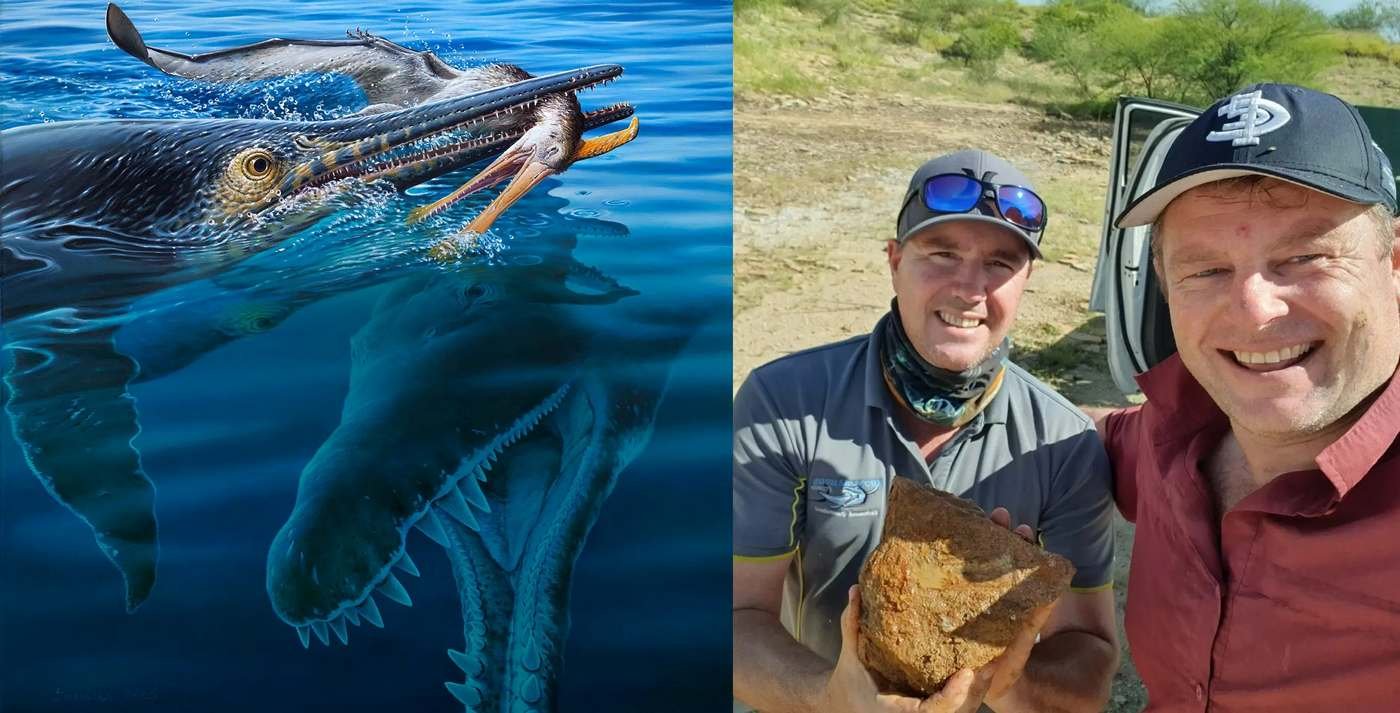
An artist’s illustration of the event, (right) Dr. White and Kevin Petersen holding the pterosaur remians – credit, Kronosaurus Korner Museum, released
In what must rank as one of the rarer fossil assemblages ever discovered, an incredible moment where the whole top-third of the Cretaceous era marine food chain was being sorted out has been presented by scientists.
Following 7 years of study, the jumble of bones is nothing less than the remains of a flying reptile known as a pterosaur lodged inside the stomach of an ichthyosaur—a large and widely-dispersed, versatile marine predator.
The ichthyosaur’s body was determined to have been mangled by something even larger—likely a pliosaur, and perhaps even Kronosaurus queenslandicus, the largest pliosaurid known to have lived, and as the species name suggests, was first discovered in the Australian state of Queensland, where the fossil jumble was found.
“[It is] a marine reptile crime scene, and it did take a bit of working out to tell that story,” Dr. Matt White, a paleontologist at the University of New England in Australia and lead author of the study presenting the discovery, tells ABC News Down Under.
The story of said discovery begins in 2019 when recreational fossil hunters were out for a day’s “fossicking,” an Aussie term for prospecting for minerals, gems, and fossils on a recreational or amateur basis, but with a license.
Two couples, Mike and Cathy Freeman and Gary and Barb Flewelling, found several large bones, jotted down their location, and donated them to a local paleontological museum dedicated to the research of the prehistoric sea which used to cover Queensland.
Unsure of what to make of the assemblage of fossils, the museum curators respectfully labeled them as “Bob” short for “bag o’ bones.”
3 years later, the curator at Kronosaurus Korner museum Kevin Petersen returned to the site and uncovered the rest of what proved to be a large, partially articulated ichthyosaur skeleton stretching almost 21 feet across the excavation.
The remains bore the signs of a brutal attack, with missing ribs, bones punctured by teeth, and disfigured vertebrae. At roughly 18-20 feet in length the ichthyosaur, like a cross between a crocodile and a dolphin, was a formidable and versatile hunter and large to boot. Petersen and the rest of the staff knew that only one thing could have wrapped its jaws around the body of the creature—a pilosaur.
Pliosaurs were aquatic carnivorous reptiles, not dinosaurs, that lived between 220 and 70 million years ago. Their short necks have seen them depicted like fish with the mouth of a crocodile, or something awfully similar to a seal, but they were enormous hunters, capable of reaching an impressive 10 meters in body length.
ANCIENT DEEP SEA DISCOVERIES: World’s Largest ‘Whale Graveyard’ Teems with Deep-Sea Life Including Species Unknown to Science
Dr. White and his co-authors wrote in their study that, up until now, very little evidence of pliosaur bites have been documented—their mouths were so large they left little behind to fossilize. The evidence on the torso of the ichthyosaur is one of an initial crushing bite, followed by several repositioning or tearing bites—notably similar to how crocodilians take prey still to this day.
This was a novel interaction of pliosaur-ichthyosaur food chain relations, but it would get stranger not long after.
More than 600 volunteer and staff hours were invested preparing the ichthyosaur specimen for examination before several unusual rock nodules behind the skull prompted scientists to investigate further. Rather than breaking the rocks apart and risking damage, researchers sent them to the Australian Nuclear Science and Technology Organization (ANSTO), where advanced synchrotron CT scanning allowed scientists to look inside without destroying the fossil.
MORE BOMBASTIC FOSSILS: Release the Kraken: 60-foot Octopuses Were Top Predators 100 Million Years Ago, Fossils Shows
There, they found the remains of fish, squid, and the jawbone of a pterosaur—a family of flying reptiles that ruled the skies during the age of the dinosaurs. Whether the ichthyosaur had snatched a pterosaur from the sky or fed upon it in a scavenging event is impossible to know, and the researchers believe the partially-digested remains were catapulted up towards the animal’s head from the force of the pilosaur’s bite, though they admit there’s a very small chance it could also have simply fallen atop the ichthyosaur’s remains from the ocean above.
More likely, they wrote, it’s the first confirmed evidence that ichthyosaurs ate pterosaurs.
“It’s one of the clearest examples ever discovered of a three-tier predator interaction and offers an unprecedented snapshot of behavior in Australia’s Cretaceous seas,” stated Dr. Dean Lomax, a renowned paleontologist who recently visited Australia for the first time during Queensland Dinosaur Week.
FOSSILIZED EVENTS: ‘Impossible Fossil’ Preserves the Exact Moment the Dinosaurs Died: ‘It’s Absolutely Bonkers’
Speaking further with ABC, Dr. White said that the exact sequence of predation is unknown, but that’s the “exciting thing.”
“[We just know] this is what’s happened to the fossil, and what happened in the exact term of events we don’t know, but that’s half the exciting thing of paleontology.”
“But did the actual kronosaurus leap out of the water and smash the ichthyosaur? Or was the ichthyosaur breaching the water and snatching a pterosaur out of mid-air to eat?” he added.
SHARE This Incredible Discovery With Your Friends Who Love Fossils…
