


[The content of this article has been produced by our advertising partner.]
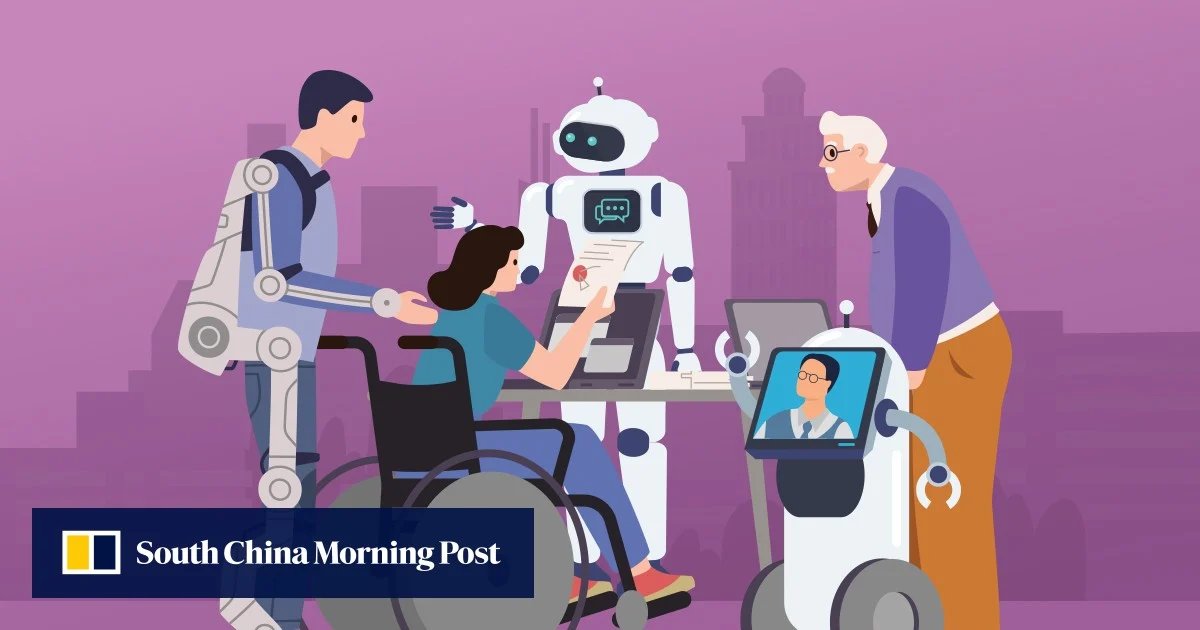
It’s no longer shocking to see robots working in restaurants and hotels. To create more inclusive opportunities, some businesses employ people with disabilities to control these service robots. The operator’s face appears on the robot’s screen, maintaining a human touch while promoting inclusion.
These telepresence robots, also known as avatar robots, allow individuals with mobility disabilities to navigate around physical barriers and engage in work interactions remotely. “Robotic technology has significant potential to enable hospitality and tourism companies to hire people with disabilities despite their mobility restrictions, creating a meaningful social impact,” says Choi Sungwoo, Assistant Professor of the School of Hotel and Tourism Management at the Chinese University of Hong Kong (CUHK) Business School.
In addition to telepresence robots, wearable robotic technologies, such as exoskeletons and bionic arms, have also made it possible for people with physical disabilities to stand, walk and perform daily tasks that may be impossible with traditional prosthetics and mobility aids. While not widely adopted in workplaces, these technologies promise to further empower individuals with disabilities to participate in the job market.
Many companies and universities are now developing technologies to help individuals with limited mobility. However, little is known about how consumers actually feel, especially when different kinds of robotic technology are now available. To address this gap, Professor Choi, together with Sara Kim of the University of Hong Kong, recently conducted a study titled Consumer perception of employees with disabilities using robots.
“We found that not all technologies are perceived equally,” says Professor Choi. “Consumers generally prefer in-person interactions, either when employees use advanced technologies like wearable robots or traditional aids such as wheelchairs, compared to employees working through telepresence robots.”
The findings suggest that companies should feel confident about hiring individuals with disabilities, as consumers usually react positively as long as they can provide in-person service. As employing people with disabilities onsite not only promotes diversity and fairness but also enhances the overall consumer experience, companies aiming to create an inclusive environment may find assistive technology a worthy investment.
Mixed reactions to telepresence
In their first experiment, Professor Choi and his collaborator recruited around 200 participants from an online data platform, Prolific, and examined consumer reactions towards services provided by employees with disabilities in different scenarios.
Participants were asked to imagine visiting an art museum and rate their likelihood of choosing a guide from three options: an in-person guide using a wheelchair, a guide operating remotely via a telepresence robot, and an in-person guide without disability.
The result shows that participants are less likely to choose the guide using a telepresence robot than either of the in-person guides. Furthermore, the guide in a wheelchair is chosen even more often than the guide with no disability. A second experiment conducted at a public university with 85 participants in a real-world setting confirmed the same findings.
Psychological and social disconnection
Why are telepresence robots less accepted? The researchers attribute it to a psychological phenomenon where people subconsciously perceive them as lacking warmth and emotions. This happens because consumers struggle to look past the machine’s physical form to connect with the human operator, effectively overlooking the employee’s feelings and personal qualities.
When consumers speak with employees through a screen, they may feel as if they’re engaging with machines rather than a real person, due to the physical separation and the robotic nature of the interaction, explains Professor Choi. “Service employees with disabilities working through telepresence robots may inadvertently create a sense of psychological distance from consumers, resulting in feelings of social disconnection,” he adds.
Physical presence is key in hospitality
To explore how to ease potential concerns towards employees who provide service via telepresence robots, the researchers conducted a third experiment, recruiting nearly 200 people from Prolific. This time, participants were presented with scenarios involving a restaurant server. Similar to the previous experiments, the server was either working remotely through a robot, working onsite using a bionic arm, or working onsite without disabilities.
Across three experiments, consumers were less receptive to frontline staff working remotely. Professor Choi notes that the findings suggest physical presence is paramount in frontline service roles. No matter whether the staff is using a traditional wheelchair or a cutting-edge wearable robot, consumers’ responses are as positive as they are towards employees without disabilities.
Using technology more thoughtfully
While employing remote-controlled robots sounds like a win-win solution, companies must recognise that some technologies foster acceptance and inclusion, whereas others may backfire.
Given consumers’ reactions to telepresence robots, Professor Choi recommends that companies committed to social inclusion prioritise assistive technologies like mobility aids or wearable robotics for frontline employees. He also encourages governments and NGOs to provide financial assistance to individuals and businesses that cannot afford these technologies.
Nevertheless, telepresence robots can still play a role. “They can offer valuable opportunities for individuals with disabilities to engage in the workforce, especially in behind-the-scenes roles like accounting and admin support, or when in-person work isn’t possible, such as during natural disasters, severe weather conditions, or personal injury,” says Professor Choi. In these cases, he emphasises the need for additional efforts to maintain personal connection through warmth and empathy, bridging the psychological gap that technology may create.
Finally, it is crucial to take the perspective of people with disabilities into prime consideration. Professor Choi notes that many people with disabilities are hesitant to enter the workforce, often due to a lack of confidence rather than employer reluctance. Based on the current research, he plans to explore how robotic technologies influence employees’ job performance and identity perceptions in his future studies.
“With the advancement of robotic technologies, we hope more people with disabilities can access these tools, navigate around physical barriers, and become more active in the workplace and society at large.”
About Professor Choi Sungwoo
Professor Choi Sungwoo is an Assistant Professor of the School of Hotel and Tourism Management at CUHK Business School. His research focuses on bridging the literature on social psychology with that on consumer behaviour, with a particular interest in service innovation and technology.
