


The trust fund that supplements incoming payroll taxes to pay monthly Social Security benefits is projected to be depleted in the last three months of 2032, which will force an immediate, across-the-board 22% benefits cut, the latest Board of Trustees report said.
For the past 16 years, the cost of Social Security’s retirement program has exceeded the amount it receives from taxes collected from paychecks, forcing it to dip into its trust fund reserves to cover the shortfall. Last year, the trust fund was forecast to run out in 2033. Then, in August, the date was moved up to the end of 2032 due to tax provisions in the One Big Beautiful Bill Act that passed almost a year ago.
If Congress doesn’t act and allows the trust fund to empty, the program will only pay out what the government collects in taxes. On average, beneficiaries would lose about $500 monthly, the nonprofit Committee for a Responsible Budget estimates.
“This should be a wake-up call: Congress needs to act,” said Myechia Minter-Jordan, chief executive at AARP, a nonprofit, nonpartisan organization representing older adults. “Americans have worked hard and paid into Social Security their entire lives, and they deserve to count on it when they retire. “
Why is November key for Social Security?
Senators elected in November will be part of the class that either lets Social Security’s trust fund run dry or implements reforms, analysts noted.
“These insolvency dates may feel abstract and far away, but the reality is that the senators elected in 2026 will be in office when Social Security reaches insolvency,” said Margaret Spellings, president and chief executive of the Bipartisan Policy Center. “The question is no longer whether these challenges demand attention. It is whether Washington will find the will to act.”
According to a nonprofit, nonpartisan Peterson Foundation poll, jointly conducted by Democratic firm Global Strategy Group and Republican firm North Star Opinion Research, in late May:
96% of voters nationwide are urging candidates to clearly explain their plans to prevent automatic Social Security benefit cuts.
That includes 96% of Democrats, 92% of independents and 97% of Republicans.
It also includes at least 94% of voters across each of the age brackets: 18-29; 30-44; 45-54; 55-64; and 65+.
The “survey makes it clear that, across party lines, voters overwhelmingly want solutions from candidates this election season,” said Michael Peterson, the foundation’s chief executive.
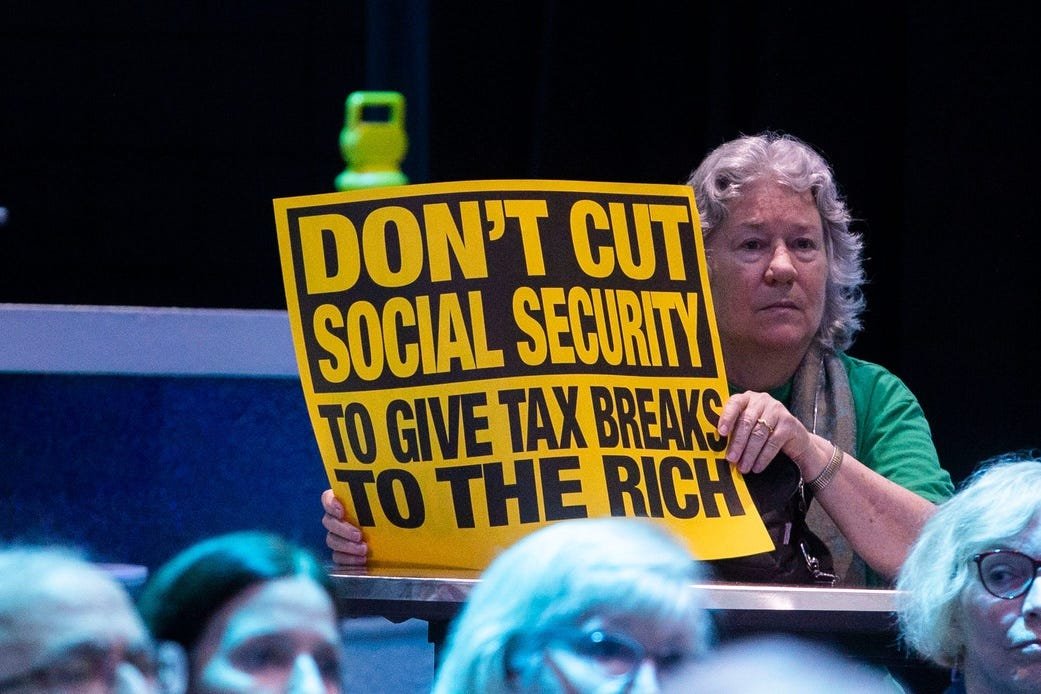
People listen during a town hall on Social Security hosted by the Leon County Democrats with former Commissioner of Social Security Administration Martin O’Malley speaking May 9, 2025. Mishalynn Brown/Tallahassee Democrat / USA TODAY NETWORK via Imagn Images
How can Congress protect Social Security benefits?
There have been no lack of ideas, only lack of will, to “fix” Social Security so benefits don’t get cut. Over the past several years, they’ve included:
The “six-figure limit,” or capping annual Social Security benefits at $100,000 for couples
Raise or eliminate the income cap that can be taxed to fund Social Security benefits. In 2026, only incomes up to $184,500 are taxed to pay for benefits.
Increase the 12.4% payroll tax on your income that goes to Social Security payments. The payroll tax is usually split between you and your employer so each pays 6.2%.
Raise the full retirement age (FRA) to receive maximum Social Security benefits. Until the 1980s, 65 was considered FRA, but in 1983, with Social Security facing insolvency, Congress passed legislation that gradually raised the full retirement age to 67. In 2026, FRA was at 67, and some researchers think FRA should be raised again.
“As in 1983, legislators can institute reforms that will ensure the fiscal health of the program for another 75 years, or in perpetuity,” wrote Stephen Nuñez, the progressive Roosevelt Institute’s director for stratification economics. “In fact, they could have done so at any point in the past two decades (at considerably less cost).”
Congress has “a host of options to close the fiscal shortfall and secure the Social Security Trust Fund against future unanticipated developments. The question is not whether we can fix Social Security, but rather who will bear the costs when we do,” he said.
Medora Lee is a money, markets, and personal finance reporter at USA TODAY. You can reach her at mjlee@usatoday.com and subscribe to our free Daily Money newsletter for personal finance tips and business news every Monday through Friday.
This article originally appeared on USA TODAY: Social Security fund to dry up in 2032. Beneficiaries face 22% pay cut
