

Close Menu

    Subscribe to Updates

    Get the latest creative news from FooBar about art, design and business.

    What's Hot

    7 Things to Try When Affirmations Just Aren’t Working for You

    August 18, 2026

    11-week-old puppy fulfills hospice patient’s last wish

    August 18, 2026

    7 Ways To Work With Verbal Processing When You Think Out Loud

    August 18, 2026
    Facebook X (Twitter) Instagram
    Trending
    • 7 Things to Try When Affirmations Just Aren’t Working for You
    • 11-week-old puppy fulfills hospice patient’s last wish
    • 7 Ways To Work With Verbal Processing When You Think Out Loud
    • Construction Worker Discovers Gold Hoard After Literally Striking a Gold Bar with His Jackhammer
    • Accessible housing means dignity, not just ramps and doorways
    • Claiming Social Security and Still Working? Above $24,480, the Earnings Limit Takes Back $1 of Every $2
    • Threatened Bird Species Given Tiny Foot Casts to Help Recovery After Hit by Car
    • 16 Strategies to Forgive Yourself for Past Mistakes
    Moving MountainsMoving Mountains
    Facebook X (Twitter) Instagram
    Tuesday, August 18
    • Home
    • Mental Health
    • Life Skills
    • Self-Care
    • Well-Being
    • Awareness
    • Inspiration
    • Workers Comp
    • Social Security
      • Injuries
      • Disability Support
      • Community
    Moving MountainsMoving Mountains
    Home » Scientists follow 2,000-pound sea turtle with tracking device
    Community

    Scientists follow 2,000-pound sea turtle with tracking device

    TECHBy TECHJune 2, 2026No Comments3 Mins Read
    Facebook Twitter Pinterest LinkedIn Tumblr Reddit WhatsApp Email
    Search
    Share
    Facebook Twitter LinkedIn Pinterest WhatsApp Email

    Fewer than 1,000 leatherback sea turtles remain in the Eastern Pacific, nesting along the coastline that runs from Mexico to Ecuador.

    Scientists have previously fitted tracking devices to leatherbacks on other beaches across Latin America and from bycatch near Ecuador. However, they recently tagged the first nesting leatherback in Ecuador, the southern limit of the species’ nesting range.

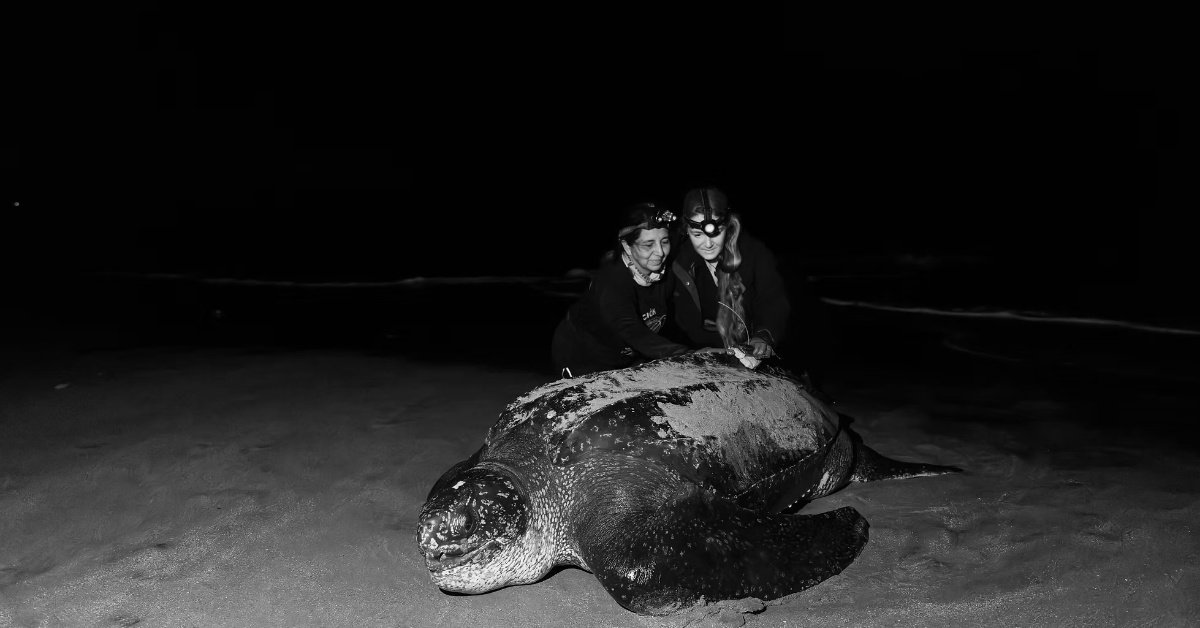
    Scientists named the turtle Lucero, “morning star” in Spanish, and estimated her age at 25-40 years. They plan to gather data on her migration and feeding patterns, which should help inform conservation policies for the critically endangered subpopulation. (Globally, the species, Dermochelys coriacea, is listed as vulnerable.)

    Researchers from Ecuador-based Fundacion Reina Laud were at sea when they first spotted Lucero heading toward a remote stretch of beach to nest. They alerted Callie Veelenturf, a marine conservation biologist and founder of the U.S.-based Leatherback Project.

    The team didn’t know where Lucero would emerge, so they stationed people the length of the beach with radios to watch out for her, according to Veelenturf.

    “It was really quite an adventure because we just spent multiple nights out on the beach waiting for her,” she told Mongabay in a video call.

    When sea turtles lay eggs, they enter a trance-like state in which they don’t seem to notice activity around them, Veelenturf said.

    That’s when the team attached a satellite tag to the top of Lucero’s shell. Now, each time she surfaces to breathe, the tag pings a satellite and transmits information about her movements.

    A female leatherback sea turtle returning to the ocean after laying her eggs, tagged with a satellite transmitter on Playa Pajonal, Ecuador. All photos taken with red light only under Ministry of the Environment and Energy permits. Photo by Will Lucero

    Leatherbacks can be found across most of the world’s oceans, but the eastern Pacific subpopulation has declined by roughly 98% over the last several decades. One of their biggest threats is getting caught in fishing nets as bycatch, which can be deadly for turtles and expensive for fishers, whose nets get damaged in these entanglements.

    By tagging Lucero, the researchers want to learn where she travels, when, and how deep she dives. With that information, they can better advise fishers on how to avoid areas frequented by sea turtles.

    “We wanted to understand how the habitat use and the fishing grounds use is overlapping,” Veelenturf said.

    She added that fishers have another practical motivation for helping the 900-kilogram (2,000-pound) turtles: “They can eat their weight in jellyfish every single day, and jellyfish consume juvenile fish and fish larvae. So when you have a healthy leatherback population, [it] supports healthy fish stocks and fishing communities in turn.”

    Since laying her eggs, Lucero has migrated south to coastal Peru, her tracker shows. The tag will likely stay attached for a year or two, though Veelenturf said she hopes it lasts long enough to trace Lucero’s migration route and foraging grounds.

    “Every day I check it and hold my breath and wait to see the transmitting signal,” she said.

    ‍

    This article was originally published on Mongabay.

    ‍

    Header image: Callie Veelenturf and Kerly Briones with Lucero on Playa Pajonal, Ecuador. Photo by Nikki Riddy.

    2000pound Device Follow Scientists Sea Tracking Turtle
    TECH
    • Website

    Related Posts

    11-week-old puppy fulfills hospice patient’s last wish

    August 18, 2026

    Threatened Bird Species Given Tiny Foot Casts to Help Recovery After Hit by Car

    August 18, 2026

    Can festivals leave the land better than they found it?

    August 18, 2026
    Leave A Reply Cancel Reply

    Don't Miss
    Inspiration

    7 Things to Try When Affirmations Just Aren’t Working for You

    By TECHAugust 18, 20260

    In the vast universe of self-help and personal development, affirmations have emerged as a shining…

    11-week-old puppy fulfills hospice patient’s last wish

    August 18, 2026

    7 Ways To Work With Verbal Processing When You Think Out Loud

    August 18, 2026

    Construction Worker Discovers Gold Hoard After Literally Striking a Gold Bar with His Jackhammer

    August 18, 2026
    Stay In Touch
    • Facebook
    • Twitter
    • Pinterest
    • Instagram
    • YouTube
    • Vimeo
    Our Picks

    7 Things to Try When Affirmations Just Aren’t Working for You

    August 18, 2026

    11-week-old puppy fulfills hospice patient’s last wish

    August 18, 2026

    7 Ways To Work With Verbal Processing When You Think Out Loud

    August 18, 2026

    Construction Worker Discovers Gold Hoard After Literally Striking a Gold Bar with His Jackhammer

    August 18, 2026

    Subscribe to Updates

    Get the latest creative news from SmartMag about art & design.

    About Us

    At Moving Mountains, we believe that every individual has strength, value, and purpose—regardless of mental health challenges or physical disabilities. This platform was created to inspire hope, promote understanding, and empower people to live meaningful and confident lives beyond limitations.

    Latest Post

    7 Things to Try When Affirmations Just Aren’t Working for You

    August 18, 2026

    11-week-old puppy fulfills hospice patient’s last wish

    August 18, 2026

    7 Ways To Work With Verbal Processing When You Think Out Loud

    August 18, 2026
    Recent Posts
    • 7 Things to Try When Affirmations Just Aren’t Working for You
    • 11-week-old puppy fulfills hospice patient’s last wish
    • 7 Ways To Work With Verbal Processing When You Think Out Loud
    • Construction Worker Discovers Gold Hoard After Literally Striking a Gold Bar with His Jackhammer
    • Accessible housing means dignity, not just ramps and doorways
    Facebook X (Twitter) Instagram Pinterest
    • About Us
    • Contact Us
    • Privacy Policy
    • Terms & Conditions
    • Disclaimer
    © 2026 movingmountains. Designed by Pro.

    Type above and press Enter to search. Press Esc to cancel.