

Close Menu

    Subscribe to Updates

    Get the latest creative news from FooBar about art, design and business.

    What's Hot

    Social Security Recipients: July Payments Schedule and Extra SSI Payment Details

    June 26, 2026

    Family Happiness Through Mindful Awareness

    June 26, 2026

    How You Furnish Your First Place Says More About Your Mindset Than You Think

    June 26, 2026
    Facebook X (Twitter) Instagram
    Trending
    • Social Security Recipients: July Payments Schedule and Extra SSI Payment Details
    • Family Happiness Through Mindful Awareness
    • How You Furnish Your First Place Says More About Your Mindset Than You Think
    • Why Depression and Anxiety Overlap—and How Therapists Recommend Managing Both Conditions
    • Social Security July payment schedule: Here’s when recipients get their checks
    • Jet skiers save dying sea turtle with ‘bloody, peeling’ infection
    • I’m 62 With $800,000 and $2,600 Monthly Social Security Income. What Can I Spend in Retirement?
    • 50 Words of Encouragement for Seniors & the Elderly
    Moving MountainsMoving Mountains
    Facebook X (Twitter) Instagram
    Friday, June 26
    • Home
    • Mental Health
    • Life Skills
    • Self-Care
    • Well-Being
    • Awareness
    • Inspiration
    • Workers Comp
    • Social Security
      • Injuries
      • Disability Support
      • Community
    Moving MountainsMoving Mountains
    Home » A New York Cemetery Was Hiding Over 5 Million Burrowing Bees, One of the World’s Largest Concentrations
    Community

    A New York Cemetery Was Hiding Over 5 Million Burrowing Bees, One of the World’s Largest Concentrations

    TECHBy TECHMay 29, 2026No Comments4 Mins Read
    Facebook Twitter Pinterest LinkedIn Tumblr Reddit WhatsApp Email
    A New York Cemetery Was Hiding Over 5 Million Burrowing Bees, One of the World's Largest Concentrations
    Share
    Facebook Twitter LinkedIn Pinterest WhatsApp Email

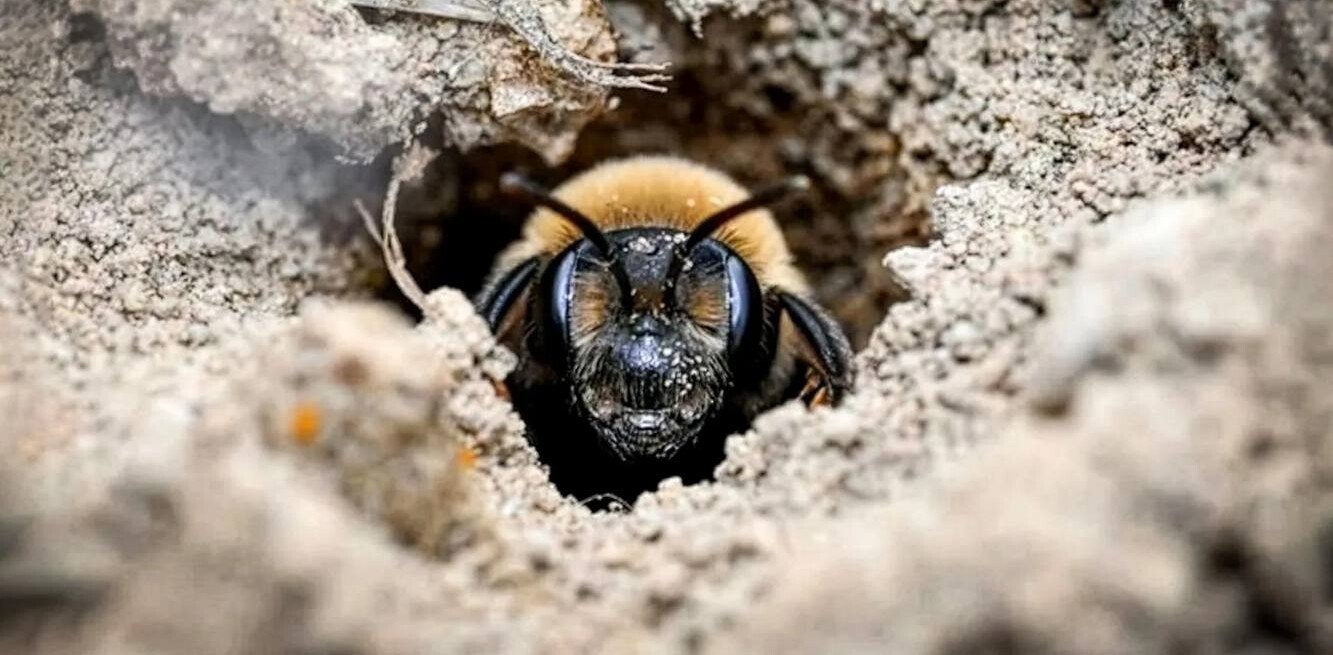
    Andrena regularis bee nesting near the east lawn cemetery entrance – credit, Bryan Danforth

    At roughly 5.5 million, a colony of ground-nesting bees that scientists discovered under a New York cemetery may be one of the largest bee aggregations ever documented.

    Subsequent research showed that the bees have likely lived there for more than 100 years, thriving in the cemetery’s undisturbed sandy soil—an incredible discovery.

    Rachel Fordyce used to save money by parking at Ithaca’s East Hill Plaza and walking through East Lawn Cemetery on her way to work at a Cornell University entomology lab. During one walk in the spring of 2022, she noticed something unusual. Bees were everywhere.

    She collected some in a jar and brought them to her supervisor, Bryan Danforth, professor of entomology in Cornell’s College of Agriculture and Life Sciences.

    “These are all over the cemetery,” she told him. The insects were identified as Andrena regularis, commonly called the “regular mining bee,” a solitary wild bee species that nests underground and helps pollinate crops and wild plants.

    That simple observation led to the extraordinary discovery: a 100-year-old colony of 5.5 million solitary bees across 1.5 acres. According to the researchers, that is comparable to more than 200 honeybee hives, and exceeds Manhattan’s human population by more than threefold.

    “I’m sure there are other large bee aggregations that exist around the world that we just haven’t identified, but in terms of what is in the literature, this is one of the largest,” said Steve Hoge, lead author of the resulting study on the colony published April 13th in the journal Apidologie.

    To estimate the bee population and study emergence patterns, researchers used a new monitoring method involving emergence traps. These small mesh tents cover less than a square meter of ground and funnel emerging insects into glass jars.

    “You capture a whole community of animals coming out of the ground with this approach,” Danforth said.

    Between March 30th and May 16th, 2023, the research team placed 10 traps throughout the cemetery. They collected 3,251 insects representing 16 species of bees, beetles, and flies. A. regularis overwhelmingly dominated the samples.

    Researchers used the number of bees captured in each trap to calculate average bee density across the cemetery’s total land area. Based on those calculations, the estimated total population ranged from about 3 million to 8 million bees.

    The study also explored the biology of these poorly understood wild bees while also highlighting their importance as pollinators for valuable agricultural crops such as apples, one of New York’s signature commodities.

    “The research elevates the value of solitary ground-nesting bees and shows just how abundant these bees are, how important they are as crop pollinators, and that we need to be aware of these nest sites and preserve them,” Danforth said.

    Historical records showed that A. regularis has been present at East Lawn Cemetery since at least the early 1900s. The cemetery itself dates back to 1878.

    Scientists say the discovery strengthens the idea that cemeteries can act as important refuges for biodiversity. Older cemeteries, especially in cities, are already known to shelter uncommon plants, insects, birds, and mammals.

    BEE-AUTIFUL DISCOVERIES: Unique Honeybees Found Only in Southern California Can Fend Off Deadly Varroa Mites

    Keven Morse, superintendent of East Lawn Cemetery, said he has seen deer, geese, hawks, foxes, coyotes, and countless bees during his family’s 46 years helping manage the nonprofit cemetery.

    “I just felt bad having to mow in certain areas,” Morse told a Cornell University news team. “There’s probably three or four sections where they really migrate heavy, there’s a lot of them.”

    Researchers explained that cemeteries provide especially good habitat because the land is peaceful, rarely disturbed, and largely free of pesticides.

    WORK FROM CORNELL: Cornell Researchers Create First-of-its-Kind Durable and Recyclable Plastic

    Cornell Orchards, located about one third of a mile from the cemetery, may help support the massive bee population by providing abundant spring flowers. Danforth also noted that the bees prefer sandy soil, which the cemetery contains in large amounts.

    “These populations are huge, and they need protection,” Danforth said. “If we don’t preserve nest sites, and someone paves over them, we could lose in an instant 5.5 million bees that are important pollinators.”

    SHARE This Incredible Discovery In Eastern Ithaca With Your Friends… 

    Bees Burrowing Cemetery Concentrations Hiding Largest Million Worlds York
    TECH
    • Website

    Related Posts

    Jet skiers save dying sea turtle with ‘bloody, peeling’ infection

    June 26, 2026

    Influencer fills pool with 50K pickles, breaking world record

    June 26, 2026

    Unique Double Cochlear Implant Surgery Lets Twins Hear Mom’s Voice for the First Time

    June 26, 2026
    Leave A Reply Cancel Reply

    Don't Miss
    Social Security

    Social Security Recipients: July Payments Schedule and Extra SSI Payment Details

    By TECHJune 26, 20260

    As July 4th approaches, those collecting Social Security benefits may be wondering about how the…

    Family Happiness Through Mindful Awareness

    June 26, 2026

    How You Furnish Your First Place Says More About Your Mindset Than You Think

    June 26, 2026

    Why Depression and Anxiety Overlap—and How Therapists Recommend Managing Both Conditions

    June 26, 2026
    Stay In Touch
    • Facebook
    • Twitter
    • Pinterest
    • Instagram
    • YouTube
    • Vimeo
    Our Picks

    Social Security Recipients: July Payments Schedule and Extra SSI Payment Details

    June 26, 2026

    Family Happiness Through Mindful Awareness

    June 26, 2026

    How You Furnish Your First Place Says More About Your Mindset Than You Think

    June 26, 2026

    Why Depression and Anxiety Overlap—and How Therapists Recommend Managing Both Conditions

    June 26, 2026

    Subscribe to Updates

    Get the latest creative news from SmartMag about art & design.

    About Us

    At Moving Mountains, we believe that every individual has strength, value, and purpose—regardless of mental health challenges or physical disabilities. This platform was created to inspire hope, promote understanding, and empower people to live meaningful and confident lives beyond limitations.

    Latest Post

    Social Security Recipients: July Payments Schedule and Extra SSI Payment Details

    June 26, 2026

    Family Happiness Through Mindful Awareness

    June 26, 2026

    How You Furnish Your First Place Says More About Your Mindset Than You Think

    June 26, 2026
    Recent Posts
    • Social Security Recipients: July Payments Schedule and Extra SSI Payment Details
    • Family Happiness Through Mindful Awareness
    • How You Furnish Your First Place Says More About Your Mindset Than You Think
    • Why Depression and Anxiety Overlap—and How Therapists Recommend Managing Both Conditions
    • Social Security July payment schedule: Here’s when recipients get their checks
    Facebook X (Twitter) Instagram Pinterest
    • About Us
    • Contact Us
    • Privacy Policy
    • Terms & Conditions
    • Disclaimer
    © 2026 movingmountains. Designed by Pro.

    Type above and press Enter to search. Press Esc to cancel.