


Discussion
This study used a combination of a scoping review, electronic survey and focus groups to establish whether the current CEP standards and guidelines were fit for purpose by reaching a consensus on a complete, definitive list of the key knowledge and skills required by a registered CEP in the UK. The respondents to the survey consisted of a variety of different stakeholders with a wide range of clinical exercise experience and expertise. An overall agreement level of 98% was identified across CEP knowledge and skill requirements; however, one domain (behaviour change and communication) dropped to 93% and had no content that had 100% agreement. Although still accepted, within the section behaviour change and communication, the criteria labelled ‘understanding contemporary evidence-based theories of behaviour change’ were somewhat less valued skills for a CEP compared with others. Interestingly, behaviour change implementation within clinical services has previously been identified as unstandardised and without a clear strategy for its delivery by registered CEPs.29 Previous research30 acknowledges that a service-wide multidisciplinary team (MDT) approach to behaviour change is optimal. Therefore, CEPs, as part of an MDT, should be sufficiently skilled to contribute in this area and support patients with an empathetic, empowering and autonomous approach, given the evidence of positive long-term behaviour change of patients once skills are mastered by staff.31 32 It cannot be underestimated how important it is for such skills (theoretically learnt in an academic setting) to be developed through real-life application,33 yet less emphasis was placed on these skills compared with exercise-based content by respondents, even though more recent evidence suggests it is an area of competence that is lacking across healthcare professionals (and possibly the expert group) as a whole.34
The highest levels of agreement came in the areas of ‘exercise design and delivery‘, ‘clinical practice‘ and ‘assessment of health status and functional capacity‘ (98%, 99% and 99%, respectively). The ability to prescribe safe and effective exercise, in combination with the skills and competence to deliver the information in a technically correct manner to patients, has previously been identified as fundamental to the role of a CEP.35 36 In parallel, high levels of knowledge and skills in clinical practice, for example legal and ethical professional boundaries, record keeping and quality assurance, have been acknowledged as underpinning the role of CEPs.9 Further, the understanding of current health status, specifically the use of clinical assessments such as cardiopulmonary exercise tests, was acknowledged as essential in underpinning the exercise prescription requirements for a patient. The unequivocal nature of agreement within these domains also supports previous research that clinical practice as an overarching concept alongside the exposure to real-world mentoring and learning through placements is essential across CEP training.29 The lowest individual set of criteria accepted by respondents was CEPs requiring ‘a knowledge and understanding of biomechanics‘ with an 84% agreement. This criterion forms part of the foundational knowledge within the professional standards of CEPs or equivalent in other countries (eg, Australia and Canada),37 with an understanding of the movement systems of the human body seen as valuable in the treatment, management and prevention of individuals with clinical conditions.38 Moreover, biomechanics knowledge can be utilised when designing exercise programmes to ensure that patients are prescribed evidence-based exercises that consider their individual physical limitations.39 Again, this criterion was accepted by respondents, but in the UK, this level of knowledge is frequently seen within undergraduate sport and exercise science courses and therefore, it could be assumed that this was a potential reason for it not being as highly valued by this stakeholder group.
Renal conditions, such as chronic kidney disease, listed within the current scope of practice scored 76% acceptance in the survey, yet focus group participants identified the need to retain this condition. Multimorbidity is a common feature in patients with renal conditions, with prevalence in cardiovascular disease, diabetes and frailty frequently observed.39 Acknowledgement that exercise was underutilised in renal conditions was apparent, providing future service development opportunities if CEPs were qualified. Chronic pain, a leading cause of global disability,40 was the highest scoring condition in the survey not previously featured within the CEP-UK scope of practice and identified by respondents as a requirement. Although chronic pain is a specific disease, it is frequently cited as a comorbidity in several clinical conditions (eg, musculoskeletal and cancer); therefore, it could be considered for inclusion within an umbrella category, for example musculoskeletal conditions, in the prescription and design of exercise interventions.41 42 Liver disease has evidence to suggest that exercise is beneficial42 and was therefore recognised as required for CEP understanding due to a lack of exercise provision in this area. Although a specific condition, liver disease is often linked to metabolic disorders and therefore could be incorporated into that overarching health condition category within the scope of practice due to the probable overlap in content coverage and delivery during training. Additionally, immunological disorders have been linked to a broad spectrum of conditions identified as essential for CEPs, notably within a cancer remit,43 and were therefore accepted by respondents to ensure sufficient coverage of these areas within the cancer category. Rather than expanding the existing and extensive list of health condition categories, adding these conditions as ‘subgroups’ into similarly aligned categories for the next iteration of the CEP-UK curriculum standards is recommended based on this consensus evidence.
Three health conditions (eating disorders, neoplastic (tumours and growths) and blood disorders) were not accepted by the respondents. Neoplastic, blood disorders and cancer conditions were highlighted as ‘being very similar’ by respondents and therefore no explicit inclusion was identified with previous literature recognising that neoplasms, like all other abnormal growths, can be either benign or cancerous.43 Despite evidence identifying the benefits of exercise in treating individuals with eating disorders and a recent study in Australia by Bergmeier and colleagues44 that identified AEPs as possessing the expertise to play a key role in treating patients with eating disorders, inclusion of this condition was rejected potentially due to a lack of research into exercise interventions across this population and a lack of CEPs in tertiary eating disorder clinics in the UK.44 Interestingly, although a knowledge of stroke is identified in the current CEP-UK curriculum framework and scope of practice,2 6 it was felt that a more specific outline of the knowledge and skills required for real-world practice in this area could be adopted to ensure that graduate CEPs were sufficiently educated on entering a role within this field, with this being a potential reason for the lack of CEP employment in this area currently in the UK.20 It was identified that CEPs should work closely with all nine professions outlined in the survey. Akin to clinical practice being an overarching theme in previous research,9 stakeholders acknowledged that interprofessional education, where knowledge, skills, ideas and values are shared between different healthcare professions, can help enhance CEP skillsets,29 30 therefore improving the quality of patient-centred care and justifying inclusion.
Strengths and limitations
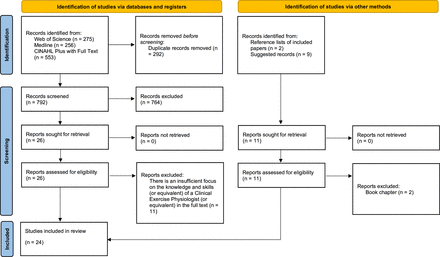
A PRISMA scoping review was completed in this study and used to inform the electronic survey. The respondents to the survey consisted of academics, CEPs and relevant healthcare professionals who have all had experience in the delivery of clinical exercise provision. Due to clinical exercise physiology being a new, emerging profession within the UK, most of the respondents were working within, or were highly interested in the field which introduced potential selection bias. However, the sample size was identified as sufficient given the infancy of healthcare registration in the profession with the high response rate demonstrating good internal validity.22
