


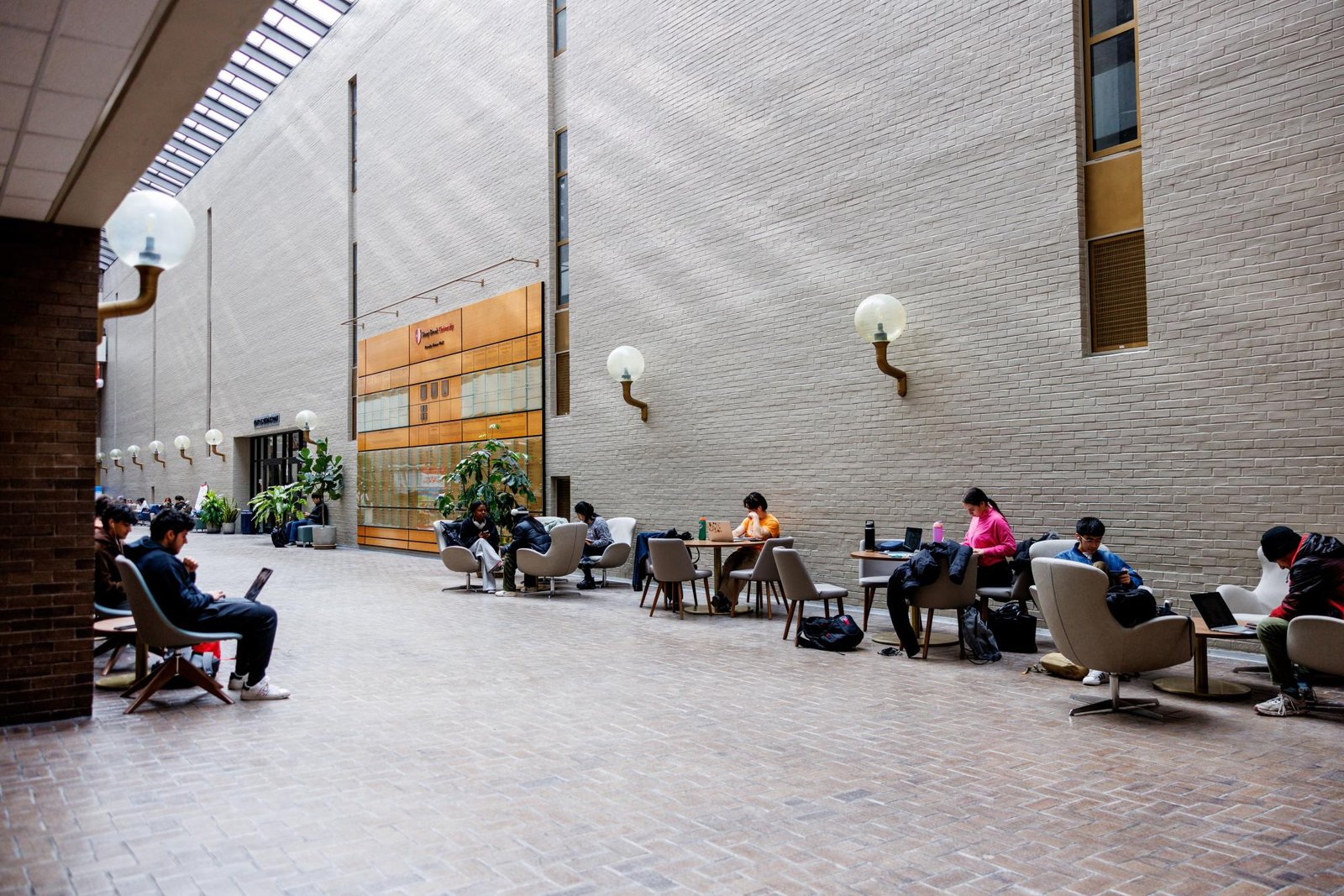
Students sit inside the atrium of the Frank Melville Jr. Library. As the spring semester intensifies, college students may experience highs levels of academic burnout and neglect self-care. STANLEY ZHENG/THE STATESMAN
As the spring semester progresses and academic demands intensify, many Stony Brook University students are finding themselves pushing through burnout and exhaustion rather than addressing it. For some, chronic stress has become so normalized that self-care feels like a luxury rather than a necessity, even as pressure begins to take a toll on their mental and physical well-being.
Burnout, caused by chronic and severe stress, is characterized by mental, emotional and physical exhaustion. More than 55% of college students experience some degree of academic burnout. These circumstances can be worsened by internal and external pressures such as grade maintenance, challenging coursework, social isolation, homesickness, financial stress and more.
For Yanci Castro, a sophomore English major who recently transferred to Stony Brook from Suffolk County Community College, burnout has been a recurring challenge, exacerbated by both the sudden transition to a major state university and the colder months of the spring semester.
Castro graduated with her associate degree one semester earlier than expected, and transferred to Stony Brook. She explained that the transition to Stony Brook was overwhelming and significantly impacted her mental health.
“I had to get up and leave behind a college I already grew so familiar with,” Castro said. “It didn’t feel like [I had] enough time to process it.”
While the transition itself was difficult, Castro said her burnout also tends to peak during the spring semester, where she finds it more difficult to stay motivated.
“My worst case of burnout is usually at the beginning of the spring semester because the cold weather makes going outside undesirable, and that makes me feel lazy,” Castro said.
To cope, Castro relies on a consistent self-care routine, which includes going to bed at a reasonable time, maintaining her skincare routine and journaling before bed. When she neglects these habits, the effects are immediate.
“When I neglect my self-care, the outcomes are always obvious,” she said. “Academically, I get lazy and don’t put as much effort into homework as I would if I were well rested. Mentally, I start to feel bad about myself, which doesn’t help give me the motivation to complete my tasks for the day.”
Other Stony Brook students report similar experiences. Sarah Jennings, a junior majoring in biochemistry, explained in an email that consistently prioritizing academics over rest has taken a substantial toll on her mental and physical health.
“I get far more anxious when I neglect taking time for myself, especially the longer I go without making time for myself,” Jennings wrote. “By the end of the semester, I am exhausted physically and mentally.”
A graphic depicting the prevalence of depression and anxiety in undergraduate college students according to the University of Michigan’s 2024-2025 Healthy Minds Study. ILLUSTRATED BY STANLEY ZHENG/THE STATESMAN
These challenges extend beyond Stony Brook. According to the University of Michigan’s 2024-2025 Healthy Minds Study, which includes data from over 84,000 undergraduate students from 135 colleges and universities across the United States, 37% of students report moderate or severe depressive symptoms, while 33% report moderate or severe anxiety symptoms.
Only 36% of college students are considered to be thriving, a decrease from 38% in 2024.
Smita Majumdar Das, the executive director of Behavioral Health and Counseling and Psychological Services (CAPS), explained in an email with The Statesman that consistently prioritizing academic demands over self-care can have long-lasting, harmful effects on students’ mental and emotional well-being.
“Being successful in any sphere of life, whether academics, social, or professional, is a marathon and not a sprint,” Das wrote. “Pushing oneself beyond one’s endurance regularly will eventually lead to burnout and in the long run, the cumulative effects will be more debilitating to one’s emotional health.”
College-aged students are at a heightened risk for stress due to the specific developmental stage they are in. Pressures can intensify for marginalized students such as women, first-generation college students and students with disabilities, who may face additional barriers to resources and support.
Castro, a first-generation college student, said she feels the responsibility to succeed not only for herself, but also for her family.
“I always feel pressure to do more than well throughout the semester,” she said. “I tend to compare myself with people in my major, especially as a first-gen[eration] student who’s still figuring out what resources are available to me. I feel the weight of wanting to make my family proud, and that makes me push back my sleep schedule and struggle with time management.”
Das noted that many Stony Brook students are highly driven and accustomed to managing multiple responsibilities at once, which can worsen stress and fatigue.
“Our Seawolves are incredibly high-achieving,” Das wrote. “I often see students push themselves past the point of exhaustion because they feel they ‘should’ be able to handle everything. However, those small moments to rest aren’t indulgent — they’re what keep us steady, resilient and able to show up fully for the things that matter.”
Jennings explained that even brief moments of rest can feel difficult to prioritize when academic responsibilities dominate her schedule.
“From early in the morning to late at night, I am usually constantly working on something for one of my classes,” she wrote. “When there aren’t enough hours in the day to accomplish everything, the first thing that gets tossed for me is self-care.”
Balancing demanding coursework, extracurriculars and external responsibilities often causes individuals to sacrifice self-care and well-being before other responsibilities. Das explained that sacrificing self-care will gradually diminish students’ well-being, even if the effects are not immediately noticeable.
“Students carry and juggle a lot, and with that, taking care of one’s needs can fall to the bottom of the list,” Das wrote. “Over time, even the most dedicated students can lose focus, withdraw socially or feel like they’re constantly trying to catch up.”
As exhaustion becomes routine, students may come to view exhaustion and stress as a typical part of the college experience, rather than recognizing them as signs of burnout. Kerri Mahoney, director of the Center for Prevention and Outreach (CPO), said that this can lead to serious health consequences.
“When self-care is put on the ‘back burner[,]’ we see interruptions to our sleep cycle, a decrease in energy, higher susceptibility to illness like the cold or flu and sometimes a feeling of being ‘stuck,’” Mahoney wrote.
Jennings explained that she has experienced these effects firsthand, describing how prolonged stress has led to noticeable physical consequences throughout her college experience.
“This built up [of] anxiety and stress takes a physical toll as I lose my appetite when I’m in these states,” she wrote. “During my freshman and sophomore years, I lost a lot of weight from not eating, as the stress made me feel sick all the time.”
Mahoney noted that neglecting self-care is typically not a conscious choice made by students, but added that limited education around mental health makes it difficult to recognize when things are worsening.
“If a student hasn’t had conversations or education around the importance of self-care or mental health wellness, they might find it harder to realize their behavior or actions are having a negative impact on their overall well-being,” Mahoney wrote. “That is where CPO can play a key role in educating students.”
Mahoney added that stigma and misinformation can discourage students from seeking help early, even when mental health challenges begin to interfere with academics or daily functioning. When left unaddressed, mental health struggles can also intersect with other public health issues, including substance abuse.
“When someone is struggling with their mental health and hurting internally, alcohol or other drugs can feel like an ‘escape,’ however, substances can often exacerbate mental health symptoms and create a spiraling effect,” Mahoney wrote.
A graphic featuring the four bystander intervention trainings offered by the Center for Prevention and Outreach (CPO). ILLUSTRATED BY STANLEY ZHENG/THE STATESMAN
To address these concerns, CPO offers bystander intervention training workshops such as Green Dot, Red Watch Band and Mindful Moments. These programs aim to help students identify stressors and practice healthier habits that they can then incorporate into their daily lives.
Even with these resources available, practicing self-care consistently can feel difficult when academic expectations leave little room for rest. Jennings said that while she understands the importance of self-care, prioritizing it often feels incompatible with academic success.
“I feel like it is a choice I have to make between getting all As and taking care of myself,” she said. “I’ve never had a semester where I felt like I could attain both.”
For Castro, learning how to care for herself has been an evolving process throughout her education journey.
“Before college, I thought self-care simply meant looking good in social settings,” she said. “Now, I understand that it’s more than that. It’s also making time for the things that benefit me in the long run. By prioritizing myself, I give myself more opportunities to succeed.”
Das emphasized that self-care does not need to be time consuming to be effective.
“Self-care doesn’t have to be an elaborate ritual,” Das wrote. “Small, consistent habits — like taking a three-minute break every hour, listening to an uplifting song or going for a quick walk — can make the biggest difference in how we feel and function.”
