


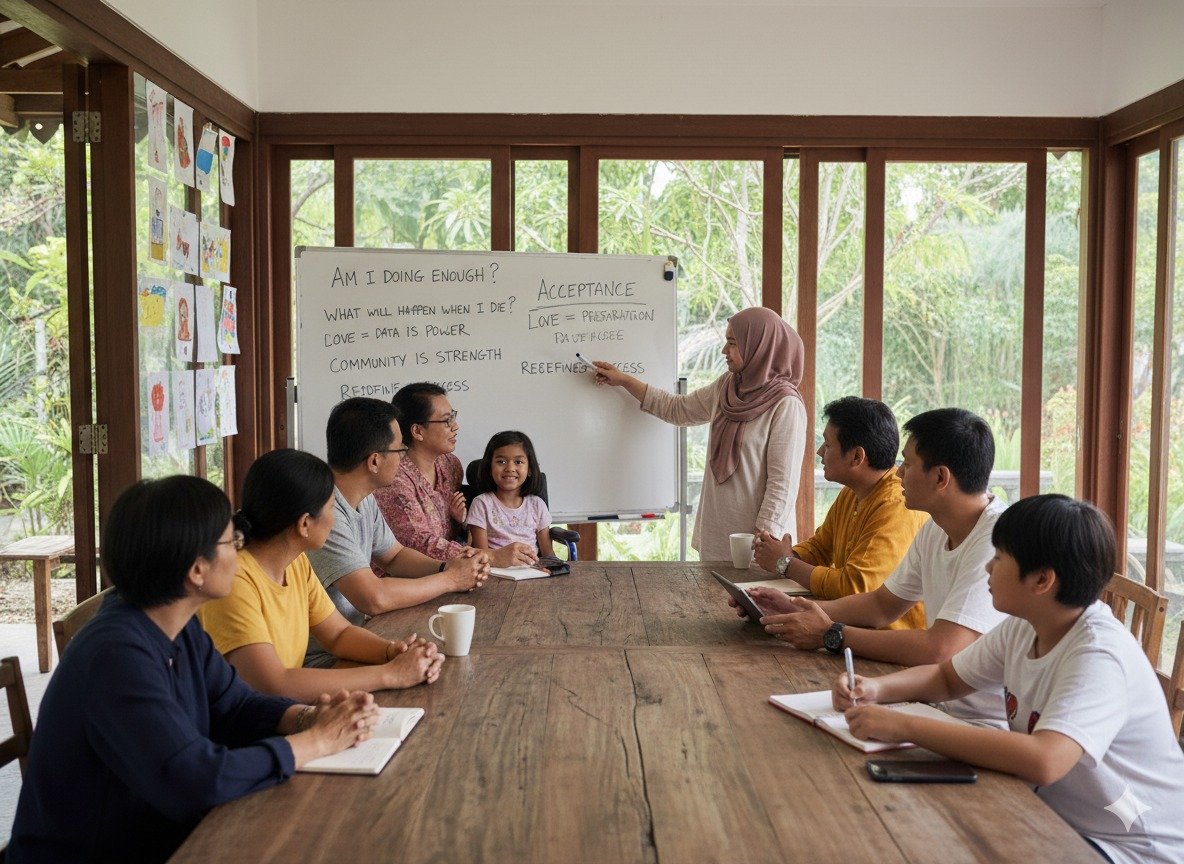
AI-GENERATED IMAGE
Alvin Teoh
A group of parents of children with disabilities in Malaysia share their experiences:
In Malaysia, parenting is already a full-time job.
For both parents who are working, their children are normally taken care of by their grandparents, relatives and friends or sent to day care centres.
But for parents of children with disabilities, it is a role that comes with deeper emotions, heavier responsibilities and many hidden battles that outsiders rarely see and cannot understand.
If you are a parent of such a child reading this, chances are you have asked yourself questions like:
“Am I doing enough?”
Support the struggle to build a Malaysia based on Justice, Freedom, Solidarity: Tel: 04-658 5251 email: [email protected]
“Why does my child behave this way?”
“What will happen to my child when I die?”
These questions are not signs of weakness. They are signs of love.
The hidden emotional journey
Psychologically, parents often experience a cycle of shock, denial, guilt, anger, grief and finally acceptance.
This cycle does not happen once – it repeats itself at every new stage of the child’s life: diagnosis, early intervention and pre-school, school, transition out of school and adulthood.
Many parents also carry an extra burden – comparison. Our society is highly academic-focused.
Report cards, UPSR (Year 6 exams, before they were abolished), PT3 (Year 9 exams, set for a comeback in 2027), SPM (Year 11 exams) – everything feels like a scoreboard.
For parents of children with ADHD, autism or learning disabilities, who are blind and visually impaired, deaf and hearing impaired, physically disabled or with multiple disabilities or rare diseases and so on, this environment can feel toxic and crushing.
As one experienced doctor and mother of four children with ADHD, Dr Haseanti Hussein from Kuching, Sarawak, shared recently in the chat group of The National Family Support Group for Children and People with Special Needs: “One of the hardest things to accept is that you cannot put too high an expectation on your child/children with disabilities. Society is obsessed with academics, and this is toxic for us.”
Acceptance, however, does not mean giving up.
It means redefining success.
You are not alone
According to data published in December 2025 by the Department of Statistics, only about 805,509 people are officially registered as ‘OKU’ (people with disabilities), roughly 2.4% of Malaysia’s population of 34 million as at the end of 2024.
Yet the World Health Organization (WHO) estimates that around 16% of any population lives with some form of disability.
This gap tells us one important thing: many people with disabilities are invisible in the system and their voices are unheard.
If we include their immediate family members (assuming each person with a disability only has two immediate family members) whose lives are directly affected, this community represents about half of people in society.
This 50% does not mean everyone has a disability, but it shows how many lives are affected.
Why does this matter? Because data drives policy. Budget allocations, school support, therapy services and even urban planning depend on numbers.
Without registration, our children are simply not taken into account in the planning as they are inadequately represented.
Haseanti strongly advocates for registration of people with disabilities, even for children who are coping well in mainstream schools.
The ‘OKU’ card is not a label of shame. It is a tool for protection, access and future planning – covering medical benefits, educational assistance and social support, if parents are no longer around. In simple terms – registration is love expressed as preparation.
Parenting is not perfection
One of the biggest emotional traps parents fall into is self-blame.
When a child has meltdowns, emotional outbursts or behavioural challenges, parents often internalise it as their failure.
But as many parents openly share in peer support groups, even the most patient parent will lose it sometimes. Anger, exhaustion and tears in the bathroom are part of the journey.
Psychologically, what children with disabilities need most is emotional regulation support, not punishment driven by anger. Clear boundaries, consistent consequences and intentional rewards work better than shouting or physical punishment.
As one parent wisely said: “It’s OK to be not OK. But what you do about it makes the difference.”
Back to basics
Parents across Malaysia are rediscovering something powerful – simple, back-to-basics strategies.
These include physical play at playgrounds and parks, sensory activities like sand, grass, climbing and crawling, household chores to build independence, and consistent routines for sleep and meals.
Medical professionals and therapists often remind parents that movement helps regulate emotions.
Play is not a reward – it is a need. Diet and sleep also matter.
Many doctors in Malaysia advise reducing excessive sugar, ensuring enough water (we live in a hot, tropical country) and prioritising eight hours of sleep for children.
These are not miracles, but they create stability, and stability helps behaviour.
Medication, therapy, diet, sports and emotional support are not ‘either-or’ choices. They work best together, depending on each child. No two children are the same.
Redefining success
One inspiring example is Haseanti’s own children. Despite ADHD and learning challenges, all four were in mainstream schools.
The eldest daughter is delving into animation, art and music, while the eldest son is an international digital music composer. Her twins are still exploring their potential in high school – they attend mainstream classes with other teenagers without disabilities.
Their success did not come from forcing them into society’s mould but from understanding their strengths.
Success for children with disabilities is not always straight A-grades. It could be about being able to cook a simple meal, managing emotions better than last year, communicating needs clearly or living independently one day.
These wins matter. As parents we celebrate them.
The power of community
Perhaps the most important psychological lifeline for parents is community.
Support groups, whether on WhatsApp, Telegram or physical meet-ups, give parents a safe space to say, “I’m tired,” without judgement.
Talking to people who have ‘been there, done that’ reduces isolation and burnout.
As one parent shared honestly: “People without children with disabilities cannot fully understand our pain. But together, we can advocate for our children’s future.”
Advocacy starts at home, grows in community and eventually reaches policymakers.
A message to parents
You are not weak, and you are not failing. You are doing one of the hardest jobs any parent can do.
Your child does not need a perfect parent, only one who is present, informed and full of love. Love your child as they are. Prepare for their future bravely. And remember – you are not alone.
In Malaysia, change may be slow but it begins with parents who refuse to stay silent, who register their children, who speak up and who support one another.
This has been proven by many countries such as the US, the Netherlands, New Zealand and Taiwan.
For parents who wish to advocate better for their children, remember – data is power, community is strength, and love when paired with action creates real change.
Alvin Teoh is the parent of a child with disabilities.
This article is based on over 300 messages exchanged on 19 January 2026 when Alvin Teoh introduced a supermum, Dr Haseanti Hussein, to the National Family Support Group for Children and People with Special Needs chat group.
Haseanti is a mother of four children with ADHD. She is also a medical doctor, PhD holder, public health expert, certified professional medical and health trainer in Asia. She is also a bullying survivor.
The views expressed in Aliran’s media statements and the NGO statements we have endorsed reflect Aliran’s official stand. Views and opinions expressed in other pieces published here do not necessarily reflect Aliran’s official position.
AGENDA RAKYAT – Lima perkara utama
- Tegakkan maruah serta kualiti kehidupan rakyat
- Galakkan pembangunan saksama, lestari serta tangani krisis alam sekitar
- Raikan kerencaman dan keterangkuman
- Selamatkan demokrasi dan angkatkan keluhuran undang-undang
- Lawan rasuah dan kronisme
Support Aliran’s work with an online donation. Scan this QR code using your mobile phone e-wallet or banking app:
