


February 04, 2026
3 min read
Add topic to email alerts
Receive an email when new articles are posted on
Please provide your email address to receive an email when new articles are posted on .
“
data-action=”subscribe”>
Subscribe
We were unable to process your request. Please try again later. If you continue to have this issue please contact customerservice@slackinc.com.
Back to Healio
Key takeaways:
- Mothers who breastfed had a significantly lower likelihood of reporting depression or anxiety 10 years after giving birth.
- Longer periods of breastfeeding conferred lowest odds of depression and anxiety.
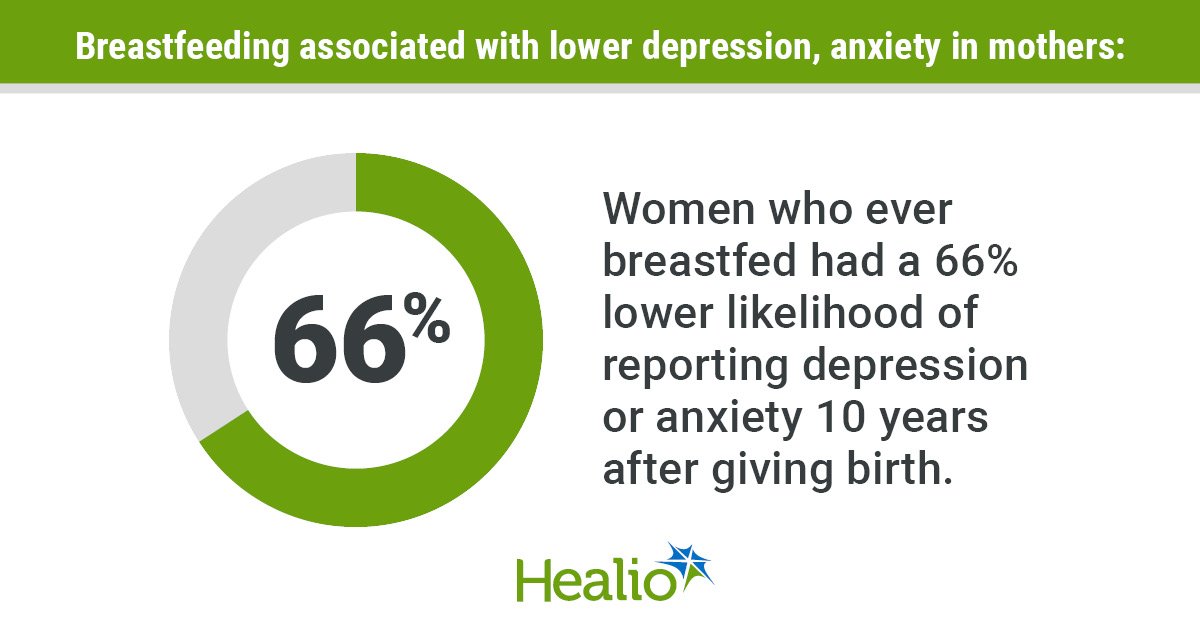
Breastfeeding may significantly lower the likelihood women experience depression and anxiety 10 years after giving birth.
Researchers also observed a dose-response relationship, as women who breastfed for longer periods had lower odds for these mental health conditions, and those who breastfed for at least 12 months decreased their likelihood of depression and anxiety more than 60%.
Data derived from McNestry C, et al. BMJ Open. 2026;doi:10.1136/bmjopen-2024-097323.
Fionnuala M. McAuliffe
“The idea that something so natural and accessible could reduce anxiety and depression in women is very exciting,” Fionnuala M. McAuliffe, MD, honorary fellow of ACOG, head of women’s and child’s health and director of the Perinatal Research Centre at University College Dublin and professor of obstetrics and gynecology at National Maternity Hospital Dublin, told Healio.
Breastfeeding vs. formula
Numerous studies have been published on the short- and long-term benefits of breastfeeding compared with formula for infants, according to study background.
Breastfeeding has been associated with reduced risk for infection and sudden death during the first year of life, improved mental health and cognitive function as infants, better academic attainment during childhood, less eczema, and lower risk for obesity and chronic disease as adults.
Research has been growing on the benefits for mothers, too.
Healio previously reported breastfeeding for 6 months could significantly reduce the risk for triple-negative breast cancer.
“We know that breastfeeding can reduce type 2 diabetes,” McAuliffe said. “Our research group recently looked at cardiovascular disease and markers for cardiovascular disease, and we found that those that breastfed had better cardiovascular health later on in life.”
“We know that breastfeeding is associated with less postnatal depression, which is an important health issue,” she added. “But nobody really has looked at mental health benefits beyond the postnatal period.”
McAuliffe and colleagues investigated using the longitudinal cohort from the ROLO study, a randomized trial evaluating low-glycemic index diet on macrosomia recurrence. Participants were pregnant with their second child and had no preexisting medical conditions.
Researchers included 168 women (mean age at start of trial, 32.4 years; standard deviation, 3.7; 95.2% white Irish) who had completed lifetime breastfeeding questionnaires and had full health history data at 10 years postpartum in their analysis.
The association between breastfeeding and depression and anxiety served as the primary endpoint.
‘Every breastfeed is a benefit’
Most women (72.6%) reported breastfeeding at any point at 10 years. The cohort had a median breastfeeding duration of 30.5 weeks (range, 0-488).
In all, 20.8% of women reported depression or anxiety at any point and 13.1% reported it at the 10-year mark.
Depression and anxiety at 10 years had a significant association with younger age (P = .03), reduced physical activity (P = .04) and lower well-being scores (P = .02) at study entry. Current smoking also had an association with depression and anxiety at 10 years (P = .02).
Women who ever breastfed had a significantly lower likelihood of depression and anxiety at 10 years (OR = 0.34; 95% CI, 0.12-0.94).
Throughout the study period, lower depression and anxiety had an association with ever breastfeeding (OR = 0.4; 95% CI, 0.18-0.91), longer exclusive breastfeeding (OR = 0.98; 95% CI, 0.96-0.99) and breastfeeding for at least 1 year in a lifetime (HR = 0.38; 95% CI, 0.15-0.96).
“When we look at other health benefits for the mother, breastfeeding for longer gives a stronger signal for those health benefits,” McAuliffe said. “It was interesting for us to see that anxiety/depression reduction was stronger for those women who had lifetime breastfeeding over 12 months.”
Researchers acknowledged study limitations, including relatively small sample size and patient-reported data.
They noted future research could evaluate first-time mothers and those with preexisting depression and anxiety to see how breastfeeding impacts their wellbeing and mental health.
Promoting the benefits of breastfeeding and policy measures enabling more women to do it is a more pressing concern, though.
“There’s big variation in Europe in terms of breastfeeding rates,” McAuliffe said. “The rates here in Ireland would be on the lower end compared to other European countries. We have a lot of ground to make up. Our focus here is to increase our breastfeeding rates, which have increased over the last couple of years. We’re very pleased about that, and women are feeling more comfortable to breastfeed in public.
“It’s something that countries have to work on, societies have to work on, to support mothers to breastfeed. There can be a convenience element to formula, in that others can feed the baby. I think breastfeeding rates overall, worldwide, are stable or increasing, but constant attention is needed to keep them at a high level.”
Support from clinicians, family members and society is “critical” to this goal, she added.
“Every breastfeed is a benefit,” McAuliffe explained. “Clinicians should encourage women to breastfeed
“If we support women and they want to breastfeed, they will breastfeed,” she continued. “They often just need some additional support from their health care providers, but also from their family, the immediate family partner and other family members around them. They have to feel comfortable when they’re out and about with their baby. They want to feel comfortable.”
For more information:
Fionnuala M. McAuliffe, MD, can be reached at fionnuala.mcauliffe@ucd.ie.
Published by:
Ask a clinical question and tap into Healio AI’s knowledge base.
- PubMed, enrolling/recruiting trials, guidelines
- Clinical Guidance, Healio CME, FDA news
- Healio’s exclusive daily news coverage of clinical data
Learn more
Add topic to email alerts
Receive an email when new articles are posted on
Please provide your email address to receive an email when new articles are posted on .
“
data-action=”subscribe”>
Subscribe
We were unable to process your request. Please try again later. If you continue to have this issue please contact customerservice@slackinc.com.
Back to Healio
