


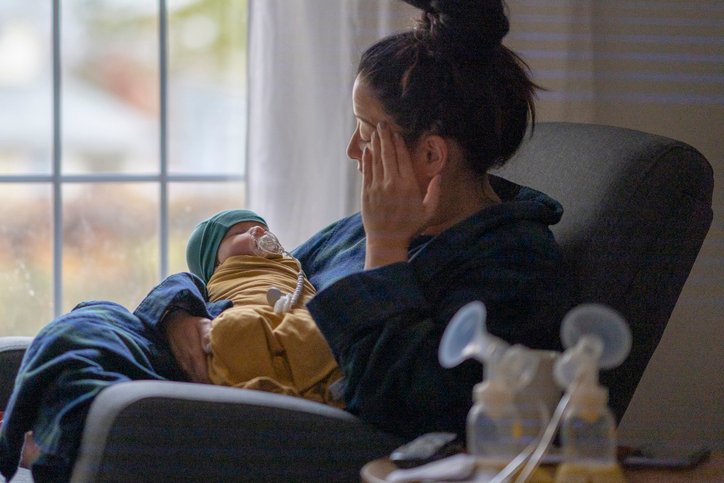
Postpartum depression is increasingly recognised across Europe, but the availability and quality of support for women after childbirth continue to vary significantly between member states, raising questions about how awareness is translated into action.
Postpartum depression is the most common mental health condition following childbirth, affecting around 12% of mothers in Europe and, in severe cases, leading to suicide.
But despite its prevalence, many women remain undiagnosed and untreated due to stigma, limited awareness and gaps in support within health systems.
While women’s health and mental health have gained political attention in recent years, postpartum depression remains only weakly addressed at the EU level.
This comes despite the European Parliament’s health committee’s preparation of an own-initiative report on a strategy for women’s health, and the European Commission publishing a Roadmap for Women’s Rights in March last year, which calls for more gender-sensitive healthcare.
Strategies exist, but implementation varies widely
Across member states, postpartum mental health is increasingly referenced in national strategies, yet delivery remains inconsistent and highly dependent on local capacity.
In Spain, perinatal mental health has recently been elevated within national planning. “For the first time, perinatal mental health has a strategic line in our mental health plan,” said Clara Benedicto of Spain’s Mental Health Commission within the ministry of health.
Meanwhile, in Ireland, perinatal mental health is now included in both its national women’s health action plan and the country’s mental health strategy. This policy alignment has supported the rollout of specialist perinatal mental health teams within maternity hospitals.
Even so, Peggy Maguire, director general of the Dublin-based European Institute of Women’s Health, cautioned against overestimating coverage.
“Many women still lack access to care, and milder cases often go undetected,” she said, noting that service availability varies by region and that early intervention remains uneven.
Maguire stressed that maternal mental health should be viewed through a long-term policy lens. “Supporting maternal mental health is not just a health priority, it’s an investment in families, communities and the future of Europe,” she said.
Without sustained funding and workforce planning, she warned, national strategies risk benefiting only a subset of women.
Data gaps and fragmentation
Benedicto mentioned that Spain’s inclusion of perinatal mental health in its national strategy has enabled funding for early detection, training for healthcare professionals and support for women with severe mental illness, but she also pointed to a core policy limitation.
“We don’t really know the magnitude of what’s happening,” Benedicto said, referring to the lack of comprehensive data on maternal mental health outcomes.
Without robust indicators, she noted, it becomes difficult to assess needs, measure impact or ensure accountability across regions, she added.
The absence of comparable data was a recurring theme throughout the debate, highlighting a broader EU-level gap.
While health remains a national competence, speakers noted that the lack of harmonised indicators limits the EU’s ability to support evidence-based policymaking or identify best practices across member states.
Awareness does not equal access
While stigma around maternal mental health has begun to decline, several speakers argued that policy responses have not kept pace with lived experience.
Presenting findings from a survey of nearly 10,000 mothers across Europe, Johanna Schima, vice-president of Make Mothers Matter and head of its European delegation, noted that “50% of the survey mothers say that they have experience or they experienced some kind of a mental condition,” including depression, anxiety and burnout.
Yet many women continue to rely on informal or community support that falls outside formal healthcare systems. “We need our villages, our villages to hear you, to support you,” Schima said. She argued that policy frameworks remain heavily focused on clinical care, with limited attention to community-based services that could support prevention and early intervention.
Several participants noted that EU and national funding instruments, including social and cohesion funds, rarely prioritise maternal mental health at the community level, despite evidence that such services can reduce pressure on healthcare systems.
More than just screening
From a clinical and research perspective, concerns were raised about policy approaches that focus on detection without ensuring follow-up.
“We really need a life course approach,” said Annick Bogaerts, associate professor of midwifery sciences at KU Leuven, arguing that pregnancy and the postpartum period should be addressed within a broader continuum of women’s health.
Bogaerts cautioned that screening initiatives alone are insufficient.
“It’s not just about administering a questionnaire,” she said, pointing to fragmented care pathways and weak coordination between maternity services, primary care and mental health providers.
She argued that without clear responsibility for follow-up, screening risks becoming a procedural exercise rather than an effective entry point into care, particularly in health systems where referral pathways and workforce capacity remain limited.
Treatment and innovation gaps
The debate also highlighted gaps in how postpartum depression is addressed within treatment and innovation frameworks.
“There is a clear unmet medical need,” said Marina Vasiliou, managing director of Biogen France, noting that postpartum depression is still largely treated with therapies developed for other forms of depression.
“Postpartum depression is treated as any kind of depressive episode with chronic drugs that were developed 30 years ago and that take a long time to act, so they don’t take into consideration these acute periods around birth,” she told the event.
Therefore, “postpartum depression has to be recognised to be a specific kind of depression,” she added.
Speakers noted that postpartum depression is often addressed indirectly under broader mental health policies, limiting incentives for targeted research, innovation and reimbursement pathways.
For the event participants, this recognition was seen as a necessary first step towards more targeted research, adapted therapies and more consistent access to care across member states.
[BM]
